Roller Brake vs Disc Brake on an E-Bike

Roller Brake vs Disc Brake on an E-Bike: Which Do You Need in the Netherlands?
The short version
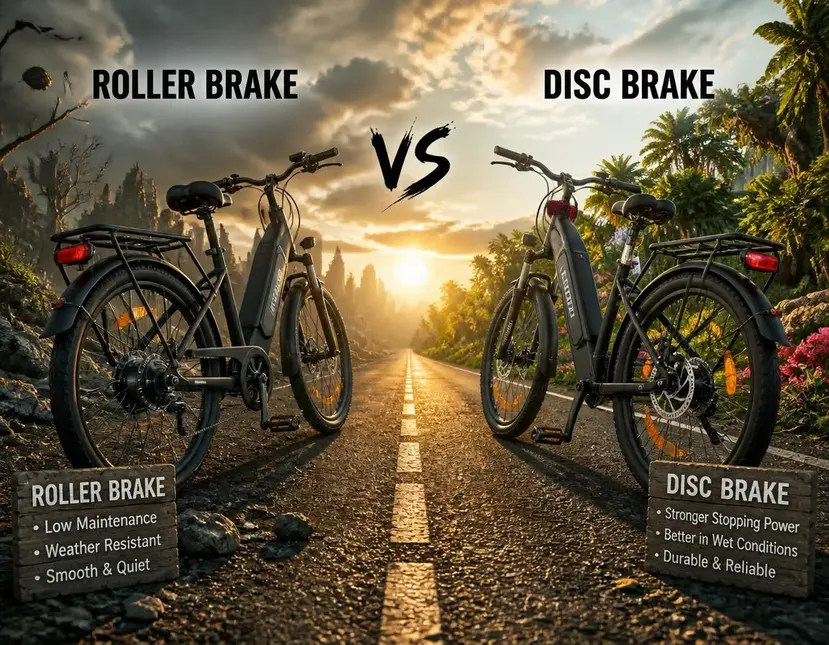
For flat Dutch riding at 25 km/h with a normal load, a good roller brake stops you fine and needs little more than a dab of special grease once a year. Hydraulic disc brakes stop harder, stay strong in the wet and on long descents, and they’re the brakes I’d want if you’re on the heavy side, carry a child or cargo, ride a speed pedelec or take the bike to the hills. The weak spot is a cheap rear roller brake: when the ANWB tested ten budget e-bikes, eight had brakes that were too weak, mostly at the back. Discs cost more to keep going, at around €30 for new pads at a shop and €30–€38 per brake for a bleed.
Walk into any Dutch bike shop and you’ll see both: city e-bikes with a fat, finned drum at the hub, and sportier ones with a steel disc and a calliper. They solve the same problem in very different ways, and which one is right for you has less to do with the spec sheet than with how much you weigh, what you carry and where you ride. Here’s how I’d choose, using Dutch test results and real 2026 workshop prices.
How each brake actually works
A roller brake is Shimano’s take on the old drum brake. Everything happens inside a sealed unit at the hub. Pull the lever and the cable turns a cam, which pushes rollers outwards; the rollers press steel brake shoes against a steel drum, and a special grease keeps the whole thing from grabbing. The big aluminium fin around it is there to get rid of heat. Because it’s sealed, rain and road grit stay out.
A disc brake works much like a car’s. A steel rotor is bolted to the hub and a calliper squeezes two pads against it. On e-bikes the calliper is nearly always hydraulic, so your lever pushes oil instead of pulling a cable. You get more power for less finger effort, and it’s easy to dose. Cheaper bikes sometimes use mechanical discs, which run on a cable and need adjusting as it stretches.
- 1Aluminium cooling fin, there to shed heat
- 2Steel drum, closed off from rain and grit
- 3Steel brake shoes, running in special grease
- 4Rollers on a cam that push the shoes out when you pull the lever
- 5Steel rotor bolted to the hub, cooled by the air as it spins
- 6Calliper with two pads that grip the rotor
- 7Hose filled with oil, so the lever pushes fluid instead of pulling a cable
Two more Dutch staples muddy the roller-versus-disc question. Hydraulic rim brakes, mostly made by Magura, press pads onto the wheel rim with oil pressure; the ANWB calls them reliable and easy to dose, and they’re popular on e-bikes. And some Dutch e-bikes still add a coaster brake (terugtraprem), which only brakes the rear wheel. Cortina, which fits coaster brakes to its basic models, warns that braking only the rear wheel makes a skid more likely, and says other brakes suit e-bikes better.
Roller brake vs disc brake: the quick comparison
Here’s how the three brakes you’ll meet on Dutch e-bikes stack up. I’ve added hydraulic rim brakes because they’re the common middle ground in Dutch shops.
| What matters | Roller brake | Hydraulic disc | Hydraulic rim (Magura) |
|---|---|---|---|
| Stopping power | Moderate, and it varies a lot by model | The strongest, with fine control | Strong and easy to dose |
| In the rain | Sealed, so rain hardly affects it | Strong in any weather | Stops a little later in the wet |
| Long descents, heavy loads | Can overheat and fade | Copes best | Strong, but pads and rims wear |
| Upkeep | Special grease about once a year | Pads, an occasional bleed, keep oil off the rotor | Pads, and the rims wear in time |
| Running costs | Lowest | Highest | Low to medium |
| Noise | Quiet, unless it’s short of grease | Can squeal when dirty | Collects grit in the wet |
| Where you’ll find it | City and budget e-bikes, often with hub gears | Pricier and sportier e-bikes | Plenty of Dutch e-bikes, Gazelle’s included |
✅ A roller brake is enough if…
- You ride mostly flat routes in town or across the polder, at up to 25 km/h.
- You’re of average build and carry a bag or two, not a child or a week’s shopping.
- You’d rather never think about your brakes between yearly services.
- The bike passes a hard stop from 25 km/h on your test ride.
🛑 Go for hydraulic discs if…
- You’re on the heavy side, or regularly carry a child seat, full panniers or cargo.
- You ride a speed pedelec.
- You ride long descents, at home in Limburg or on holiday abroad.
- You want the shortest stops in all weather and don’t mind a bigger service bill.
What Dutch tests actually found
The most useful numbers I know of come from the ANWB’s budget e-bike test. It took ten e-bikes of around €1,000 and braked them as hard as possible from 25 km/h, wet and dry, with each brake on its own and both together. Eight of the ten had brakes that were too weak, and it was mostly the rear brake letting them down. European rules allow a stop of no more than 11 metres from 25 km/h on the rear brake alone on dry tarmac. Two of the bikes needed 15.5 and 20.5 metres.
Now look at what those rear brakes were. On the three test reports I went through, for the Vogue, the Sparta and the eventual winner from Anyway, all priced at €1,099, the rear brake was a Shimano roller brake every time. Vogue blamed poor adjustment on the test bike, and the Sparta’s rear brake still fell short after a retest. Anyway fitted a stronger rear brake to win, and offered to swap the brake free of charge on bikes it had already sold.
That doesn’t prove roller brakes can’t work. It shows that a cheap rear roller brake, set up badly, is the weakest link on a budget e-bike. The Dutch consumer site ID.nl goes further and says a roller brake can’t stop an e-bike from 25 km/h within an acceptable distance. I think that’s too sweeping for the stronger models, but it’s a fair warning about the cheap ones. Shimano clearly knows where the bar sits: it says its e-bike-ready BR-C6000 roller brake, used with its matching lever, brakes 30% harder at the front and 10% harder at the rear than the model before, and beats the European test standard at a total weight of 130 kg.
Spend more and brakes stop being the problem. In the ANWB’s 2026 test of twelve e-bikes priced from €3,199 to €3,999, every bike scored 8.5 or 9 out of 10 for braking.
Do the 11-metre check on your test ride
Find a quiet, dry stretch with nobody behind you, get up to 25 km/h and stop with the rear brake only. The European limit is 11 metres, roughly six bike lengths, and a healthy brake should beat it with room to spare. Then stop again with both brakes. If the rear feels weak, or grabs, ask the shop to adjust it before you pay. My guide to buying an e-bike in the Netherlands has the rest of the test-ride checklist.
Heat, hills and heavy loads: where roller brakes struggle
Braking turns your speed into heat, and an e-bike brings a lot more of it to every stop than an ordinary bike. It’s heavier and it cruises faster, so a hard stop has roughly twice as much energy to get rid of. Add a child seat and the week’s shopping and it climbs again. A speed pedelec is in another league.
Energy your brakes have to absorb in one stop
My own sums: energy = ½ × mass × speed². Weights used: 80 kg rider, 17 kg city bike, 27 kg city e-bike, 30 kg speed pedelec, 19 kg for a child in a seat and 10 kg of shopping. It’s physics, not a test result.
On flat Dutch roads that’s no problem, because each stop is short and the brake cools before the next traffic light. A long descent is different. The brake has to keep turning energy into heat for minutes on end, and a sealed roller brake can’t dump that heat quickly. That’s why Shimano’s own manual tells you not to brake continuously on long slopes. Overheat one and the grease suffers: Shimano warns the brake can then grab unexpectedly hard, and Cycling UK’s technical editor notes reports that an overheated roller brake can’t always be brought back to full power with fresh grease.
Weight matters just as much. Shimano sizes some of its front roller brakes by total weight, bike, rider and luggage together: one version for 70 to 100 kg and another for 100 to 130 kg. A 27 kg city e-bike with an 80 kg rider is past 100 kg before you’ve bought a single grocery. The ANWB says roller brakes are less suited to heavy loads, and Sheldon Brown’s long-standing advice is blunter: no roller brake is suitable as a drag brake on a cargo bike or a tandem. If you’re carrying kids, my child seat guide covers how much a passenger changes the handling. For cargo e-bikes and anything that falls under the speed pedelec rules, hydraulic discs are the only brakes I’d consider.
Riding in Limburg or abroad?
The Netherlands is flat, but holidays often aren’t. On long descents in the Ardennes, the Eifel or the Alps, brake firmly and then let go rather than dragging, share the work between both brakes, and stop to let a roller brake cool. Shimano says not to touch the area around it for 30 minutes after a hard ride.
Rain, grit and Dutch winters
This is where roller brakes earn their keep. Everything is sealed, so rain and road grit stay out, and Cortina, which fits them to many of its city bikes and e-bikes, says they work well in the wet. That’s the reason so many Dutch commuters never think about their brakes at all.
Hydraulic discs brake strongly in the rain too; Gazelle says their stopping power holds whatever the weather. Their weak point is contamination. Oil, chain lube or a film of soap on the rotor makes them squeal and lose bite, and grit makes them rub. When you clean an e-bike with discs, keep degreaser and lube well away from the rotors; my guide to washing an e-bike shows how. Ordinary rim brakes are the ones that really feel Dutch weather: Gazelle says they brake less well in the wet.
One winter quirk: the grease in a roller brake thickens in the cold, and Shimano notes the wheel can turn slightly heavier because of it. Nothing to worry about, but it isn’t your motor getting weaker.
What each brake costs to run in 2026
Roller brakes are the cheap option to own. The ANWB’s advice is to have them greased with special roller brake grease, ideally once a year, and a tube costs about €10 to €23 online. Shimano’s procedure uses only about 5 grams per brake, so it’s an easy job to add to the annual service. When a roller brake is worn out, or has been cooked on a descent, you replace the whole unit: about €65 to €92 for the part at webshops selling to the Netherlands, plus fitting.
Disc brakes cost more because the pads are consumables, and the ANWB notes they wear faster on an e-bike than on an ordinary bike. A pair of Shimano resin pads costs about €10 to €20, and shops charge around €12.50 to €17 to fit them, which lines up with the ANWB’s estimate of roughly €30 all in. Every so often the brake fluid needs bleeding: two Dutch workshop price lists I checked charge €29.99 and €37.50 to bleed a brake. A new rotor is about €15.
What common brake jobs cost in the Netherlands
Prices checked in October 2026 at 12GoBiking, Mantel, bike-components, Rat Bikes and Decathlon, and on the workshop price lists of HM Fietsen and Bike Totaal Van Oudenaarden. Labour prices exclude parts unless the row says fitted.
So over a few years a roller brake costs you very little, while discs add a pad change here and a bleed there. For what the rest of an annual service costs, see my e-bike service cost guide, and for where to buy pads and rotors, my spare parts guide.
Words you’ll hear at the fietsenmaker
Rollerbrake (roller brake), schijfrem (disc brake), hydraulische velgrem (hydraulic rim brake), terugtraprem (coaster brake), remblokjes (pads), remschijf (rotor) and ontluchten (bleeding the brakes).
Which brake suits your riding?
Put in your own numbers and I’ll tell you which brake I’d want. It uses the same weight bands Shimano uses for its roller brakes, and nothing you enter is saved or sent anywhere.
Roller or disc? Check your own riding
Bike weights are typical figures.
Fill in your details above
The suggestion appears here as soon as you change a field. Without the script, the table below gives you the same answers.
| You | My pick | Why |
|---|---|---|
| Light rider, flat commute, a bag or two | A good roller brake | Little upkeep, sealed against rain, enough for short stops at 25 km/h |
| Average build, daily shopping or panniers | A strong roller brake, or hydraulic rim or disc brakes | Bike, rider and luggage pass 100 kg quickly |
| Child seat on board | Hydraulic discs | Extra weight and a passenger who matters more than any bag |
| Cargo e-bike | Hydraulic discs | No roller brake is suitable as a drag brake on a cargo bike |
| Speed pedelec | Hydraulic discs | More than five times an ordinary bike’s energy in every stop |
| Hills or holidays abroad | Hydraulic discs | Roller brakes overheat and fade on long descents |
Living with roller brakes
Roller brakes forgive a lot, but they aren’t maintenance-free. Five habits keep them working.
- Grease them yearly. Ask for Shimano’s special roller brake grease at your annual service, and keep it in the brake. Sheldon Brown points out it’s abrasive and not meant for bearings, so it isn’t interchangeable with ordinary grease either way.
- Listen to them. Shimano says abnormal noise, or braking that suddenly feels much sharper than usual, can mean the brake is short of grease. Stop riding and get it looked at.
- Don’t drag them downhill. Brake firmly, let go, repeat. Continuous braking on a long slope is what overheats a roller brake.
- Keep the cable adjusted. A roller brake works through a cable, so the lever travels further as the cable stretches. Expect to pay about €14 for a shop to adjust them.
- Know your puncture routine. Taking out a rear wheel with a roller brake means unhooking the brake cable and the clip that holds the brake arm to the frame. It’s easy once you’ve seen it done, and my tyre replacement guide walks through getting a wheel out.
Living with hydraulic disc brakes
Discs ask for a little more attention, and most of it is about keeping them clean and catching wear early.
- Look at the pads when you clean the bike. If you can barely see pad material left on the backing plate, book new ones before the metal reaches the rotor.
- Keep oil, lube and soap off the rotor. Contaminated pads squeal and lose bite, and they often have to be replaced rather than cleaned.
- Treat a spongy lever as urgent. The ANWB warns that a soft, spongy lever can mean an oil leak in the system. Get to a shop before the brake stops working altogether.
- Leave the lever alone with the wheel out. Squeezing it with no rotor in the calliper pushes the pads together, and getting them apart again is fiddly.
- Bed in new pads. Do a handful of firm stops on a quiet road before you rely on them in traffic.
Upgrading, or buying second-hand
Can you swap roller brakes for discs? On most bikes, no. Disc brakes need mounting points on the frame and fork and hubs that take a rotor, and a bike built around roller brakes rarely has either. You’d be looking at new wheels at the very least.
What you can do is fit a stronger roller brake. The unit slides onto the hub’s splines, so a shop can swap a basic one for an e-bike-ready model like the BR-C6000, which Shimano pairs with its BL-C6010 lever, as long as your hub is compatible.
Buying used? Test the brakes from speed, check how much pad material is left on discs and listen for a dry, scraping roller brake. My second-hand e-bike buying guide has the full checklist. One old issue is worth checking too: Shimano still lists a safety warning for its BR-C3000-R, BR-C3010-R and BR-C6000-R rear roller brakes on bikes sold after 1 July 2015, some of which could suddenly lose braking power. The 2016 recall notices say affected brakes carry the production codes NF to NL, and that a white paint dot marks a brake that has already been checked. Back then dealers replaced affected brakes free of charge, so if you’re not sure about yours, ask a dealer to look.
My rule of thumb
Light rider, flat routes, and you want to forget about your brakes? A good roller brake. Anything heavier, faster or hillier? Hydraulic discs. And whatever you buy, brake-test it from 25 km/h before you pay.
FAQs
Are roller brakes good enough for an e-bike?
For flat Dutch riding at up to 25 km/h with a normal load, a well-adjusted roller brake from one of Shimano’s stronger models does the job and needs little more than yearly greasing. It is the weaker choice if you are heavy, carry a child or cargo, ride long descents or ride a speed pedelec, because a sealed roller brake has less power and sheds heat slowly. In the ANWB’s test of budget e-bikes the rear brake was the usual weak point, and on the models I checked that was a roller brake, so test it from 25 km/h before you buy.
Are disc brakes better than roller brakes on an e-bike?
Hydraulic disc brakes stop harder, are easier to dose and keep working on long descents and in the wet, which is why they suit heavier riders, cargo bikes and speed pedelecs. The trade-off is upkeep: pads wear and cost around €30 to replace at a shop, and the brake fluid needs an occasional bleed at roughly €30 to €38 per brake. Roller brakes win on low maintenance, not on stopping power.
Can I swap the roller brakes on my e-bike for disc brakes?
Usually not. Disc brakes need mounts on the frame and fork plus hubs that take a rotor, which bikes built for roller brakes rarely have, so it would mean new wheels at the very least. The realistic upgrade is a stronger roller brake: Shimano says its BR-C6000, used with its matching lever, brakes 30% harder at the front and 10% harder at the rear than the model before, and a shop can fit it to a compatible hub.