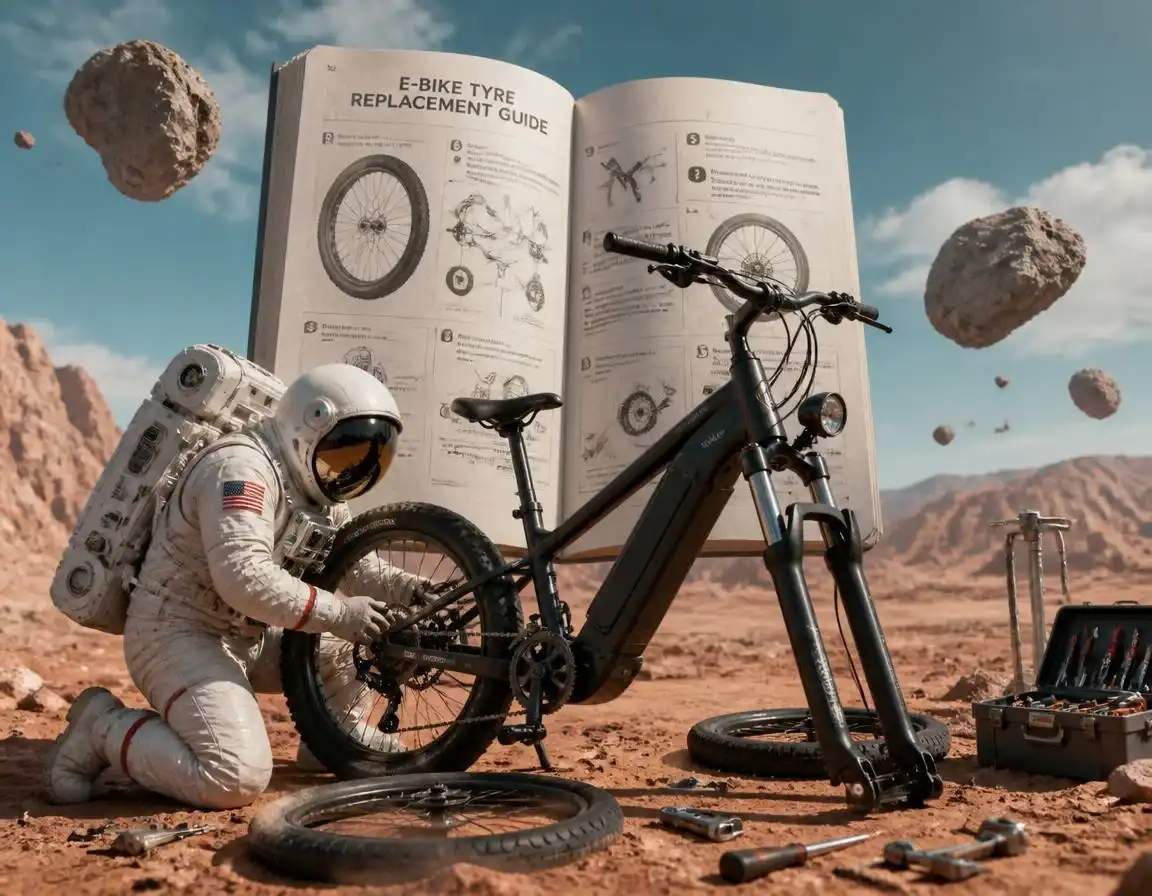
E-Bike Tyre Replacement Guide

E-Bike Tyre Replacement Guide 2026: When to Replace, Costs & DIY Steps
The short version
Most e-bike tyres need replacing between 3,000 and 6,000 kilometres, with the rear wearing roughly twice as fast as the front. Premium puncture-resistant models such as the Schwalbe Marathon Plus regularly stretch past 8,000 km on the same wheel. A new e-bike-rated tyre costs €25–55 in the Netherlands, or €30–55 fitted with a tube at a workshop. Check wear dots, sidewall cracks and repeated punctures first. Fitting it yourself is doable with three tyre levers and a decent pump, even on a hub-motor wheel. Speed pedelecs need ECE-R75 (E-50) rated tyres.
Why e-bike tyres wear out faster than regular bike tyres
An e-bike is not a bicycle with a bit of help. It is a heavier machine that rides faster, and your tyres feel every kilo and every kilometre per hour of that. Three things do the damage.
Weight. A mid-drive city e-bike weighs around 22–26 kg before you sit on it, against 17–21 kg for a classic omafiets. Add rider, bags and a crate of groceries and the tyre carcass carries load all day, every day. Heavier load means more friction in the rubber and faster abrasion.
Speed and distance. Pedal support quietly turns a 7 km ride into a 15 km ride, and raises your average speed. More kilometres at higher speed means more rubber left on the tarmac. Industry wear estimates for standard e-bike tyres cluster around 2,500–6,500 km for the rear, well below what the same tyre would manage on a non-electric bike.
Torque. A mid-drive motor typically pushes 50–85 Nm through the rear wheel, and some performance or cargo-specific motors go past 100 Nm. Every pull-away from a traffic light scrubs the rear tread, which is why the rear tyre typically needs replacing about twice as often as the front. Hub-motor bikes spread wear a little more evenly, but the weight penalty remains.
None of this is a reason to baby the bike. It is a reason to check the rubber once a month and to buy the right tyre when the time comes.
When to replace: the five signs that actually matter
Kilometres are a guideline, not a rule. A cargo parent hauling two kids wears a rear tyre out at 3,000 km; a light rider on smooth asphalt can stretch the same model past 6,000. So read the tyre, not the odometer. These five signs decide it.
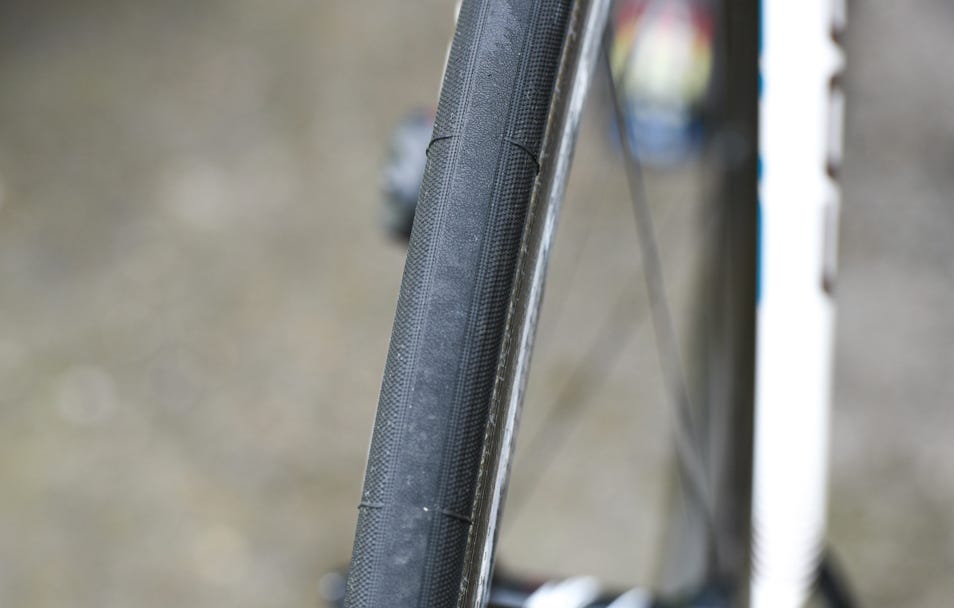
- The tread is gone in the middle. Run a finger across the tyre. A flat, shiny centre strip — or a tyre that looks squared off — is finished. Many touring tyres, including the Schwalbe Marathon family, carry tiny wear dimples in the centre tread; when those dots disappear, the tyre is at its limit.
- Cuts, cracks or bulges in the casing. Small tread cuts that do not reach the casing can survive. Sidewall cracks, fraying fabric or any bulge mean the structure is compromised: replace immediately, no negotiation.
- A cluster of punctures. One puncture is bad luck. Three in a month means the protection belt under the tread is worn thin and glass is getting through. New tyre, not new tubes.
- Age, even with tread left. Rubber perishes. A bike that stands outside through Dutch winters grows sidewall cracks around year five regardless of kilometres. Press the sidewall: hard, grey, crackly rubber grips badly in the wet.
- The ride feels different. Squirming in corners, a greasy feel on wet brickwork, or pressure that drops faster than it used to all point at a tired carcass.
Typical ranges for quality e-bike-rated tyres in Dutch conditions. Cargo bikes, heavy riders and tuned commutes sit at the lower end; a premium puncture-resistant tyre such as the Marathon Plus can beat the top of this range on either wheel.
One more timing tip: if the rear is dead and the front is halfway there, replace both if your budget allows. A matched pair behaves more predictably in the wet, and you only pay the labour once. Our Amsterdam e-bike repair guide shows what workshops charge per job, so you can price the pair before you walk in.
Reading sizes, and getting pressure right
Buy the wrong size and the best tyre in the shop is a paperweight. The number that matters is the ETRTO code on the sidewall, written as width–diameter in millimetres: 50-622 means a 50 mm wide tyre for a 622 mm bead-seat diameter — the standard 28-inch Dutch wheel. The inch marking next to it (28 × 2.00) says the same thing less precisely. Match the second number exactly; the first can move a little.
Width flexibility: staying within about ±5 mm of the original width is safe on almost every e-bike. Go wider and you must check mudguard, frame and chaincase clearance — a 55 mm tyre under a tight chaincase rubs itself to death in a week.
| Tyre width (ETRTO example) | Typical sidewall range | Sweet spot, solo rider ±80 kg |
|---|---|---|
| 37–40 mm (40-622) | 3.5–6.0 bar | 4.0–5.0 bar |
| 47–50 mm (50-622) | 2.5–5.5 bar | 3.5–4.5 bar |
| 55–60 mm (55-622) | 2.0–4.5 bar | 3.0–4.0 bar |
| Fatbike ±100 mm (4″) | 0.6–1.2 bar | 0.8–1.0 bar |
The sidewall range always beats any table, including this one. Inside that range: heavier rider, cargo or a packed backpack pushes you toward the top; rough paths and comfort push you toward the bottom. Under-inflation is the silent tyre killer — it causes pinch punctures, sloppy handling and extra wear, and it costs you battery range too. Fatbike owners, note that those balloon tyres live at pressures car drivers would call a flat tyre; our fatbike rules for 2026 covers where those bikes may ride as well.
Choosing the right e-bike tyre in 2026
Four things separate an e-bike tyre from a bargain bin tyre: casing strength, puncture protection, rubber compound and approval markings.
- Approval marks. For a standard 25 km/h e-bike, Dutch law treats the bike as a bicycle, so no special tyre is legally required. For speed pedelecs (45 km/h), the bike is a moped-class vehicle and tyres carrying the Europe-wide ECE-R75 approval — labelled E-50 by Schwalbe and other major brands — are the recognised standard. The legal class itself is set out on the Rijksoverheid’s speed pedelec pages. If you ride an S-pedelec, an E-50 or ECE-R75 mark on the sidewall is not a marketing badge, it is your shortlist filter.
- Puncture protection. Schwalbe rates protection from 1 to 7; the SmartGuard belt in the Marathon Plus and Marathon E-Plus sits at level 7 and is the reason those tyres earn their “flat-less” nickname. For daily Dutch commuting with industrial-estate shortcuts, level 6–7 is worth the extra euros and the slight weight penalty.
- Compound. E-bike-rated compounds such as ADDIX are tuned for the heat and abrasion of sustained 25 km/h riding. They wear slower than sporty rubber under motor load.
- Load rating. Cargo e-bikes want tyres built for payload — cargo-specific models carry reinforced sidewalls. Putting a lightweight city tyre under a 60 kg cargo bike is false economy.
Going tubeless in 2026: a growing number of e-bike-rated tyres are now tubeless-ready. Sealant seals small punctures without you stopping, and you can usually run a touch less pressure for a smoother ride over Dutch brick and cobbled sections. The catch: you need a tubeless-compatible rim, sealant needs topping up every few months, and it does nothing for a sidewall cut or a proper blowout — carry a spare tube regardless.
| Your riding | Look for | Typical Dutch shop price, 2026 |
|---|---|---|
| Daily city commute | E-bike-rated tour tyre, protection level 6–7 | €35–55 |
| Trekking & weekend polder trips | Tour tyre with light tread, reflective sidewall | €30–45 |
| Cargo e-bike, kids aboard | Cargo-rated, reinforced casing | €40–60 |
| Fatbike | 4″ width, matching ETRTO diameter | €45–80 |
| Winter ice commuter | Studded winter tyre (front at minimum) | €50–70 |
| Tight budget, short hops | Decent brand city tyre, level 4–5 protection | €20–30 |
Schwalbe’s flagship Marathon Plus, the tyre most Dutch workshops reach for first, sells for around €35–45 in bike shops depending on width. That single price tells you something: the tyre is rarely the expensive part of e-bike ownership — the battery and the labour are. Spending €10–20 more on rubber that lasts 2,000 km longer is usually the best-value upgrade on the whole bike.
What replacement costs in the Netherlands in 2026
| Item | Typical price, 2026 |
|---|---|
| Budget city tyre (non e-bike-rated) | €20–30 |
| Branded e-bike-rated tyre (Marathon Plus / E-Plus class) | €35–55 |
| Inner tube (Presta, Schrader or Dunlop valve — match yours) | €8–15 |
| Rim tape, if perished | €5–10 |
| Workshop job: rear tyre + inner tube fitted | €30–55, e-bike-rated tyres at the pricier end |
| Workshop labour rate context | €60–90 per hour, average around €75 |
The spread in labour rates is real and documented: the Consumentenbond’s price research, last updated in February 2026, puts the typical bike shop hourly rate at €75, with a range between €60 and €90 depending on the shop, and confirms that BOVAG-member shops give three months’ guarantee on repairs. Our own Amsterdam repair price guide splits dealers (€75–100/h), independents (€60–75/h) and mobile mechanics (€60–65/h plus call-out) — for a tyre job, the independent or mobile option is usually the smart euro.
DIY or workshop: an honest comparison
🧰 Do it yourself
€35–70 in partsTime: 30–45 minutes the first time, 15 once you know it.
Tools: three tyre levers, a floor pump with a gauge, spanners for axle nuts.
Best for: mid-drive bikes and plain front wheels; careful hands on hub motors.
🏪 Let a workshop do it
€30–55 for the jobTime: drop off, ride home the next day — or wait an hour at busy shops.
Extras: they spot worn rim tape, stretched spokes and brake rub while the wheel is out.
Best for: hub motors with sealed connectors, chaincases, and anyone without tools or time.
Our honest view: change your first tyre at home with this guide, and let a workshop handle anything involving a sealed motor connector you cannot identify, a rusted axle nut, or a chaincase you have never opened. Both routes are legitimate; the wrong one is riding a bald tyre for “one more month”.
Replacing an e-bike tyre step by step

- Prepare. Shift to the smallest rear sprocket, switch the bike off and remove the battery if it sits in the frame — the bike gets lighter and nobody triggers a system fault mid-job. Put the bike in a stand, or flip it onto saddle and bars with a cloth under them.
- Take the wheel out. Mid-drive or plain wheel: open the quick-release or thru-axle and drop the wheel out. Hub motor: undo the axle nuts, then unplug the motor cable at its connector — grip the connector bodies, never the cable — and note which way the torque washers sit before anything moves.
- Deflate and unseat. Let all air out (press the valve core), then push both tyre beads into the rim’s centre channel. Work one bead over the rim edge with levers, starting opposite the valve.
- Pull the tube and inspect everything. Remove the old tube, then run your fingers slowly along the inside of the tyre to find the glass or thorn that killed it — wear gloves or use a cloth. Check the rim tape covers every spoke hole, and look for rim cracks or sharp edges.
- Fit the new tyre, one side only. Match the rotation arrow to the wheel’s direction of travel. Seat one bead fully around the rim by hand.
- New tube in, slightly inflated. Pump the tube to just-round (about 0.5 bar), tuck the valve through the rim hole, lay the tube inside the tyre, then work the second bead on by hand from opposite the valve. Use levers only as a last resort — they pinch tubes.
- Seat and inflate. Inflate to about 1 bar and check the thin moulding line runs evenly above the rim all the way round on both sides; nudge and re-seat where it dips. Then inflate to your target pressure from the sidewall range.
- Refit the wheel carefully. Hub motor: torque washers back into their frame slots, axle nuts snug and evenly torqued to the manufacturer’s figure if listed, motor cable clicked home and clipped into its guide so it cannot touch the tyre or rotor. Spin the wheel: no brake rub, no wobble, cable free.
- Test ride gently. Two quiet kilometres, hard braking once in a safe spot, then recheck pressure. New beads settle.
Three e-bike-specific traps: never lever against a disc rotor or let the wheel hang by a brake hose; never pry a tyre with a screwdriver (scratched rims leak and fail); and never refit a hub-motor wheel with the torque washer tabs outside their slots — that is how axles spin and cables shear.
Making the next set last longer
- Check pressure monthly, with a gauge, not a thumb. Every 0.5 bar below target costs wear, grip and range. A decent floor pump with a gauge is a €25–40 investment that pays for itself in one saved tyre; our accessories guides cover pumps, levers and tube kits worth carrying.
- Pick glass out early. A shard sitting in the tread walks its way inward over a few rides. Flick it out with a key or lever tip during your monthly check.
- Respect the load limits. If you commute with heavy panniers or a front seat, run pressures in the upper half of the sidewall range and inspect the rear monthly.
- Park out of the sun when you can. UV is what cracks sidewalls on bikes that live outside; a €10 cover or a shady corner adds years to the rubber.
- Carry a rescue kit: tube, three levers, mini pump or CO₂. Fifteen minutes at the roadside beats walking.
- Recycle the old tyre. Most Dutch fietsenmakers will take a worn tyre for recycling when you buy a new one, and larger municipalities accept bike tyres at the local milieustraat. Skip the household bin.
- Buying used? Tyres tell the truth about a second-hand e-bike’s life. Squared-off rear tread on a “barely ridden” bike is a negotiation lever — our second-hand e-bike buying guide walks through the rest of the checks.

And if your current tyres are fine but the bike around them is ageing — battery fading, motor whining — the money question changes. Our guides to how long an e-bike battery lasts and what a replacement battery costs help you decide whether new rubber is worth putting on an old frame.
Frequently asked questions
How many kilometres do e-bike tyres last?
Typically 3,000–6,000 km on the rear and roughly double that on the front, for quality e-bike-rated tyres in Dutch conditions. Premium puncture-resistant tyres such as the Schwalbe Marathon Plus regularly pass 8,000 km on the same wheel. Cargo bikes, heavy riders and rough surfaces sit at the lower end. Wear signs — a slick centre strip, vanished wear dimples, sidewall cracks or a run of punctures — override any kilometre count.
Can I fit a normal (non e-bike-rated) tyre on my e-bike?
Legally yes on a standard 25 km/h e-bike, because Dutch law classes it as a bicycle. Practically it is a poor trade: ordinary tyres wear faster under the extra weight and torque and puncture more often, so you rebuy sooner. On a speed pedelec (45 km/h) the answer changes — those bikes are moped-class and need tyres carrying the Europe-wide ECE-R75 approval, sold as E-50 tyres.
What does a tyre replacement cost at a Dutch bike shop in 2026?
Our Amsterdam repair guide puts a rear tyre plus inner tube job at €30–55, with e-bike-rated tyres at the pricier end, on top of which the Consumentenbond’s research puts hourly labour at €60–90 (average around €75), explaining the spread between shop types. Doing it yourself costs parts only: €35–55 for a branded e-bike-rated tyre plus €8–15 for a tube. BOVAG-member shops include three months’ guarantee on the work.
New rubber fitted? Then get back out there — and if the rest of the bike is due for attention, our deals page tracks seasonal price drops on tyres, pumps and everything else an e-bike owner quietly accumulates.