Fatbike Tire Width Ban Amsterdam

Fatbike tire width ban in Amsterdam: the 7 cm rule, fines and what’s still legal
The short version
Amsterdam’s fatbike tire width ban is in force. Since 11 May 2026, nobody may ride a pedal-assist bike with tyres wider than 7 cm inside Vondelpark. Riders aged 16 and over pay €115, riders aged 12 to 15 pay €57.50, and walking the bike through the park is still allowed. At the end of October the city decided to keep the ban but not extend it to other parks yet. Enschede has a similar rule for its shopping centre. Nationally nothing has changed: 250 W, 25 km/h assist and a 6 km/h throttle decide whether a fatbike is a legal bicycle, and police roller benches check that in about 30 seconds. A skinnybike (tyres under 7 cm) gets you into the park, but not past the police.
What the Amsterdam fatbike tire width ban says
In autumn 2025 this was a proposal. The council backed the by-law route in February 2026, and since 11 May 2026 it is a sign at the park gate. The rule is short: nobody may ride a fatbike inside the Vondelpark, and the city defines a fatbike as a bicycle with pedal assistance and tyres wider than 7 cm. It is a local area ban with a tyre-width definition, nothing more.
The legal basis is article 2.17c of Amsterdam’s Algemene Plaatselijke Verordening (the municipal by-law). Mayor Femke Halsema signed the designation decision naming Vondelpark on 23 March 2026, it was published in the Gemeenteblad on 2 April, and it took effect on 11 May. This is not a vehicle ban. The decision itself says riders can still use other parts of the city and the cycle paths around the park, and your fatbike stays a legal bicycle everywhere else. The gemeente Amsterdam announcement covers the same ground.
Amsterdam’s reasoning is spelled out in that decision. It cites at least 120 reports of fatbike nuisance in the park in 2025, and police records of 73 incidents involving a fatbike rider in 2025, up from 38 in 2024. Earlier enforcement and information campaigns had not brought the numbers down.
Enforcement is by municipal enforcers (handhavers, also called BOAs), not the police. They stand at the park entrances and measure tyres with callipers. The first two weeks, from 11 to 25 May, were warnings only. After that the fines started: €115 for riders aged 16 and over, €57.50 for ages 12 to 15, and children under 12 cannot be fined. The city counted 39 fines between 25 May and 8 June, 94 by early July, and 167 fines plus 138 warnings between 11 May and 1 September.
Why 7 cm?
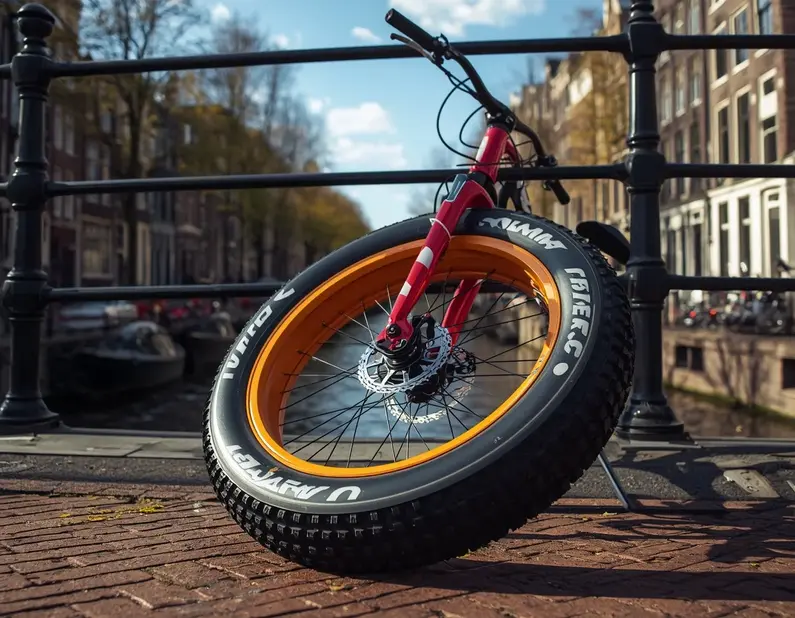
Because almost nothing else on a Dutch cycle path is that wide. A typical city e-bike tyre measures 4 to 5.5 cm. A chunky e-mountainbike tyre reaches about 6.6 cm. A real fatbike starts at 4.0 inch, roughly 10 cm, and runs up to 4.8 inch, past 12 cm. A line at 7 cm catches nearly every fatbike and almost nothing else; the main exception is snow tyres for some mountain bikes. The pressure behind rules like this is injury data: VeiligheidNL registered 301 fatbike-related emergency department visits in 2024 against 75 in 2023 and none in 2020, and a bit more than half of the victims were aged 12 to 17. Those numbers come from a sample of hospitals, so the true count is higher.
Anyone can check the rule in seconds. The ETRTO size on your sidewall starts with the nominal tyre width in millimetres: “100-559” is 10 cm of rubber and a ban inside the park, “50-622” is an ordinary e-bike tyre that rolls straight past the sign. Enforcers do not read the sidewall, though. They measure the tyre, so if yours is close to 70 mm, measure it yourself before you head for the gate.
The weak point is just as obvious. Tyre width says nothing about speed, weight or behaviour, and the market found the gap quickly. More on that in the skinnybike section below.
Where the ban applies and what you can still do
One park, for now. The ban covers the whole Vondelpark, with signs at the entrances and enforcers patrolling at busy times. At the end of October 2026 the city finished evaluating it (ANP reported the decision on 29 October). The ban stays, it will not be extended to other locations for the time being, and Amsterdam wants to see national legislation first. Alderman Elise Moeskops said a majority of park users appreciate the ban, that fatbike owners are choosing other routes and that people notice less nuisance. 20 objections to fines have been rejected, although an appeal is still possible.
| Situation | Allowed? |
|---|---|
| Riding a pedal-assist bike with tyres over 7 cm inside the park | No: €115 (16+) or €57.50 (12 to 15) |
| Walking a fatbike by hand through the park | Yes |
| Riding on the streets and cycle paths around the park | Yes |
| Crossing on the Vondelbrug, the bridge above the park | Yes, the bridge is excluded from the zone |
| Riding a skinnybike with tyres of 7 cm or less | Yes, it falls outside the definition |
| Riding a rented “fat e-bike” from a rental shop | No, the same rule applies to rentals |
| A fat-tyre bike without pedal assistance | Not covered by the wording, since pedal assistance is part of the definition |
| Riding a legal fatbike anywhere else in Amsterdam | Yes |
Can you walk a fatbike through Vondelpark?
Yes. The ban covers riding, not carrying or pushing, and enforcers at the gates point riders to that option. If you rent in Amsterdam, our Amsterdam e-bike rental guide for tourists explains why choosing the standard model over the fat one avoids the problem altogether.
Will Amsterdam extend the ban?
Not for now. Before the October decision, the West district chair had said she was open to a ban in Westerpark, but the city has now put expansion on hold until national law on fatbike-free zones arrives. That law is covered in the last section.
Who enforces what
Keep the two enforcement tracks apart. Municipal enforcers handle the park rule and issue the €115 zone fine. The police handle the national vehicle rules on speed, power and throttle anywhere in the country, and their fines are higher. A legal fatbike can get you fined in Vondelpark, and a tuned skinnybike can get you fined everywhere else.
Enschede’s shopping-hours ban
Amsterdam got the headlines, but Enschede went first. Since 11 March 2026, pedal-assist bikes with tyres wider than 7 cm may not ride in the pedestrian zone of the city centre during shop opening hours: 10:00 to 18:00 on Monday, Tuesday, Wednesday, Friday and Saturday, 10:00 to 21:00 on Thursday, and 12:00 to 17:00 on Sunday. The fine is also €115, and it is municipal enforcers, not police officers, who hand it out. Outside shop hours the centre is open to fatbikes again. The council’s stated aim is to protect people on foot from nuisance and unsafe situations. By the end of July the city had issued nine fines and 33 warnings.
The ban is contested. Enschede fatbike retailer La Souris has sued the municipality and wants the ban withdrawn. NOS calls it a test case, with the civil hearing on the merits planned for late January 2027. The retailer’s owner, Armando Muis, had already started selling skinnybikes in March.
As far as we could verify, Enschede and Amsterdam are still the only two Dutch municipalities with a fatbike ban in force. On 26 October 2026 a large majority of Veenendaal’s council asked the executive to prepare one for the shopping area, and other cities are waiting for the national legal basis. Our Fatbike Rules in the Netherlands 2026 guide tracks every zone as it appears.
The skinnybike loophole and why tyre width is a weak rule
Within weeks of the first bans, the market answered with the skinnybike: a fatbike look and motor with tyres just under 7 cm. Sellers told NU.nl in April 2026 that skinnybike sales were rising quickly. The bike fits both local definitions and gets into Vondelpark and Enschede’s centre. Insurers still treat it like a fatbike when pricing cover, so it saves you nothing there.
Safety groups saw it coming. Veilig Verkeer Nederland and the Fietsersbond told NU.nl they were not surprised, and the Fietsersbond’s Esther van Garderen said the problem is the motor in the bike, not how it looks. That is also why skinnybikes slip past local bans but not the national rules.
The government’s own position has moved. In August 2025, minister Robert Tieman reported that a third independent study had found separate fatbike rules unworkable, because manufacturers can adapt within weeks. In April 2026, minister Vincent Karremans changed course and ordered research into a “pragmatic” way to tell fatbikes from e-bikes. He told reporters he hopes for a definition that covers 80 to 90 percent of fatbikes, and he accepts a cat-and-mouse game with manufacturers.
Enforcement shows how little tyre width tells you. In August 2026, Enschede police stopped a group on fat- and skinnybikes and seized one bike with no chain at all, so it could not be pedalled, and a throttle capable of 120 km/h. The bike was destroyed on the spot. Thin tyres, no protection. Treat the 7 cm rule as a local access rule, not a safety certificate, and read the national numbers below before you buy. If you are weighing the two styles, our e-bike vs fat bike comparison covers the practical differences.
Police roller bench checks: what happens at a fatbike stop
Alongside the local zone bans runs a tougher national track: police checking whether the bike itself is legal. The tool is the rollertestbank, a roller bench. An officer straps your bike down and pedals it, and within about 30 seconds the bench shows where the motor assistance cuts off and whether a throttle drives the bike without pedalling. Police bought about 247 benches at roughly €17,000 each. The first trial ran in Amsterdam-Oost in February 2024, and every police unit had one by 19 June 2024. A single operation in Oosterhout in February 2026 checked 51 fatbikes in one day.
What the bench measures
| What police check | Legal limit | What a fail means |
|---|---|---|
| Pedal assistance cut-off | 25 km/h | Assistance beyond it makes the bike legally a moped |
| Throttle without pedalling | 6 km/h max (walk assist) | A throttle that carries you is moped territory |
| Rated motor power | 250 W continuous | Spec plate checked against known illegal kits |
| Tampering and evasion gear | None allowed | Dongles, hidden display modes and “opvoer” apps on a paired phone count as evidence. Fitting hardware or software designed to dodge speed checks has been banned since 1 July 2025 |
Two legal details matter. First, police do not need to catch you riding fast. According to the justice minister’s answers to parliament, reported by NOS, courts accept a fine when a bike can assist above 25 km/h, even if the rider pressed a button to cap it. Second, “but I switched the kit off” is no defence, because the test is what the bike can do, not what you were doing at the stop.
What a failed check costs
The base fine for a tuned e-bike or fatbike in 2026 is €320, the figure on the Rijksoverheid e-bike rules page. It was €290 in early 2024 and about €310 in late 2024 and 2025, because fines are indexed, so older articles quote lower amounts. A bike that assists past 25 km/h is legally an unregistered moped, and missing moped paperwork can stack on top at the same stop: no WA insurance (indicatively up to €400), no AM licence (around €190), no approved helmet (around €100 to €130).
The first stop brings a fine and a warning. A second detection within two years means the bike is seized. Extreme cases skip the warning: in July 2026, Delft police stopped an 11-year-old on a throttle fatbike that did 58 km/h, and the Public Prosecution Service allowed seizure on the first stop. After an accident you ride as an uninsured motorist, so your own injuries, your bike and the damage you cause to others can land on you. Our e-bike tuning fine guide breaks down the full stack, including the insurance traps that catch parents by surprise.
Street-legal limits for fatbikes in 2026
This is the point that ties everything together: no national Dutch law sets a tyre width limit. The Rijksoverheid states plainly that a fatbike is an electric bike. A 12 cm tyre on a 250 W bike that cuts assistance at 25 km/h is a legal bicycle on every public road in the country, and width only matters inside the two local zones. Three numbers decide legality nationwide:
- 250 W rated continuous motor power, as shown on the spec plate and not the “peak” number in an advert.
- 25 km/h pedal assistance cut-off. Pedalling harder above that speed is fine, motor help is not.
- 6 km/h throttle ceiling without pedalling, meaning walk assist only.
Add the ordinary bicycle kit: working front and rear lights after dark, reflectors, a bell and proper brakes. A legal fatbike needs no helmet, licence plate, compulsory insurance or driving licence, and has no minimum age in 2026, yet. It rides on the cycle path like any bicycle. Break any of the three numbers and the bike is no longer a bicycle: it is legally a moped, snorfiets or speed pedelec, and without type approval and registration it may not use public roads at all. The only legal route to higher assisted speeds is a type-approved speed pedelec, covered in our speed pedelec rules guide. For the wider picture of vehicle classes, see E-Bike Laws Netherlands 2026, our e-bike speed limit explainer for where the 25 km/h line comes from, and fat e-bike vs cargo e-bike rules if your wide-tyred bike carries a load.
| National e-bike law | Amsterdam Vondelpark | Enschede centre | |
|---|---|---|---|
| What the rule targets | Vehicle behaviour: speed, power, throttle | Tyre width | Tyre width |
| Definition | 250 W, assist to 25 km/h, throttle to 6 km/h | Pedal assist + tyres wider than 7 cm | Pedal assist + tyres wider than 7 cm |
| Where | Whole country | Vondelpark only (not the Vondelbrug) | Pedestrian zone in the city centre |
| When | Always | Always, since 11 May 2026 | Shop hours only, since 11 March 2026 |
| Enforced by | Police | Municipal enforcers | Municipal enforcers |
| Fine | €320 for tuning, plus stacked offences | €115 (16+), €57.50 (12 to 15) | €115 |
| A legal 25 km/h fatbike? | Fully legal everywhere | Not allowed to ride inside the park | Not allowed to ride in the zone during shop hours |
Fines at a glance (2026)
| Offence | Amount | Who enforces |
|---|---|---|
| Riding a >7 cm fatbike in Vondelpark, aged 16+ | €115 | Amsterdam enforcers |
| Same, aged 12 to 15 | €57.50 | Amsterdam enforcers |
| Same, under 12 | No fine | n/a |
| Riding a >7 cm fatbike in Enschede’s zone during shop hours | €115 | Enschede enforcers |
| Assistance beyond 25 km/h, or throttle above 6 km/h | €320 | Police |
| Fitting hardware or software that evades speed checks | Banned since 1 July 2025 (no separate amount confirmed) | Police |
| Missing moped paperwork on a bike that is legally a moped (insurance, AM licence, helmet) | Roughly €100 to €400 per item, indicative | Police |
| Second tuning offence within two years | Fine again, plus seizure of the bike | Police / Public Prosecution Service |
Seven checks before you ride or buy
Most riders who get fined never meant to buy an illegal bike. They bought a “bargain” from a marketplace that described a throttle machine as road-legal. Run this list first:
- Read the sidewall. The first number of the ETRTO code is tyre width in millimetres. Above 70 mm, or close to it? The bike is legal on the road nationwide, but plan your route around Vondelpark and Enschede’s centre.
- Check the spec plate. It must say 250 W rated. “Peak 750 W” in an advert is your cue to walk away.
- Test ride to the cut-off. In the highest mode on a safe straight stretch, assistance must fade out at 25 km/h, not surge past it.
- Thumb the throttle. Without pedalling it may crawl at walking pace. Anything faster and you are looking at a moped with a bicycle’s price tag.
- Scroll every display menu. Hidden “offroad” or “35 km/h” profiles, or an unknown app paired to the bike, are a confession in menu form.
- Ask for paperwork. The EN 15194 / CE declaration, invoices and service history. Buying used? Our second-hand e-bike buying guide has the full inspection routine.
- Bought something tuned? Have a certified dealer restore stock settings in writing and keep the work order. Our Amsterdam repair shop guide shows what to ask before booking.
What changes next: 2026 to 2027
The national plan is the one to watch. On 24 April 2026, minister Karremans presented the “Aanpak Fatbikes”: a minimum age for fatbikes, a legal basis for municipal fatbike-free zones, a helmet duty for everyone under 18 on e-bikes, fatbikes and other light electric vehicles such as e-steps, and tougher checks on illegally imported fatbikes. The research on how to tell a fatbike from an e-bike was due “this autumn”, so expect news on the definition soon.
- 1 Jul 2025Ban on fitting hardware or software that evades e-bike speed checks takes effect.
- 28 Aug 2025Minister Tieman: separate fatbike rules judged unworkable, helmet duty for under-18s on light electric vehicles announced.
- 11 Mar 2026Enschede’s shopping-hours ban starts, the first in the Netherlands.
- 24 Apr 2026Minister Karremans presents the “Aanpak Fatbikes”.
- 11 May 2026Vondelpark ban starts; fines from 25 May.
- 26 Oct 2026Veenendaal’s council asks its executive to prepare a fatbike ban.
- 29 Oct 2026Amsterdam keeps the Vondelpark ban and holds off on extending it.
- Autumn 2026Research on a pragmatic fatbike definition due; draft helmet regulation aimed for parliament.
- Late Jan 2027La Souris v. Enschede hearing on the merits.
- Sept 2027Target for the under-18 helmet duty.
The minimum age is still open. Karremans has said the government is looking at 12, 14 or 16, retailers are planning around 14, and Veilig Verkeer Nederland and the Fietsersbond want 12 for e-bikes. A minimum age needs a law change, which the ministry estimated in 2025 would take about two years. The helmet duty for under-18s is the firmest date. Our helmet buying guide explains which standards apply today (EN 1078 for 25 km/h e-bikes, NTA 8776 for speed pedelecs), and our helmet law explainer tracks the rule as it changes.
The practical takeaway if you buy now: buy to the strictest plausible version of the rules, meaning 250 W, 25 km/h and a walk-assist throttle only, and no future headline can turn your bicycle into a motor vehicle overnight. Tyre-width bans may spread to more parks or fall in court, and the national numbers will not move. The rules & regulations hub keeps every Dutch e-bike rule in one place, and the e-bike insurance guide covers what happens when a claim meets a modified bike.
FAQs
Is the fatbike tire width ban in Amsterdam city-wide?
No. It applies only in the Vondelpark, since 11 May 2026, under article 2.17c of the municipal by-law. At the end of October 2026 the city decided to keep the ban but not extend it to other places for now, because it wants to wait for national legislation on fatbike-free zones. Everywhere else in Amsterdam a legally built fatbike remains just a bicycle.
Can I walk my fatbike through Vondelpark?
Yes. The ban covers riding a pedal-assist bike with tyres wider than 7 cm, not walking beside it. You can also ride around the park on the surrounding streets and cycle paths, and cross on the Vondelbrug, which is excluded from the zone.
How much is the fine for riding a fatbike in Vondelpark?
€115 for riders aged 16 and over and €57.50 for ages 12 to 15. Children under 12 cannot be fined. Municipal enforcers issue the fine, not the police. Between 11 May and 1 September 2026 the city issued 167 fines and 138 warnings.
How do enforcers decide if my tyre is wider than 7 cm?
They measure it with callipers at the park entrances. The ETRTO number on the sidewall gives the nominal width in millimetres, so “100-559” is 10 cm and “50-622” is 5 cm, but the measured tyre is what counts. If yours is close to 70 mm, measure it yourself first.
Which other Dutch cities ban fatbikes?
Only Enschede, where pedal-assist bikes with tyres over 7 cm are banned from the pedestrian zone in the city centre during shop hours since 11 March 2026 (fine €115). Veenendaal’s council asked its executive to prepare a ban on 26 October 2026, but nothing is in force there yet.
Do skinnybikes with tyres under 7 cm solve everything?
They avoid the two local zone bans in Amsterdam and Enschede, and nothing else. The national limits on power, assistance speed and throttle still apply, and future rules such as the under-18 helmet duty are written for all e-bikes. The bike Enschede police destroyed in August 2026, chainless and capable of 120 km/h on its throttle, was a skinnybike.
How do police check whether my fatbike is legal?
With a roller bench: the bike is strapped onto drums, an officer pedals it, and within about 30 seconds the readout shows where assistance cuts off and what the throttle does without pedalling. The limits are 25 km/h for assistance, 6 km/h for a throttle and 250 W rated power, plus a check for dongles, hidden modes and evasion devices. A fail means the €320 tuning fine and possible stacked offences.
Will the fatbike ban become national?
Not as a ban. The government is working on a minimum age for fatbikes, a legal basis for municipal fatbike-free zones and an under-18 helmet duty targeted for September 2027. A legal fatbike will stay legal on public roads, but cities should get a firmer basis for zone bans like Amsterdam’s.
Sources, checked 5 November 2026: Amsterdam designation decision (Gemeenteblad 2026, 153618) · Enschede by-law amendment (Gemeenteblad 2026, 89644) · Binnenlands Bestuur / ANP, 29 October 2026 · NOS, 31 July 2026 · NH Nieuws on first Vondelpark fines · Mobiliteit.nl on Veenendaal · Rijksoverheid e-bike rules · Rijksoverheid, Aanpak Fatbikes, 24 April 2026 · Rijksoverheid, minister Tieman, 28 August 2025 (incl. VeiligheidNL figures) · NL Times on skinnybikes, 17 April 2026. Fines and local rules can change, so confirm current figures with the police or your municipality before relying on a number.