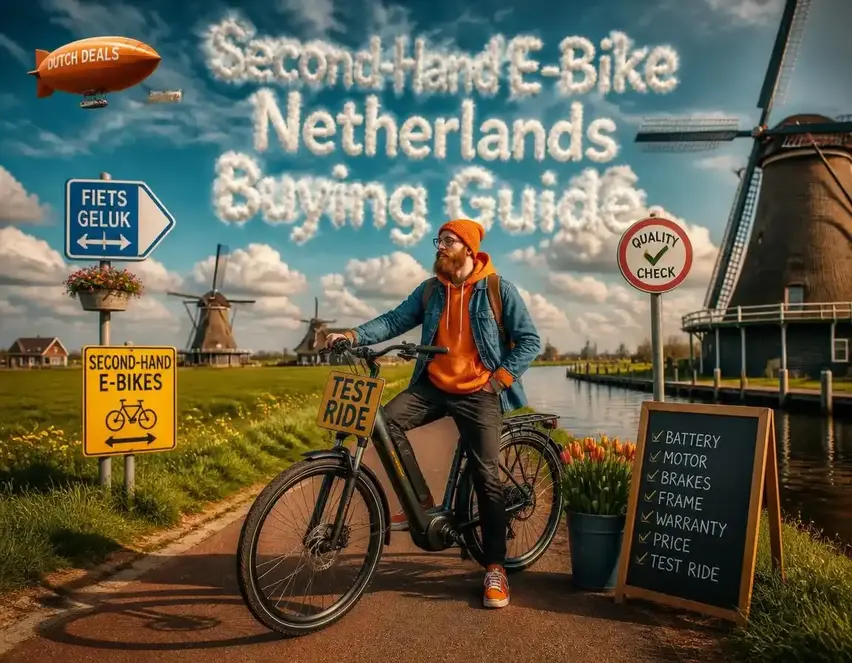
Second-Hand E-Bike Netherlands Buying Guide 2026

Second-Hand E-Bike Netherlands Buying Guide 2026: Prices, Checks & Insider Tips
How to spot a healthy battery, dodge stolen bikes and Marktplaats scams, haggle like a local, and pay what a used e-bike is actually worth — from people who ride them every day.
 Photo: Wikimedia Commons (CC)
So, you fancy a used e-bike in the Netherlands. Smart move. The awkward part? A brand-new one now costs around €2,870 on average (roughly £2,450), and that figure climbed 6% last year alone. Meanwhile the country is absolutely heaving with barely-used second-hand e-bikes: ex-lease bikes, shop trade-ins, expat leftovers, and “as new” bargains from people who bought during the boom and then realised they prefer the train.
We’ve bought, sold and test-ridden more used e-bikes than we can count, and this guide is everything we wish someone had handed us on day one. No fluff — just the checks, the prices, the scams to dodge, and the little tricks Dutch locals (and savvy expats) use.
🇳🇱 Why the Dutch used e-bike market is a goldmine in 2026
The Netherlands buys more e-bikes per head than anywhere in Europe — e-bikes made up 49% of all new bike sales in 2025, around 391,000 machines. All those bikes become tomorrow’s second-hand bargains, and 2026 is a special year for four reasons:
- A wave of ex-lease bikes is landing. Company “fiets van de zaak” schemes (a friendly 7% tax addition on the bike’s value) pushed huge numbers of new e-bikes into circulation — and those leases are now expiring, flooding the market with well-serviced, 3–4 year old bikes.
- New prices keep climbing. With the average new e-bike nudging €2,900, a clean used one at half that is simply sensible maths.
- Refurbished players made used safer. Specialists now inspect, refurbish and give 1-year warranties on second-hand e-bikes — something unthinkable five years ago.
- The Netherlands has an enormous, constantly-turning expat population. International students, contract workers and relocating families buy an e-bike for a year or two and then have to sell fast when they leave — more on exactly how to find these deals below.
💶 The 2026 price guide: what a used e-bike is really worth
Prices vary by brand, motor and battery size, but the Dutch market follows a surprisingly predictable depreciation curve. Use this table as your negotiating backbone (example values assume a bike that cost €2,500 new):
| Age of e-bike | Fair price (% of new) | Example (new = €2,500) | What to assume |
|---|---|---|---|
| Under 1 year | 65–75% | €1,600–€1,900 | Like new, warranty possibly transferable |
| 1–2 years | 55–65% | €1,400–€1,600 | Healthy battery (90%+), minor cosmetic wear |
| 3–4 years | 40–50% | €1,000–€1,250 | The sweet spot — check service history |
| 5–6 years | 25–35% | €650–€900 | Battery ageing — budget for replacement soon |
| 7+ years | 15–25% | €400–€650 | Price it as if it needs a new battery (€400–€900) |
That lines up neatly with the ANWB’s own yardstick: a €2,500 e-bike is typically worth €1,000–€1,200 after three years. If a seller wants new-bike money for a five-year-old frame, smile, thank them, and keep walking.
📊 What you should pay vs. age (share of new price)
Typical asking prices as a share of the original new price, Dutch market 2026. Mid-drive systems (Bosch/Shimano) hold value best; no-name hub-motor bikes depreciate faster.
🏪 Where to buy a second-hand e-bike in the Netherlands — ranked
| Channel | Price level | Warranty | Risk | Best for |
|---|---|---|---|---|
| Refurbished specialists (e.g. Upway) | Medium–high | 12 months (battery, motor, frame) | 🟢 Low | Peace of mind, online buying |
| Local bike shop used corner | Medium | Often 3–6 months | 🟢 Low | Test rides + honest advice |
| Theft-checked marketplaces (e.g. BikeFair) | Low–medium | Varies, some inspection | 🟢–🟡 Low–medium | Vetted stock without the legwork |
| Marktplaats (thousands of live e-bike ads) | Low–medium | None | 🟡 Medium | Bargains & haggling, if you’re careful |
| Expat & relocation Facebook groups | Low–medium | None | 🟡 Medium | Motivated sellers, often below market rate |
| Gemeente fietsdepot / AFAC | Very low | None | 🟡 Medium (fewer e-bikes, patchy stock) | Rock-bottom prices, if you’re lucky on stock |
| Facebook Marketplace (open, non-expat) | Lowest | None | 🔴 High | Experts only — stolen-bike hotspot |
Our honest take: if it’s your first e-bike, buy from a shop or refurbisher and let the 12-month warranty buy you sleep. If you know your Bosch from your Shimano, Marktplaats is where the real bargains live — just bring your checklist and your wits.
✈️ Buying from an expat who’s leaving the Netherlands
This is the single most underrated way to find a genuinely well-kept used e-bike, and it’s specific enough to the Netherlands that most generic buying guides never mention it properly. International students, contract workers and relocating families buy a decent e-bike when they arrive, use it carefully for a year or two (often still under warranty, often still with the original receipt and box), and then need to sell it fast — usually within a tight window before their flight or moving van leaves.
That combination — a well-maintained bike and a motivated, time-pressured seller — is exactly where the best deals sit. A few ways to find them:
- Expat and relocation Facebook groups for your city (Amsterdam, Utrecht, Rotterdam, The Hague, Eindhoven all have large, active ones) regularly get “moving sale” posts listing an e-bike alongside furniture and kitchenware.
- University and international-student housing noticeboards (physical and online) spike with bike sales at the end of each academic year, roughly May to August.
- Search Marktplaats for “moving sale” or “leaving NL” style wording in the listing title, not just the bike brand — sellers in a hurry often say so directly.
One genuine advantage of buying this way: a seller who’s leaving the country has zero incentive to misrepresent a stolen bike (they want a fast, clean sale, not police attention on their way out) — but you should still run every check in this guide regardless. Motivated doesn’t mean exempt from scrutiny.
🔋 The 10-minute battery test (the deal-maker or deal-breaker)
The battery is the single most expensive component on the bike — a new one costs €400–€900 in 2026, with Bosch 500–600 Wh packs at the pricier end. Everything else on a used e-bike is cheap to fix; the battery is not. So give it ten focused minutes:

- 1. Ask for the charge-cycle count. A typical battery lives 500–1,000 full cycles; 500+ means it’s middle-aged.
- 2. Request a dealer diagnostic. Bosch dealers can read out State of Health and error history — a 5-minute printout that tells you everything.
- 3. Check the serial number. Bosch lets you check a battery’s serial number on its official site before you buy.
- 4. Ride it on a full charge. Watch how fast the bars drop under load — a weak pack collapses on the first bridge or hill.
- 5. Inspect the casing. Dents, corrosion or a rattle = walk away, whatever the price.
- 6. Original charger? A missing or third-party charger is a €100+ problem and a hint of rough ownership.
📉 Typical battery capacity left vs. age
Well-cared-for batteries (stored partly charged, not drained flat) age slower; abused ones can lose this much in half the time.
⚙️ Motor, brakes & frame: the walk-away list
| Part | Good sign ✅ | Warning sign 🛑 |
|---|---|---|
| Motor | Smooth, silent assist; no error codes on the display | Knocking/clicking from a mid-drive, error messages, assist cutting out |
| Brakes | Disc pads over 1 mm, firm lever feel | Grinding, spongy lever — e-bike brakes wear fast, budget €25–€40 for pads |
| Chain & gears | Crisp shifting, chain-checker tool shows little stretch | Skipping under power — a full drivetrain refresh can cost €100+ |
| Tyres | Even tread, no cracks, puncture protection intact | Bald centre stripe — €25–€45 per tyre, fitted |
| Frame | Straight, no cracks at welds, only light scratches | Fresh paint over a crack, bent parts — crash damage, walk away |
| Paperwork & keys | Original receipt, service book, two keys + battery key | “Lost” keys and no papers — classic stolen-bike red flag |

🕵️ The 2-minute stolen-bike check (do this every single time)
Here’s the uncomfortable truth: in 2025 alone, 86,950 bike thefts were reported to Dutch police — the fourth yearly rise in a row — and e-bikes are the favourite target, with hundreds nicked every day and only a tiny slice ever recovered. That makes this check non-negotiable:
- Find the frame number (usually under the bottom bracket or on the head tube).
- Enter it, with the brand, into the RDW’s Fietsdiefstalregister (stolen-bike register) — free, and covering every bike reported stolen since 1 January 2008. (There’s a handy English version on the Dutch government’s site too.)
- Ask the seller for the original receipt and check the name matches their ID.
🚩 Marktplaats e-bike scams and how to pay safely
With millions of users, Marktplaats is also where a lot of scams targeting newcomers concentrate, and e-bikes — expensive, easy to resell — are a favourite target for fraudsters. Two patterns to know before you start messaging sellers:
| Red flag | What’s actually happening |
|---|---|
| Buyer/seller agrees instantly, no negotiation | A genuine seller usually engages a little; an immediate “yes, deal” with no back-and-forth is a common opener for a scam script. |
| They send you “their own” payment link | Legitimate Tikkie requests come from inside the Tikkie app after you’ve agreed a deal in person — a link sent cold, before you’ve seen the bike, is very likely a phishing page designed to steal your card details, not a real payment request. |
| Pressure to pay before viewing | “Someone else is interested, pay now to secure it” is one of the oldest tricks in the book — a real seller with a real bike can wait a day. |
| Brand-new account, no history, stock photos | Check the seller’s profile age and reviews; ask for a fresh photo with today’s date or a specific object in shot if anything feels off. |
🛣️ Dutch e-bike rules in 2026: the 60-second version
| Regular e-bike (pedelec) | Speed pedelec | |
|---|---|---|
| Motor support up to | 25 km/h (≈15.5 mph) | 45 km/h (≈28 mph) |
| Helmet | Not required | Mandatory (NTA 8776 helmet) — €130 fine in 2026 |
| Driving licence | None needed | AM (moped) licence |
| Minimum age | None | 16 years |
| Number plate | Not needed | Mandatory yellow plate via the RDW |
| Insurance | Not legally required (theft insurance is wise) | Third-party (WA) insurance mandatory |
| Where you ride | Cycle path, like any bike | Road / moped path |
Three 2026 updates worth knowing before you buy:
- Tuned (“opgevoerde”) e-bikes: riding or selling a chipped bike can now cost you a €290 fine and even seizure of the bike. Check that support cuts out at 25 km/h — a “fast” used bargain is a fine on wheels.
- Fatbikes are legally e-bikes — 250 W and 25 km/h, or they’re classed as motor vehicles. Anything faster or fiercer on a used ad is a red flag.
- Coming in 2027, not yet law: the Dutch cabinet has proposed a helmet requirement for under-18s on e-bikes and fatbikes, as outlined on the Rijksoverheid website. It isn’t in force yet, and adults still ride helmet-free by law (though we’d still wear one).
🧾 The test-ride checklist (save this on your phone)
- ✅ Starts smoothly; assist kicks in only when you pedal
- ✅ Support cuts out cleanly at 25 km/h (no sneaky tuning)
- ✅ Battery bars hold up on a hill or headwind stretch
- ✅ Brakes stop you straight and silent, no rubbing
- ✅ No clicks, clunks or creaks from the bottom bracket
- ✅ Gears shift crisply under load, chain doesn’t skip
- ✅ Lights, bell, display and kickstand all work
- ✅ Riding position feels right after 10+ minutes, not 2
Never test-ride before you’ve seen the papers and run the register check — and never hand over your ID or phone as a “deposit”. That’s an old trick, and it still works on nice people.
🤝 Haggle like a local (without being rude)
The Dutch respect directness wrapped in friendliness. You don’t need market-stall drama — just facts:
- Anchor with the battery. “Lovely bike, but the battery’s six years old — a new one is €700. Would you take €X?”
- Count the small stuff. Bald tyres (€70 for two), worn pads, no service book — each is a polite €25–€100 off.
- View at quiet times. End of the month and rainy Sundays produce more flexible sellers than sunny Saturdays.
- Bring instant payment. “I can transfer the money right now, at pickup” closes deals faster than any charm — just make sure it’s you generating the payment, not a link they’ve sent you (see the scam section above).
- Be ready to walk. With thousands of e-bikes advertised on Dutch marketplaces at any moment, there is always another one.
🏆 Best used e-bike brands & models in the Netherlands (2026)
| Brand | Models to look for | Why it’s a smart used buy |
|---|---|---|
| Gazelle | Arroyo, Medeo, Ultimate | Huge dealer network, parts everywhere, holds value |
| Batavus / Sparta | Etuze, Zeneo / E-Motion | Classic Dutch comfort, cheap servicing |
| Giant | Explore E+, Entice E+ | Quality frames, Yamaha/Bosch systems |
| Cube / Trek | Touring Hybrid / Allant+ | Sporty commuters that hold resale well |
| Koga | E-Nova, E-Extention | Under-rated premium build, touring royalty |
The golden thread? Bosch or Shimano Steps mid-drive systems. Any Dutch bike shop can service them, parts will exist for decades, and diagnostics are easy to read. No-name hub-motor imports are cheaper upfront — and unfixable the day something goes wrong.
💡 What a used e-bike costs after you buy it
| Item | Typical 2026 cost | How often |
|---|---|---|
| Annual service | €60–€90 | Yearly |
| Brake pads (pair) | €25–€40 | Every 1,000–2,000 km |
| Tyres (each, fitted) | €25–€45 | Every 3,000–5,000 km |
| Theft insurance | ± €4–€9 / month | Monthly — very wise for e-bikes |
| New battery | €400–€900 | Roughly year 5–8 |
Budget around €150–€250 a year all-in and you’ll never be surprised. Charging, meanwhile, costs pennies — a full 500 Wh charge is about €0.15 of electricity. Try saying that about a car.
❓ Second-hand e-bike FAQs
How much should I pay for a second-hand e-bike in the Netherlands in 2026?
For a decent 2–4 year old mid-drive e-bike, expect to pay roughly €900–€1,600 — about 40–65% of the original price. As a yardstick, a €2,500 e-bike is worth around €1,000–€1,200 after three years. Bikes older than five years should cost €650–€900, and anything 7+ years old should be priced assuming you’ll need a new battery (€400–€900).
How do I check if a used e-bike is stolen before buying it?
Enter the brand and frame number into the RDW Fietsdiefstalregister — it’s free and lists all bikes reported stolen since 1 January 2008. Also ask for the original receipt, check the frame number isn’t scratched out, and walk away from anyone who rushes you or insists on cash in a car park.
How much does a replacement e-bike battery cost in 2026?
Between €400 and €900, depending on brand and capacity, with Bosch 500–600 Wh packs at the top end. Always use that number to negotiate the price down when a used bike’s battery is weak or older than five years.
Ready to find your bargain? 🚲
Run the register check, trust the battery test, never pay before you’ve seen the bike, and ride home smiling with €1,000 still in your pocket.
For more honest e-bike advice — costs, batteries, brands and Dutch cycling life — pop over to ebykes.nl, your e-bike companion in the Netherlands.