E-Bike Child Seat in the Netherlands: Front, Rear or Cargo?

E-Bike Child Seat in the Netherlands: Front, Rear or Junior? The 2026 Fit & Safety Guide
The short version
Most Dutch e-bikes can take an e-bike child seat, but not every seat fits every bike. A front seat suits a baby from about nine months up to 15 kg. A rear seat carries up to 22 kg (about age six), and junior seats on MIK HD racks go to 27 kg. The battery position and your rack’s load rating decide what fits, so check both before you buy. Look for EN 14344:2022, a harness, footrests and spoke guards. Budget roughly €60–€170. No helmet is required for a child in a seat today.
Jump to a section
The school run is where many Dutch e-bike owners hit their first real fitting problem. The fietsstoeltje that clamped onto your old omafiets won’t necessarily fit a new e-bike: batteries have moved onto the carrier, racks now carry load ratings, and some frames were never built for a seat at all. This guide covers which seat suits which child, the weight limits that matter, the battery and rack checks that seat boxes don’t mention, what seats cost in the Netherlands in 2026, and what Dutch law asks of you today, including the helmet rule that is coming.
Front, rear or junior: which seat suits which child
Three kinds of child seat are sold in the Netherlands, and your child’s weight decides between them long before taste does.
| Seat type | Child age | Max child weight | Mounts to | Typical NL price 2026 |
|---|---|---|---|---|
| Front seat (voorzitje) | ~9 months – 3 years | 15 kg | Handlebar stem bracket | €60–€130 |
| Rear seat (achterzitje) | ~9 months – 6 years | 22 kg | Rack (clamp, MIK or MIK HD) or seat-tube frame bracket | €70–€170 |
| Junior seat | ~5 – 10 years, at least 110 cm tall | 27 kg (a few models list up to 35 kg) | MIK HD rack for most models | From about €80 |
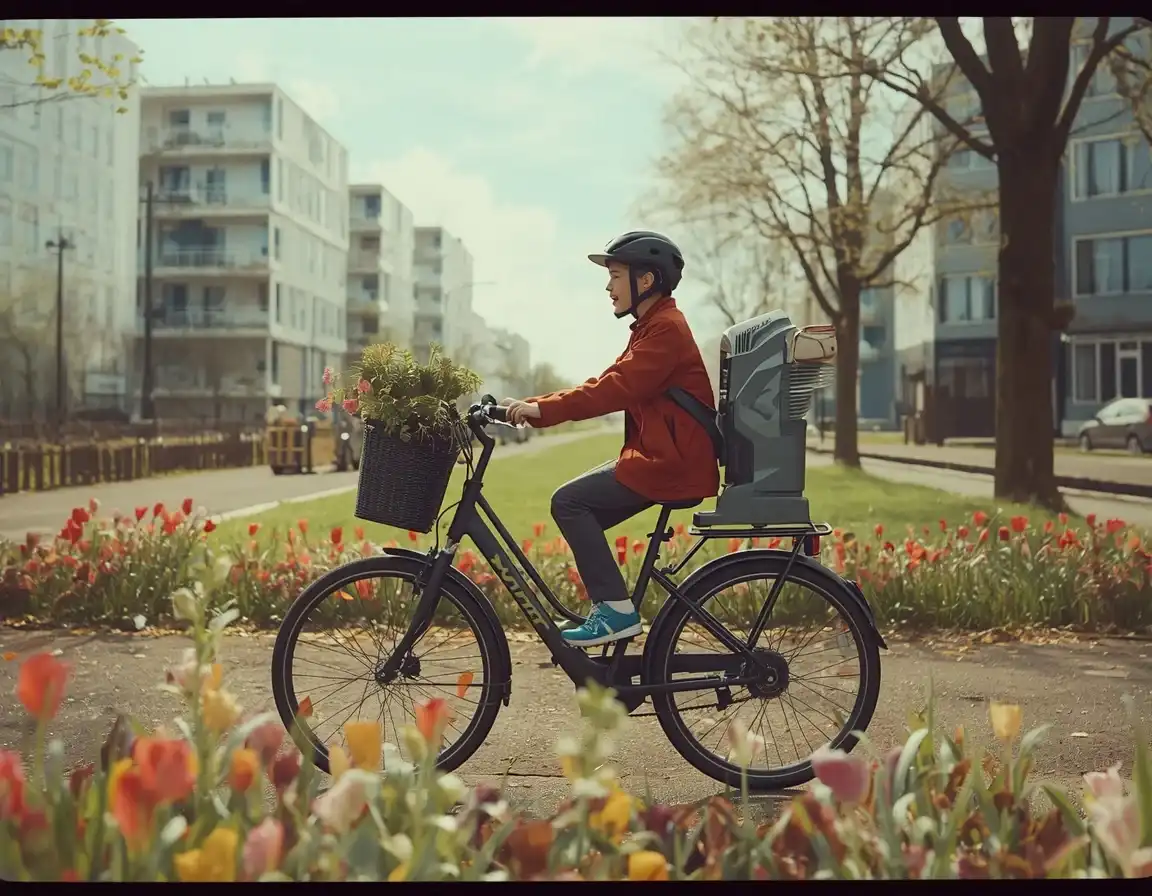
A front seat puts your child right in front of you, where you can see and talk to them. The trade-off is weight at the handlebar, so steering feels heavier at walking pace. A rear seat is the everyday choice: a bigger shell, a higher back and more room to grow, which helps when a child falls asleep on the way home. Most families start at the front and move to the back once the child passes 15 kg. Both types start at the same age, about nine months.
Junior seats are for school-age children who have outgrown 22 kg but can’t yet ride a long distance themselves. Most are made for MIK HD racks and want a child at least 110 cm tall. Weight decides, not age: treat the age ranges as a guide and the weight printed on the seat as the rule.
Age and weight limits: the numbers that matter
EN 14344:2022 is the European standard for child seats on cycles. It covers children from 9 kg up to 22 kg who can sit unaided, on ordinary bikes and on e-bikes whose assistance cuts out at 25 km/h. The 15 kg limit on front seats isn’t in the standard. It is what the makers rate their front seats for, and Dutch retailers and safety guidance use the same figure, at about age three. A heavier child belongs in a rear seat.
Nine months is a milestone rather than a rule. Your baby should sit on their own and hold their head steady, with a helmet on if you use one. Before that, use a cargo bike or trailer with a baby seat or insert that its maker approves for infants.
The number most people forget is the carrier’s load rating. A rear seat weighs roughly 2.5–3.5 kg empty. Put a 22 kg child in it and you are at about 25 kg on the carrier before a bag of gym shoes. That is why Bobike and Qibbel ask for a carrier rated to at least 27 kg (ISO 11243), while some older e-bike racks are rated for 25 kg or less. Find the rating on the rack’s sticker, in the bike’s manual or on the maker’s site before you buy the seat, not after.
What MIK HD means
MIK HD racks are tested to 27 kg and designed with child seats in mind; MIK Click Go describes HD as the first system to meet both the carrier standard (ISO 11243) and the child-seat standard. Seats from Urban Iki, Polisport, Thule and Qibbel come in MIK HD versions with a reinforced adapter plate.
MIK and MIK HD look alike but aren’t interchangeable. Buy the seat version that matches the marking on your rack, and remember that junior seats made for HD won’t go on a regular MIK rack. If your rack has no MIK marking, its rating comes from the bike maker, so read the manual.
Will it fit? The battery and rack check
This is the part generic seat guides skip. On an e-bike, the battery’s position decides which seats can physically fit.
| Battery position | What it blocks | What usually works |
|---|---|---|
| Under or on the rear rack | Rack-mounted seats: the clamp has nothing to grip | A frame-mounted rear seat (Thule sells frame-mount versions for this case) or a front seat |
| On or behind the seat tube | Frame-mounted seats, which can hit the pack or its release latch | A rack-mounted or MIK seat; check the battery still slides out with the seat on |
| Down tube or integrated in the frame | Rarely anything | Rack or frame mount; watch the rack’s load rating |
| Front-hub motor | Nothing directly, but weight sits ahead of the head tube | Fine with a rear seat; a front seat makes low-speed steering heavier, so test it first |
On some e-bikes the rear seat has to come off before the battery can be removed. If you charge the battery indoors every day, that is a daily job, so try it in the shop.
Bikes that often can’t take a child seat
Speed pedelecs are outside EN 14344, which only covers bikes that stop assisting at 25 km/h, and a speed pedelec is legally a moped. Some junior seats, including Bobike’s and Polisport’s, aren’t suitable for bikes with rear suspension. And if the bike’s manual rules out child seats, or the rack is rated below what the seat asks for, choose another bike or another mount.
The compatibility check, in order
- Find the battery. Work out which mount it blocks using the table above.
- Read the rack rating. Aim for 27 kg, as seat makers ask. If the rack says 25 kg, check the seat’s manual before you buy.
- Check the bike’s maximum total weight. Rider, bike, seat, child and bags must stay under the limit in the manual, often somewhere between 120 and 150 kg.
- Match the mount. Look for a MIK or MIK HD plate, or measure the rack: clamp seats such as the Bobike ONE Maxi need rails roughly 120–175 mm apart and round or oval tubes of about 10–16 mm.
- Check the seat tube for a frame mount. It needs a clear round or oval section; Thule’s frame mount takes 28–40 mm.
- Test it empty. Fit the seat, turn the bars lock to lock, and check that nothing touches the battery, frame, cables or your heels, and that the battery still comes out.
EN 14344 and the safety kit worth paying for
Any seat you put a child in should carry the EN 14344 label. The standard tests the shell, the attachment system, the harness, the footrests and the spoke protection. On a spec sheet, look for:
- A three-point or five-point harness with a buckle a child can’t open.
- Adjustable footrests with straps, so small feet can’t slip back.
- A hard-plastic spoke guard between the footrest and the wheel. The Rijksoverheid says a coat guard doesn’t count.
- A mount that locks the seat firmly but releases with one deliberate adult action.
- A rear reflector, and a lock or a way to take the seat off easily.
Second-hand seats are common and fine if you check them. Look for hairline cracks around the bracket, frayed harness webbing and a missing EN 14344 label, and ask whether the seat has been dropped hard or crashed. Brackets are usually brand-specific, so buy the matching one. A €40 seat with an unknown history is a worse buy than a new one at €90.
Mounting systems compared
| System | How it fits | Best for | Watch out for |
|---|---|---|---|
| Rack clamp with click-off bracket | Clamps grip the carrier rails; the seat clicks off the bracket without tools | The cheapest route, and moving a seat between bikes | Useless with a battery under the rack; check the rack rating |
| MIK click-in | The seat slides onto a standard plate on the rack | Bikes sold with a MIK rack | Seat and rack versions must match; HD seats need HD racks |
| MIK HD click-in | Reinforced plate on a rack tested to 27 kg | Family bikes, and junior seats | Ask for an HD rack when you buy the bike; whether a rack can be swapped later depends on the frame |
| Frame (seat-tube) bracket | A collar clamps the seat tube, independent of the rack | Bikes with a rack battery or no rack | Needs enough clear seat tube; can clash with a seat-tube battery; the seat sits a little higher |
| Front stem bracket | A bracket on the stem holds the front seat’s mounting plate | Front seats | Ahead-style stems need a special block; re-check the bolts after the first week |
Whichever you choose, the bracket stays on the bike and the seat comes off. Take it inside with you where you can: seats are easy to steal, and a seat left clipped to a rack at a station is one you’ll be buying again.
What an e-bike child seat costs in the Netherlands in 2026
Maximum child weight by seat type
The usual weight ceilings for each seat type. Your rack’s rating and the bike’s maximum total weight still apply on top.
Seats cost less than most e-bike accessories, and prices vary with the mount and the shop. Front seats run from about €60 to €130: the Bobike ONE Mini is around €63 and the Thule Yepp Nexxt 2 Mini between roughly €96 and €130. Rear seats start near €70 for simple models. The Bobike ONE Maxi has an advised retail price of €99.99 and often sells for €80–€100, the Qibbel Air rack seat is around €115, the Thule Yepp Nexxt 2 Maxi typically costs €145–€150, and MIK HD rear seats reach about €170. Junior seats start at about €80, and MIK HD junior models cost more. Treat these as ranges, because shops change prices often.
What you pay for is harness quality, shell stiffness and how easy the bracket is to use. The weight limits are the same whatever you spend.
Two children: the weight maths
Many bikes can carry a front seat and a rear seat together, and with a baby and a four-year-old it is often the cheapest workable answer. Check the manual first, since not every bike allows two seats. Then add it up. Two seats weigh about 6 kg, an 11 kg baby and an 18 kg four-year-old add 29 kg, so that is roughly 35 kg of passengers and plastic on a bike that weighs about 25 kg itself. With a 75 kg rider, the total is around 135 kg, which is close to the maximum total weight of many e-bikes.
Braking distances stretch, low-speed steering gets vague, and hill starts on a bridge, dyke or parking ramp take technique. Past two children, or past about age six in the rear seat, a cargo e-bike is the honest answer. The rule there is simple: one child per proper seat, each belted. Our best cargo e-bike guide compares the 2026 models. When you talk to a dealer, ask whether the bike is tested to EN 17860, the European standard for cargo cycles.
Dutch rules, helmets and insurance
Under article 58a of the RVV 1990, a child under eight may only ride on a bicycle in a seat that supports the back, hands and feet. In practice that means a proper child seat with footrests and a harness. A bare rack with a cushion isn’t legal for a five-year-old. Some older guides still cite article 61, but the rule now sits in article 58a. The Rijksoverheid’s child-seat Q&A spells out the requirement, and adds footrests and spoke guards. A standard e-bike (250 W motor, assistance ending at 25 km/h) is legally a bicycle: no licence, no plate and no minimum age. Our Dutch e-bike laws guide has the full framework.
Helmets: the Rijksoverheid says a child on the back of a bicycle doesn’t need an approved helmet, and that also holds on a standard e-bike. Helmets are compulsory on speed pedelecs and mopeds, for passengers too. The government plans to require helmets for under-18s on e-bikes and other light electric vehicles from September 2027, as set out in its helmet plan. The bill is meant to reach the Tweede Kamer in autumn 2026, both chambers must approve it, and the date could slip. The government’s announcement talks about under-18 riders and doesn’t mention passengers, and reports differ on whether a child in a seat will be covered. Many parents helmet a seat child anyway. Look for an EN 1078 cycle helmet, ideally with a slim back that doesn’t tip a small head forward against the seat. Our helmet guide tracks the bill as it moves.
Insurance: most insurers only pay out for theft if the bike was locked with an ART-approved lock, usually 2-star or higher. Some, including Rabobank’s Interpolis and Centraal Beheer, cover fitted accessories such as a child seat as standard. Others cap accessory cover or sell it as an option, so read the policy and tell the insurer about an expensive seat. Our e-bike insurance guide compares the tiers.
Frequently asked questions
Can you fit a child seat on any e-bike?
Most, but not all. The usual blocker is the battery: a pack under the rear rack rules out rack-mounted seats, so you need a frame-mounted or front seat instead, and a battery on the seat tube can clash with frame mounts. Then check the rack rating (seat makers such as Bobike and Qibbel ask for a carrier rated to 27 kg), the bike’s maximum total weight and the manual. Speed pedelecs are outside the EN 14344 standard, and some seats can’t go on bikes with rear suspension.
What age can a baby go in an e-bike child seat in the Netherlands?
From about nine months, once your baby can sit unaided and hold their head up. EN 14344:2022 covers children from 9 kg who can sit unaided. Front seats then take children up to about 15 kg (roughly age three), rear seats up to 22 kg (roughly age six), and junior seats on MIK HD racks up to 27 kg for children of about five or six and older who are at least 110 cm tall. Under Dutch law, a child under eight must sit in a seat that supports the back, hands and feet.
Is a helmet legally required for a child in an e-bike seat?
Not today. On a standard e-bike (assistance up to 25 km/h) there is no helmet rule for the rider or for a child in a seat; helmets are compulsory on speed pedelecs and mopeds. The government plans a helmet requirement for under-18s on e-bikes from September 2027, with the bill due in parliament in autumn 2026, but it is not law yet and the date could slip. The plan talks about under-18 riders, and reports differ on whether child passengers will be covered, so many parents already use an EN 1078 helmet.
A child seat works well when it suits the bike: the right mount for where the battery sits, a rack rated for the load, and a seat sized to your child’s weight. Do the compatibility check, tighten every bolt, and ride a lap of the block on your own before the first ride with your child. Get those right and an e-bike does most of what a small family car does on Dutch streets, with easier parking.