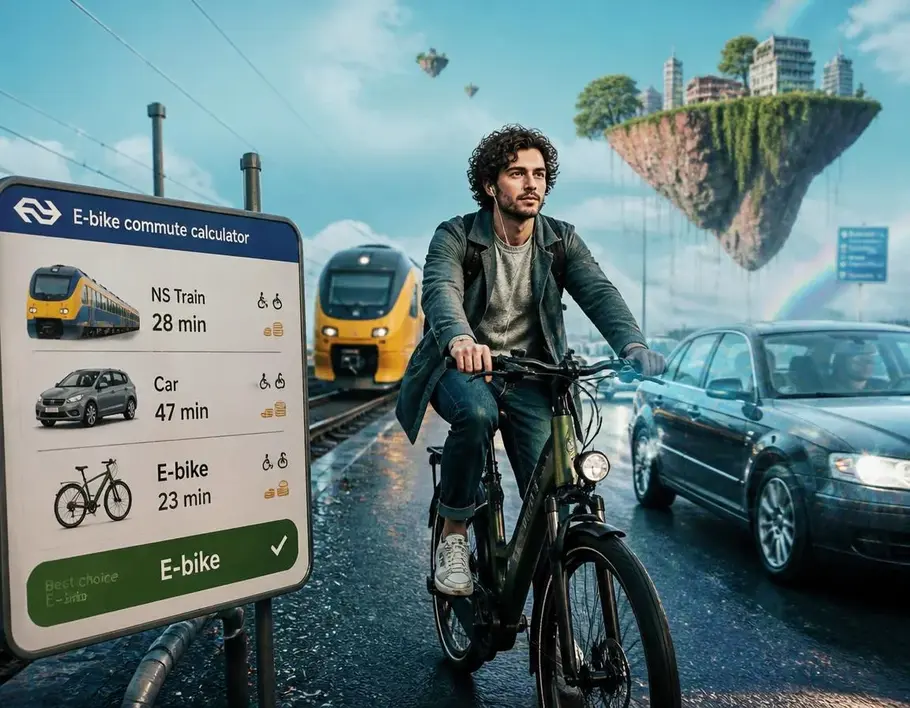
E-bike commute calculator: NS train vs car vs e-bike

Enter your commute and see what an e-bike saves you each year, and how many months it takes to pay for itself. Euro amounts, 2026 Dutch rates. Every default can be changed.
Your estimated annual saving
| Per year | Cost | Allowance | Net |
|---|
Estimates only, not tax or financial advice. Paying a travel allowance is the employer’s choice, and €0.25 per km is the most they can pay tax-free in 2026. Net below zero means the allowance is larger than your costs.
Updated 4 November 2026. Rates checked against Dutch government, CBS and NS announcements.
Is an e-bike cheaper than the train or the car for getting to work? This e-bike commute calculator gives you a number in a few seconds. Enter your one-way distance and how many days a week you go to the office. It shows your yearly saving in euros and how many months the bike takes to pay for itself, including the tax-free travel allowance (reiskostenvergoeding) of up to €0.25 per km that Dutch employers can pay in 2026.
The timing matters. NS raised fares by 6.52% on average in January 2026 and has announced another 4.7% for January 2027. CBS recorded petrol at about €2.38 a litre in late July. A commute that looked reasonable two years ago can now cost well over a thousand euros a year.
Calculate your commute savings
How the calculator works
It turns your commute into yearly kilometres, then adds up what each way of getting to work costs you.
- Yearly commute: your one-way distance, doubled, times your office days per week and your working weeks (46 by default, which leaves room for holidays and sick days).
- Car: fuel, servicing and tyres per km, plus any parking. Fixed costs such as depreciation, insurance and road tax only count if you enter them, which makes sense when the e-bike lets you sell the car.
- NS train: your single fare twice a day, or a monthly pass if you enter one, plus any bus, tram or OV-fiets at either end.
- E-bike: a flat yearly amount for insurance, servicing, tyres and charging. The calculator divides the purchase price, minus any employer contribution, by your yearly saving to get the payback time.
- Allowance: €0.25 per km on your yearly kilometres, for each way of travelling where your employer actually pays it.
Two tick boxes control the allowance. The first says your employer pays it when you cycle. The second says your employer already covers your current commute, either with the same per-km allowance for driving or by reimbursing your NS ticket in full. When both are ticked, the allowance mostly cancels out and only the cost difference is left.
The “without any allowance” figure shows what you would save if your employer pays nothing. It is the safest number to plan around.
The 2026 rates it uses
| Item | Default | Where it comes from |
|---|---|---|
| Tax-free travel allowance | €0.25 per km | The Dutch government raised the limit from €0.23 on 22 May 2026, effective from 1 January 2026. |
| NS fares | Your own fare | Up 6.52% on average in January 2026, with 4.7% announced for January 2027. |
| Petrol (Euro95) | €2.40 per litre | CBS pump prices were about €2.38 in late July 2026. Enter today’s price from your usual station. |
| Car use and servicing | 6.5 litres per 100 km, €0.05 per km | Example figures for a mid-size petrol car. Change them to match yours. |
| E-bike price | €2,500 | A mid-range commuter bike. Bright reported an average price of €2,872 for e-bikes in the Netherlands. |
| E-bike running costs | €300 per year | Insurance, servicing, tyres and charging together. See the e-bike insurance guide for the insurance part. |
| NS single fare | €6.00 | An example fare only. Check your own route in the NS app. An OV-fiets costs €4.80 a day in 2026. |
Older pages and some payroll sites still quote €0.23 per km. That was the limit until the government raised it in May 2026.
Worked example: Haarlem to Amsterdam
The assumptions: 18 km each way, three office days a week, 46 working weeks (138 commuting days and 4,968 km a year), a €2,500 e-bike with €300 a year in running costs, a €6.00 NS single fare, petrol at €2.40 a litre and a car that uses 6.5 litres per 100 km.
| Per year | Cost | Allowance if your employer pays €0.25 per km |
|---|---|---|
| NS train | €1,656 | Only if your employer pays it for the train too |
| Car, free parking | €1,023 | Only if your employer pays it for driving too |
| Car, €15 a day parking | €3,093 | Only if your employer pays it for driving too |
| E-bike | €300 | €1,242 |
Against the train, the e-bike saves €1,356 a year even when your employer pays no allowance, so a €2,500 bike pays for itself in about 22 months. If your employer pays €0.25 per km for cycling while you cover your own train ticket, the saving rises to €2,598 a year and the payback drops to 11.5 months.
Against a petrol car with free parking, the e-bike saves €723 a year and takes about 41 months to pay back. That is the hardest comparison for the bike to win on cost alone. Add €15 a day for parking and the car costs €3,093 a year, which brings the payback down to about 11 months. Selling the car changes the maths again, since insurance, road tax and depreciation then drop out too.
Money is not the only cost. The train covers this route in roughly 15 to 20 minutes. At 20 to 25 km/h, 18 km on an e-bike takes about 45 to 55 minutes each way.
Will your employer pay the reiskostenvergoeding for cycling?
No law forces them to. Dutch tax rules let an employer pay up to €0.25 per km tax-free for the trip between home and work, whatever you travel by, and that includes an e-bike. Anything above €0.25 per km is taxed as salary. Public transport works a little differently: an employer can reimburse NS tickets at the price you actually paid, tax-free, as long as you can show the costs.
Check your contract or collective labour agreement (cao) before you count on the allowance. If your employer offers bikes through a lease or a bike plan, the costs work another way again, and our guide to e-bike leasing for employees walks through it.
When the numbers say no
An e-bike commute does not suit every situation. Three cases to watch for:
- Your employer reimburses your NS ticket in full and pays nothing for cycling. Your train costs you nothing, so the bike only adds costs. The calculator will show this.
- You drive a short distance and park for free. The yearly saving is small and the payback runs to several years.
- Your commute is much longer than about 40 km each way. A standard e-bike stops assisting at 25 km/h, so a long ride takes a long time. A speed pedelec may fit better, but it follows different rules, covered in our guide to Dutch e-bike laws.
Your choice of bike changes the payback
The price presets in the calculator show how much the purchase price matters. A €1,800 bike pays itself back faster than a €4,000 one on the same commute. If you are weighing a cheaper route, our second-hand e-bike buying guide covers what to check, and the best e-bikes for expats page lists models that suit a daily commute.
FAQ
Is an e-bike cheaper than the train in the Netherlands?
For most regular commuters, yes. In the Haarlem to Amsterdam example (18 km, three office days a week, a €6.00 single fare) the train costs €1,656 a year and the e-bike €300 in running costs. A €2,500 bike pays for itself in about 22 months with no employer allowance, or about 11 months if your employer pays €0.25 per km for cycling. Your own fare and distance change the result, so enter them in the calculator.
How much is the reiskostenvergoeding for cycling in 2026?
Employers can pay up to €0.25 per km tax-free in 2026 for travel between home and work, including by e-bike. The limit was €0.23 until the government raised it in May 2026, back-dated to 1 January. Paying it is the employer’s choice, and anything above €0.25 per km is taxed as salary.
How long does an e-bike take to pay for itself?
It depends mostly on what you stop paying for. In the example above it takes about 22 months against the NS train, about 11 months against a car with €15 daily parking, and about 41 months against a petrol car with free parking. The calculator gives your own figure, and the “without any allowance” box shows the cautious case.
Does the calculator work with an NS subscription?
Yes. Enter the monthly price in the monthly pass field and it replaces the single fare. Add any bus, tram or OV-fiets costs at either end of the trip in the daily field.
Can I use it for a speed pedelec?
Yes. Change the purchase price and running costs to match the bike. Speed pedelecs follow different rules from standard e-bikes, so read the Dutch e-bike laws guide before you buy one.
Sources
- Dutch government: tax-free travel allowance raised to €0.25 per km
- IamExpat: NS fares up 6.52% in 2026
- DutchNews: NS fares up 4.7% in 2027
- CBS: daily pump prices for motor fuels
- Bright: average e-bike price
- Hart van Nederland: 2026 NS and OV-fiets price changes
- Rekenmaat: car costs per km (servicing and fixed-cost example)