Buying an Electric Bike in the Netherlands

Buying an Electric Bike in the Netherlands: The Complete 2026 Guide
The short version
Buying an electric bike in the Netherlands in 2026 means budgeting €1,800–€2,700 for a reliable new mid-drive commuter (the 2025 national average across all e-bikes was €2,872), or €900–€1,600 for a two-to-four-year-old bike with a healthy battery. There is no national purchase subsidy, but a company bike or salary-sacrifice lease can cut a third or more off that price. Before you pay, check three things: a 250 W motor, assist that cuts at 25 km/h, and a battery diagnostic. Everything else is preference.
Half the bikes sold new in the Netherlands are now electric: 391,318 e-bikes in 2025, exactly 49% of all new bike sales, according to the RAI Vereniging and BOVAG sales figures. That is great news right up to the moment you stand in a showroom, surrounded by four motor brands, six bike types and price tags running from €900 to €5,500 while a salesperson talks about newton-metres. We test-ride and price-check e-bikes for a living. This is the exact order we walk a friend through the decision: type, motor, battery, budget, tax tricks, rules, and the checks that stop a bargain becoming a €900 mistake.
Why 2026 is a good year to buy an e-bike in the Netherlands
Three things make this year unusually sensible. First, you now know what “normal” costs: the average e-bike sold in the Netherlands in 2025 went for €2,872, up 6% on the year before, so prices are still creeping up even though the big jumps of 2022–2023 are over. Our €1,800–€2,700 commuter band sits below that average because the average is dragged up by cargo bikes, speed pedelecs and premium models. Second, the wave of company lease bikes from 2021–2023 is coming off contract, so the second-hand market is full of serviced three-to-four-year-old mid-drive bikes at 40–50% of their new price. Third, the cheap, tuned end of the market is under pressure: the cabinet’s April 2026 fatbike plan targets over-powered bikes and low-quality imports with market checks and a planned ban on tuning, which should slowly clean up the shady end of the marketplaces.
Timing still matters within the year. Shops discount outgoing models around the autumn model changeover and Black Friday, so September to November is when our live deals page gets interesting. And while there is no national purchase subsidy, the tax routes below are more generous than most buyers realise.
Step 1: pick the e-bike type that fits your life
Type decides everything else: frame, motor, battery size and price. Match the bike to your longest regular ride, not your dream tour.
| Type | Typical 2026 price | Best for |
|---|---|---|
| City e-bike | €900–€2,500 | Upright commuting, school runs, errands; hub or mid-drive |
| Hybrid & trekking | €1,500–€3,500 | Longer commutes and weekend rounds; sportier position |
| Cargo e-bike | €2,000–€4,500 | Kids, groceries, business loads; see our best cargo e-bikes of 2026 |
| Folding e-bike | €1,200–€2,500 | Train + bike commutes, small flats, boat or camper storage |
| Fatbike | €1,500–€3,000 | Comfort and looks; local bans now exist, so check the fatbike rules for your municipality first |
| Speed pedelec (45 km/h) | €3,500–€6,000 | Long commutes; legally a moped, so read the rules section first |
If you are unsure, the default Dutch answer is a mid-drive city e-bike with 50–75 Nm of torque: comfortable upright posture, enough push for bridges and headwind, and the strongest resale value. New arrivals often land happiest on exactly that bike, as we explain in our best e-bike for expats guide. Browse the full e-bike category overview if you want to compare shapes side by side.
Step 2: motors and batteries, without the brochure talk
Mid-drive or hub motor?
A hub motor sits in a wheel and is cheap to build; on flat city streets a good rear hub with a torque sensor feels fine. A mid-drive sits at the pedals, pushes through the gears, and feels natural when you carry load, climb a dike or ride into a North Sea headwind. Mid-drives also hold their value better, which matters on a €2,500 purchase.
| System (250 W, legal NL spec) | Torque | Where it shines |
|---|---|---|
| Front or rear hub motor | ≈30–45 Nm | Flat city rides, budgets under €1,500 |
| Bosch Active Line | 40–50 Nm | Quiet, relaxed town cruising |
| Bosch Performance Line | 75 Nm | The all-round commuter sweet spot |
| Bosch Performance Line CX | 85 Nm | Cargo bikes, steep commutes, sporty riding |
| Shimano Steps E5000–E6100 | 40–60 Nm | Smooth city and trekking support |
| Shimano EP6 / Yamaha PW-X | 85 Nm | Heavy loads and hilly or sandy routes |
Battery: buy for your worst day, not your average day
Watt-hours (Wh) decide range. Dutch brochures quote ideal conditions; in real wind, expect roughly 70% of the printed figure. These are the bands we see in 2026:
Battery size vs real-world range (km)
One detail showroom buyers miss: is the battery removable? If you live three floors up without a socket in the bike shed, a removable pack you carry indoors is worth more than 100 extra Wh. If it is integrated, you need a plug where the bike sleeps. Either way, a well-kept pack lasts 500–1,000 full charges; our guide to how long an e-bike battery lasts and how to charge it correctly will add years to it.
Step 3: what an e-bike really costs in the Netherlands in 2026
Dutch e-bike prices sort into three bands, and the boundaries have climbed over the past two years. For context, the 2025 national average of €2,872 sits at the top of the mid-range band:
2026 price bands (€)
Budget money buys hub motors and cadence sensors: fine for short flat hops, and our best budget e-bikes under €1,500 and under-€1,000 shortlist separate the honest ones from the hopeless. Mid-range buys a mid-drive, a torque sensor and a 500 Wh-plus battery: the commuter sweet spot. Premium buys belt drives, gearbox hubs, ABS and big batteries: lovely, but only worth it if you ride daily, year-round.
Then add the running costs nobody puts on the shelf label:
| Item | Typical 2026 cost | How often |
|---|---|---|
| Annual service | €60–€90 | Yearly |
| Brake pads (pair) | €25–€40 | Every 1,000–2,000 km |
| Tyres (each, fitted) | €25–€45 | Every 3,000–5,000 km |
| Theft insurance | ≈€3–€9 per month | Monthly |
| Charging | ≈€0.20 per full charge | Every 40–100 km |
| Replacement battery | €400–€900 | Roughly year 5–8 |
For the full breakdown, including what insurers charge per provider, see our guide to what an e-bike costs in the Netherlands and the companion piece on battery replacement costs.
Step 4: new, second-hand or lease — the honest maths
Here is our own three-year comparison for a €2,500 e-bike, assumptions included: a salary-sacrifice lease costs around €1,800 net over 36 months with service, repairs and theft insurance bundled, and you hand the bike back. Buying new with net salary costs around €1,850 plus roughly €150 a year in running costs, and leaves you a three-year-old bike worth about €1,100. Buying second-hand costs around €1,300 plus about €200 a year in repairs, and leaves you a bike worth about €700 with an ageing battery. Lease wins on cash flow and risk; buying new wins if you keep bikes six years or more; second-hand wins on pure paper maths if you can judge a battery.
Used prices follow a surprisingly steady curve, which makes them easy to negotiate against:
| Age of e-bike | Fair price (% of new) | Example (new = €2,500) |
|---|---|---|
| Under 1 year | 65–75% | €1,600–€1,900 |
| 1–2 years | 55–65% | €1,400–€1,600 |
| 3–4 years | 40–50% | €1,000–€1,250 |
| 5–6 years | 25–35% | €650–€900 |
| 7+ years | 15–25% | €400–€650 (price in a new battery) |
Refurbished specialists and dealer used corners sit at the safe end of that market; open marketplaces sit at the risky end. Our second-hand e-bike buying guide ranks every channel and lists the walk-away signs. If your employer offers a scheme, read our e-bike lease guide for employees before you spend anything privately: paying from gross salary is worth 35.75–49.50% of the lease fee depending on your tax bracket.
Step 5: subsidies, tax tricks and the company bike
Let us be blunt, because webshops love banners that imply otherwise: there is no national e-bike purchase subsidy in the Netherlands in 2026. What exists runs through the tax system, and it is often worth more than a subsidy would be:
- Fiets van de zaak. Your employer buys or leases the bike and 7% of the consumer price is added to your taxable income each year. On a €2,500 e-bike that is €175 a year, roughly €5–€7 a month in extra tax depending on your bracket. Some employers absorb even that through the work-related costs scheme, making the bike free. The Belastingdienst fietsplan page and Ondernemersplein’s company-bike walkthrough explain both sides.
- Tax-free kilometre allowance. On your own bike, employers may pay up to €0.25 per km tax-free in 2026. On a 10 km each-way commute that is around €1,070 a year, which quietly subsidises any bike you buy privately. Note you cannot stack this with a company bike.
- Self-employed routes. Buy through your business and you deduct VAT, depreciate the bike and claim investment credits; electric cargo bikes on the 2026 Milieulijst unlock an extra environmental deduction.
- Medical need. If you cannot cycle on a standard bike, your municipality can provide an adapted e-bike through the Wmo, with a personal contribution capped at €21.80 a month in 2026 (the Rijksoverheid’s Wmo figure).
Our e-bike subsidy and incentives overview lists the local cargo-bike schemes still open this year, municipality by municipality.
Step 6: the three rules that decide whether your bike is a bicycle
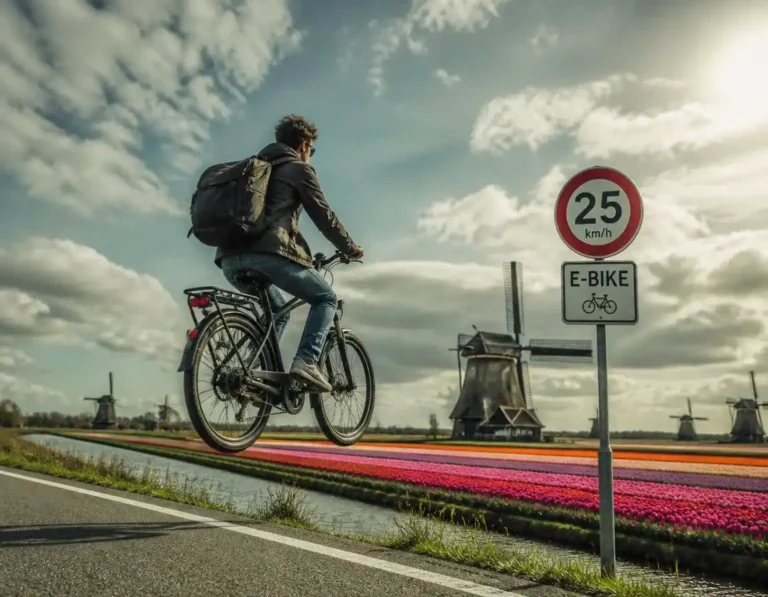
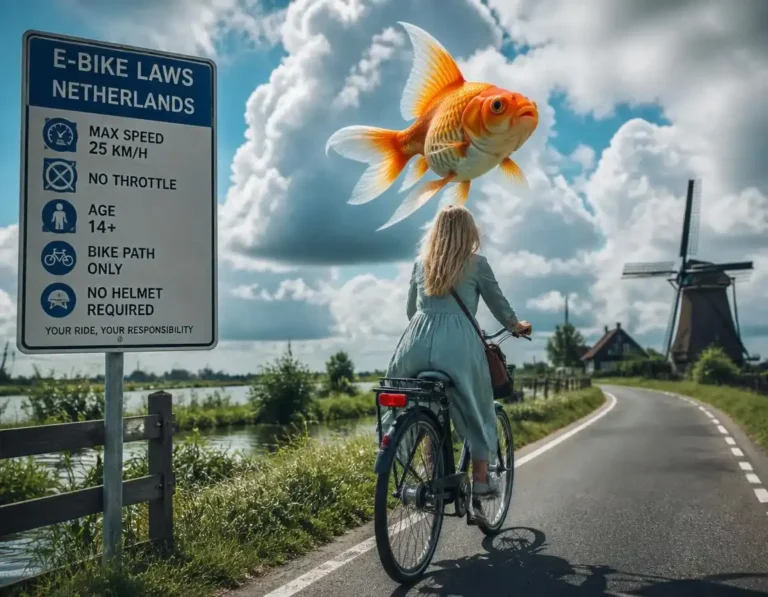
Dutch e-bike law fits on a beer mat. Your e-bike is legally a bicycle if the motor is 250 W continuous, assistance cuts off at 25 km/h, and any throttle works only as a 6 km/h walk assist. Meet those three and there is no helmet law, no licence, no number plate and no minimum age, as the Rijksoverheid e-bike rules page confirms. Break one and your bike is an unregistered moped: a €310–€320 fine, possible confiscation on a second stop, and no insurance cover if you crash.
| Rule | Legal e-bike / fatbike | Speed pedelec (45 km/h) | Tuned bike |
|---|---|---|---|
| Legal class | Bicycle | Moped | Unregistered moped (illegal) |
| Helmet | Not required | Mandatory (NTA 8776) | Moped rules apply |
| Licence / age | None / none | AM licence / 16+ | 16+, and still illegal as ridden |
| Plate & insurance | None / none | RDW registration + mandatory WA insurance | Required, and you will have neither |
Three 2026 developments are worth knowing before you choose, especially if you are eyeing a fatbike. Local bans have arrived. Enschede was the first, on 11 March 2026: riding a fatbike (an e-bike with tyres wider than 7 cm) in the pedestrian centre during shop opening hours costs €115. Amsterdam followed with the Vondelpark on 11 May 2026, and other cities are weighing similar rules. Both bans apply only to the wide-tyre look, which is why “skinnybike” models with slimmer tyres are suddenly popular. National rules are coming. The January 2026 coalition agreement promises a separate vehicle category for fatbikes, with a minimum age, a helmet duty and powers for municipalities to create fatbike-free zones; the timing is not fixed yet. A helmet mandate is on its way. The cabinet plans a helmet duty for all riders under 18 on e-bikes and fatbikes, with the bill expected in parliament in autumn 2026 and a target start of September 2027, per the cabinet’s helmet plan. If you are buying for a teenager, budget for a good helmet now. For the full picture, including the official speed pedelec rules, see our Dutch e-bike laws for 2026, the speed limit rules per class and our piece on whether you need a helmet.
Step 7: the checks that save you €500 (or the whole bike)
With 86,950 bicycle thefts reported in 2025, provenance checks are not paranoia. Before money changes hands, find the frame number (usually under the bottom bracket) and run it through the RDW stolen-bike register, free and covering reports since 01/01/2008. Then ask for the original receipt and check the name matches the seller’s ID.
On any used or refurbished bike, spend ten minutes on the battery, the only expensive part: ask for the charge-cycle count (500+ of a 500–1,000 cycle life means middle-aged), request a dealer diagnostic readout of its state of health, check the casing for dents or corrosion, and ride it on a full charge to watch how the bars hold up on a bridge. A missing original charger is a €100+ problem and a hint of rough ownership.
Then ride it for at least ten minutes, including a bridge with the assist off so you feel the true weight. Our test-ride checklist, saved on your phone, beats any sales pitch:
Buying from a shop also buys you a service address. If you are in the capital, our Amsterdam repair shop price guide shows what fair labour rates look like before you need them.
Day-one kit and the costs after the purchase
Budget €150–€300 on top of the bike itself. Insurers typically want an ART-approved lock, and for e-bikes many now ask for two: a frame lock plus an ART-rated chain or cable to a fixed object, around €70–€150 in total; our best e-bike lock roundup tests the ones worth buying. A tracker adds a second layer, from about €35 for a Bluetooth tag to €100–€150 for a 4G unit with motion alerts, compared in our GPS tracker buyer’s guide. Theft cover starts around €3 a month on a modest bike; our e-bike insurance guide explains what the small print demands. Racks, bags and a good rain jacket live in our accessories section.
FAQs about buying an electric bike in the Netherlands
How much should I budget for my first e-bike in the Netherlands in 2026?
For a reliable new mid-drive commuter from a known brand, budget €1,800–€2,700, which sits just below the 2025 national average of €2,872 across all e-bike types. Tighter budgets are workable: decent new hub-motor bikes start under €1,500, and a two-to-four-year-old used mid-drive typically costs €900–€1,600 if the battery checks out.
Is there a subsidy for e-bikes in the Netherlands in 2026?
There is no national purchase subsidy for private buyers. The real savings run through tax: the fiets van de zaak adds just 7% of the consumer price to your taxable income, employers may pay €0.25 per km tax-free on your own bike, self-employed riders deduct VAT and investment credits, and some municipalities still fund cargo bikes or Wmo adapted bikes.
Do I need a helmet, licence or insurance for an e-bike in the Netherlands?
Not for a legal e-bike (250 W, assist cutting at 25 km/h): no helmet, no licence, no plate, no mandatory insurance, at any age. A speed pedelec is a moped: NTA 8776 helmet, AM licence from age 16, RDW registration and WA insurance are all mandatory. A helmet rule for riders under 18 on ordinary e-bikes is targeted for September 2027.
Pick the type first, the battery second and the brand last, and you will end up with a bike that fits your commute instead of a showroom mood. And if a “bargain” assists past 25 km/h on the test ride, smile, shake hands, and walk away.