Can You Wash an E-Bike?

Can You Wash an E-Bike? The Safe-Wash Guide for Dutch Riders
The short version
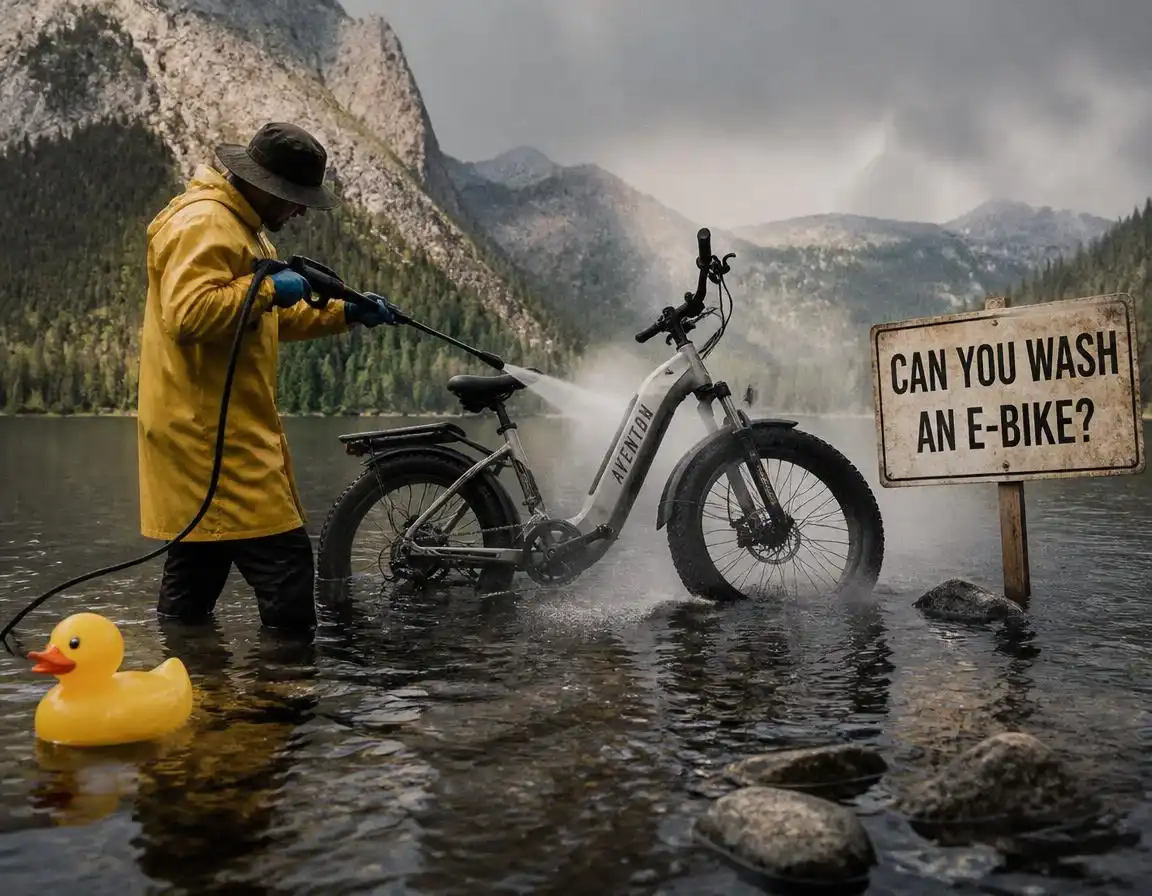
Yes, you can wash an e-bike: a bucket, a soft brush, plain water or bike shampoo, and a gentle hose rinse if you like. What you can’t do is point a pressure washer, steam cleaner or car-wash lance at it. Bosch and Shimano both warn against high-pressure cleaning, because forced water gets past motor seals, hub bearings and connectors, and the damage shows up weeks later as error codes and rusty bearings. Take the battery off, keep water away from the motor, hubs, charging port and display, dry the contacts, lube the chain and run a quick function check. That is the whole method. Below is exactly how we do it, plus what to do after a salty Dutch winter ride.
Can you wash an e-bike? The honest answer
Yes, you can. Rain, puddle spray, a canal-side splash or a bucket of soapy water: a decent e-bike shrugs all of it off. The ANWB counts an average of 192 rainy days a year in the Netherlands, and e-bike motors, batteries and displays are sealed at the factory precisely because the bike will live outside in that weather.
But there is a big difference between water-resistant and waterproof, and that difference is where washed e-bikes die. The water itself is rarely the problem. The problem is pressure (a jet forcing water past seals it was never meant to pass) and chemistry (aggressive degreasers and solvents attacking rubber seals and plastics). Get those two right and washing is one of the kindest things you can do for your bike: grit in the drivetrain wears chains and cassettes far faster than a clean one, and winter road salt quietly eats frames, bolts and contacts.
Everything below is the routine we use on Bosch, Shimano, Bafang and hub-motor bikes, and it lines up with what the makers publish. Bosch’s battery guide says never to clean the pack with a high-pressure cleaner or a direct water jet. Shimano’s STEPS manuals say not to use a high-pressure washer or thinners and harsh solvents. Bosch UK has told MBR that shampoos and care products that don’t attack plastics or seals are fine, and that the battery and a removable display should come off first.
Brands do differ on hoses. Giant and Specialized have been reported as accepting a gentle garden-hose rinse (Specialized with a warning to stay away from bearings and the chainring area), while Bosch and Shimano rule out high-pressure washing specifically. So your own manual is the final word; this guide is the safe middle path that satisfies all of them.
Why the pressure washer stays in the shed
This is the single most expensive mistake in e-bike cleaning. A household pressure washer delivers roughly 100 to 160 bar. E-bike seals are designed for rain and splashes, not for a concentrated jet at point-blank range. Point that jet at a hub, the headset, the bottom bracket or the motor casing and it pushes water, and fine grit with it, straight past the seals into the bearings. The bike rides fine for a week or two. Then the bearings start to grumble, contacts corrode, and error codes appear that no reset will clear.
Bosch UK’s advice, as reported by MBR, is that a jet wash can push water into the bearings. Shimano’s manuals simply say not to clean the bicycle in a high-pressure wash. Specialized adds that spraying too close to the bearings or the chainring area causes premature wear and can void the warranty. In other words, the damage is real, and it can also complicate a warranty claim.
Steam cleaners are no better: heat plus force is the same problem as a pressure jet, with hot moisture driven into places liquid water alone would not reach. And yes, that includes the brush lane at the car wash. The lance is a pressure washer, and the rotating brushes grind grit into paint and around seals.
Not to scale: a pressure washer runs at roughly 30 to 80 times the pressure of a shower hose, so the green and amber bars are drawn wider than they should be. E-bike seals cope comfortably with the green and amber zone. The red zone is where warranty arguments start.
Hose, bucket or jet? Which water method is safe
“Can you hose down an e-bike?” is the question we get most. The short answer is yes, as long as it is a hose and not a jet. Here is how each option stacks up.
| Method | Verdict | Why |
|---|---|---|
| Bucket, sponge, soft brush | ✅ Best | No pressure at all, and you control exactly where the water goes |
| Waterless bike-wash spray + microfibre cloth | ✅ Good for light dirt | Zero water near the electrics; dry-brush heavy mud off first |
| Garden hose, shower setting, about 1 m away | ✅ OK for rinsing | Fine for floating mud off the frame and wheels; keep it off the hubs, motor, cradle, port and display |
| Hose with trigger or jet nozzle, up close | ⚠️ Avoid | Concentrates force on seals; Specialized warns specifically against getting close to bearings and the chainring area |
| Cordless “bike washer” (many advertise roughly 3–9 bar) | ⚠️ Grey area | Far below a pressure washer but above a shower. We found no maker approval for e-bikes, so use the lowest setting, keep your distance and never aim at seals. A bucket is safer. |
| Household pressure washer (100–160 bar) | 🚫 Never | Bosch and Shimano both warn against high-pressure cleaning |
| Steam cleaner | 🚫 Never | Heat and force together stress seals and drive moisture inwards |
| Car wash (lance or brush lane) | 🚫 Never | A pressure washer plus grit-grinding brushes |
What your e-bike’s IP rating really means
Most electrical parts on an e-bike carry an IP (ingress protection) code from the manufacturer. It tells you what kind of water the part tolerates, and just as importantly, what it does not.
| Rating | Plain English | Where you see it |
|---|---|---|
| IPX4 / IP54 | Splashing water from any direction: rain, puddle spray, a damp cloth | Older Bosch Intuvia displays (IP54) and many other components |
| IPX5 / IP55 | Low-pressure water jets from a nozzle: heavy spray, not a pressure washer | Current Bosch Smart System displays such as Intuvia 100/200, Kiox 300 and Purion 200 (IP55) |
| IPX6 | Powerful jets: storm-and-wave territory | Some hub motors and batteries; check the spec sheet |
| IPX7 | Temporary immersion, up to 1 m for 30 minutes | A few batteries; never assume yours is one |
Three caveats worth remembering. First, the rating applies to the component, not to the whole bike: your frame bearings, charging port and connector plugs have no such rating at all. Second, a rating describes riding in the wet, not cleaning. Shimano’s manuals call the STEPS components fully waterproofed for wet-weather riding and, in the same breath, forbid high-pressure washing. Third, a pressure washer or steam cleaner would need an IPX9-class seal, which no mainstream e-bike component claims. When in doubt, your manual beats any internet table, including this one.
The kit you need (and what it costs)
You don’t need a workshop. A kitchen-sink kit does the job, and most of it already sits on the shelves of Dutch supermarkets, DIY stores and bike shops. Browse our accessories and spare parts pages for care products and genuine replacements.
| Item | Why you need it | Typical price (NL, 2026, indicative) |
|---|---|---|
| Bucket | The only “pressure” an e-bike ever needs | €4–€8 |
| Soft brush set + sponge | Soft bristles lift grit without scratching paint or seals | €8–€15 |
| Bike shampoo (or mild dish soap) | Cleans without attacking plastics, rubber seals or paint | €8–€12 |
| 2–3 microfibre cloths | Drying is half the job; one cloth for the bike, one for contacts | €8–€12 |
| Chain degreaser | For the chain and cassette only, kept far away from motor and brakes | €8–€12 |
| Wet-weather chain lube | The Dutch climate is a wet climate; dry lube washes off in one shower | €8–€12 |
| Technical Vaseline | A thin film on battery contacts keeps corrosion away (Bosch’s own tip) | €3–€6 |
| Hose with shower nozzle (optional) | Gentle rinse from a metre away; never a jet setting | €15–€30 |
All in: roughly €50 to €80 once, without the optional hose, and it lasts seasons. Skip strong all-purpose degreasers and car shampoos with wax or citrus solvents. Bosch warns that strong cleaning agents can affect the surface of the battery, and Shimano says no thinners or harsh solvents on its components.
Shopping in Dutch: the words you need
| Dutch | English | Where you will see it |
|---|---|---|
| elektrische fiets schoonmaken | cleaning an e-bike | Search terms and how-to guides |
| hogedrukspuit, hogedrukreiniger | pressure washer | The thing to leave in the shed |
| fietsshampoo, kettingreiniger | bike shampoo, chain degreaser | Bike shops, Decathlon, DIY stores |
| kettingolie (nat = wet-weather) | chain lube | Pick the wet-weather version for NL |
| technische vaseline | technical Vaseline | Pharmacies and DIY stores |
| accu, strooizout | battery, road salt | Manuals and winter care advice |
How to wash an e-bike, step by step
Plan for 25 to 35 minutes, in shade rather than full sun (soap dries into spots on hot paint), with the bike upright on its kickstand or in a stand, never upside down, because water then drains towards parts that expect to shed it the other way. Short on time? A 10-minute version is in the frequency table below.
1Power down and strip the electrics
Switch the system off and unplug the charger; never wash a bike that is charging. Remove the battery and, if yours comes off, the display. That is Bosch’s guidance, and a fixed display gets covered with cling film or a cloth. Some makers, including Shimano and Giant, describe their batteries as waterproof for normal use, so check your manual, but treat the cradle and charging port as no-water zones either way. Wipe the port area with a dry cloth and close any rubber cap. Keep the battery somewhere dry at room temperature while you work; our guide on how to charge an e-bike battery correctly covers the storage rules in full.
2Knock off the loose grit
Rinse gently: a bucket poured from the top of the frame down, or a hose on its softest shower setting held about a metre away. You are floating mud off, not blasting it. Keep the flow away from hubs, headset, motor, cradle and port.
3Wash the frame and running gear
Bucket of lukewarm water with bike shampoo (or a few drops of mild dish soap). Soft sponge or brush over frame, fork, mudguards, tyres, saddle and rack. Work top to bottom, and rinse your sponge often so you are not rubbing collected grit around the paint.
4Degrease the drivetrain, and only the drivetrain
Apply degreaser to the chain, cassette and chainring with a stiff brush. If the cranks turn backwards freely, use that to work it in; on drive systems where they don’t, a chain scrubber tool does the job. Two strict borders: no degreaser on the motor casing or its seals, and none anywhere near the disc brake rotors and pads, because contaminated brakes squeal for weeks.
5Rinse gently again
Clean water from the bucket or the shower-setting hose until the suds and degreaser are gone. Resist the urge to “finish off” with the jet setting; this is the moment most damage happens.
6Dry properly, contacts first
Microfibre cloth over the whole bike, then a dry cloth into the battery cradle, around the contacts and over the charging port. Add a whisper-thin film of technical Vaseline to the contacts. Leave the bike standing for 15 to 30 minutes so hidden water drips out before the battery goes back in. Clean the battery itself only with a well-wrung damp cloth; both Shimano and Bosch say no direct water on the pack.
7Lube, refit and run the function check
Once everything is dry: a drop of wet lube per chain link, with the excess wiped off after a minute so it doesn’t collect grit, and kept off the brake disc. Refit the battery until it clicks and locks. Then check that the battery and display are seated correctly, press the buttons and confirm assist kicks in before you ride off. While you are down there, glance at tyre wear and cuts; our e-bike tyre replacement guide shows what to look for.
Part by part: the five zones that need a different approach
Motor
Sealed and splash-happy, but not jet-proof. Wipe the casing with a damp cloth, brush mud out of the cooling fins with a dry or damp brush, and keep degreasers and jets off the axle seals. A mid-drive motor that starts clicking or cutting out after a wash is usually telling you water got past a seal. That is a dealer job, not a home one.
Battery
Damp, well-wrung cloth on the case; dry cloth on the contacts; a thin film of technical Vaseline on the contacts if you ride year-round. Never jet-wash the pack: forced water around the seam is one of the classic battery killers in our piece on how long an e-bike battery actually lasts. A pack that has been soaked (canal incident, flooded underpass, pressure washer) does not go back on the bike or on the charger until a dealer has checked it. If the worst happens, our breakdown of e-bike battery replacement costs in the Netherlands has the 2026 prices: about €420–€830 list price for popular 500–750 Wh Bosch and Shimano packs, with the Consumentenbond quoting €250–€900 for new packs overall. That is precisely the invoice this whole article is trying to prevent.
Charging port and charger
Cap closed during the wash, port dried afterwards, and charging only once everything is dry. The charger brick itself must stay completely dry, and Shimano’s manuals warn against inserting or removing the plug while it is wet. If yours took a dunk, don’t dry it and hope: genuine replacements cost about €65–€130 for most systems, which is cheap insurance next to a cooked battery. Our charger replacement guide explains how to match the model code and avoid unsafe lookalikes.
Display and controls
Removable displays come off and get a damp cloth, with attention to the contact pins on the back. Fixed units stay on the bike under their cover during the wash, then get wiped and dried around the buttons. Giant has told MBR that most of the error codes it sees trace back to water between the display and its bracket, so dry that joint properly. Sticky, damp buttons are another classic cause of “stuck control” codes.
Brakes and bearings
Rotors and pads get clean water or nothing at all; soap film on a rotor means noise and faded braking. Hubs, headset and bottom bracket get no direct water, ever. They are the parts a pressure washer kills first, and the first things a workshop checks when a bike arrives with grumbling wheels.
Wash tweaks by bike type
The method above works for every e-bike, but each type has one thing worth adjusting.
| Bike type | What to adjust |
|---|---|
| City, hybrid & trekking | Most grime sits on the chain, cassette and underside of the mudguards. Dry the chaincase edges and light connectors, then re-lube. |
| Mountain e-bikes (eMTB) | Wash the same day: dried mud and sand act like sandpaper on the drivetrain. Keep water away from pivots, shock seals and the chainring area. |
| Cargo bikes (bakfiets) | Use less water where it is hard to dry, take the battery off and dry the contacts on both pack and holder, and check battery and display after reconnecting. Wash the box and rain tent separately. |
| Fatbikes | Rinse sand and beach salt out of the drivetrain after dune or beach rides, and dry the hub-motor cable exit. Where you may ride one is a separate question: see our fatbike rules for 2026. |
| Folding e-bikes | Rinse and dry the hinges and latches, then check they close fully before you fold and carry the bike indoors. |
| Speed pedelecs | Same wash rules, plus keep the yellow moped plate clean and readable. Registration runs through the RDW, and our speed pedelec rules guide covers plate, helmet and licence in full. |
How often should you wash an e-bike?
Bosch UK’s answer, as reported by MBR, is a wash soon after each ride so dirt doesn’t become ingrained, and they are not wrong that fresh dirt is easy dirt. Real life looks more like this:
| Your riding | Quick wipe-down | Full wash |
|---|---|---|
| Daily city commute, dry months | Weekly, 2 minutes with a damp cloth | Monthly |
| All-weather commute or cargo school run | After every salty or muddy ride | Every 2–3 weeks |
| Off-road / e-MTB weekends | — | After every muddy ride, same day |
| Winter rider (Nov–Feb) | Weekly salt rinse, gentle, then dry | Monthly plus extra chain lube |
| Fair-weather weekend rider | After bug or pollen rides | Every 4–6 weeks |
The 10-minute version: remove the battery, wipe the frame with a damp cloth, brush the chain and cassette, dry the contacts, lube the chain and run the function check. Wipe and lube the chain at least monthly in the wet season. Washing is not a service, though: Dutch dealers publish a yearly or 2,500 km interval, and our Amsterdam repair guide shows what a service costs (€60–€135, with €90 typical, excluding parts).
Dutch winter: salt is the real enemy
Winter flips the risk around. Water is still something to respect, but road salt is actively corrosive: the ANWB warns that strooizout is bad for your bike, and it sits on frames, bolts, chains and contacts and quietly oxidises them all season. Our routine from November to February:
- Rinse, don’t scrub, after salty rides. A gentle lukewarm rinse (or a thorough damp-cloth wipe if you are short on time) gets the salt off before it bites. Motor maker Mivice gives the same advice, with the same warning: never a high-pressure cleaner. Salt particles stick everywhere, even if you didn’t ride through a single puddle.
- Dry the contact zones. Battery cradle, port, bolts around the motor: a dry cloth after every wet ride prevents the white crust of corrosion. A thin film of technical Vaseline or a corrosion-protective contact spray helps on bikes that live in an unheated shed.
- Lube more often. A wet winter week can strip a chain in days; lube after every rinse-and-dry.
- Warm the battery before it meets the charger. After a freezing ride, bring the pack indoors and let it reach room temperature before charging.
- Parking the bike for weeks? Clean and lightly lube it first, take the battery and display inside, and store the pack at 30–60% charge in a dry room (Bosch allows 0–20 °C, or 10–20 °C where the air is damp). Same numbers as in our charging and storage guide.
If water got in anyway: e-bike won’t behave after a wash
Sometimes you buy a bike second-hand with a pressure-washer past (our second-hand e-bike buying guide has the checks), or a flooded street does what a wash shouldn’t. If the bike acts dead or throws error codes after getting wet, the order matters more than anything else:
- Don’t switch it on and don’t plug it in. Powering a wet system turns small damage into total damage.
- Remove the battery and dry the case and cradle contacts with a clean, dry cloth.
- Give it 24 to 48 hours somewhere warm and dry. Not on a radiator, not with a hair dryer: fast heat drives moisture deeper and stresses seals.
- Inspect the contacts for white or green crust, brush it off dry, and protect them with a thin film of technical Vaseline.
- Only then refit, switch on and test. If error codes survive a clean restart, or the bike was fully submerged, or the pack shows swelling or smell: stop, and hand it over. Our step-by-step troubleshooting guide walks you through the codes and checks, and our roundup of e-bike repair shops in Amsterdam lists workshops that diagnose properly instead of guessing.
Swollen, smoking or too hot to touch? Don’t ride it, charge it or keep it indoors. Move it somewhere safe away from buildings and, in an emergency, call 112. A soaked or damaged pack never goes in the household bin: hand it in at a bike shop (ideally a Wecycle collection point) or your municipal milieustraat.
For context on the stakes: a shop diagnostic in the Netherlands typically costs €20–€50, a controller replacement €120–€450, and a new branded battery €420–€830. A bucket costs €6. The maths is not subtle.
FAQs
Can I wash my e-bike with a pressure washer or in a car wash?
No. A household pressure washer delivers roughly 100–160 bar, which forces water past motor seals, hub and headset bearings and into connectors, and the damage usually surfaces weeks later as corrosion and error codes. Bosch and Shimano both say not to clean with high pressure. Car-wash lances and brush lanes combine that jet with grit-grinding brushes, and steam cleaners add heat, so those are out too. A bucket, a soft brush and a gentle hose on its shower setting clean an e-bike perfectly well.
Can I use a hose on my e-bike?
Yes, gently. Use the shower or mist setting from about a metre away, aim at the frame and wheels rather than the motor, hubs, headset, battery cradle, charging port and display, and never use a jet or trigger setting up close. Brands differ on hoses: Giant and Specialized have been reported as accepting a low-pressure rinse, while Bosch and Shimano only rule out high-pressure washing. When in doubt, follow your own manual.
How often should I wash an e-bike?
For a daily city commute, a two-minute damp wipe weekly and a full wash monthly keeps everything happy. All-weather and cargo riders should wash every two to three weeks and rinse salt off after winter rides; off-road riders wash after every muddy ride. The rule behind the rules: fresh dirt is easy dirt, and grit left in a chain wears drivetrain parts far faster than any washing ever will.
Should I remove the battery before washing my e-bike?
Yes, if it comes off. Bosch advises removing the battery (and the display, if removable) before cleaning, and wiping the pack with a damp cloth rather than any water jet. Shimano and Giant describe their systems as waterproof for normal riding, so check your manual, but the cradle and charging port stay no-water zones either way. Dry the contacts, add a thin film of technical Vaseline, and never wash a bike while the battery is charging.
My e-bike got soaked in rain or a flooded street. Can I ride and charge it?
Rain and puddle spray are fine; e-bike electrics are sealed for exactly that. A proper soaking is different: don’t switch on or charge until it’s dry. Remove the battery, dry the case and cradle contacts, let the bike stand 24 to 48 hours at room temperature (never on a radiator), then check the contacts for corrosion before refitting. If the bike was fully submerged, or the pack is swollen or smells hot, keep it off the bike and out of the house and let a dealer or collection point handle it.
Sources and checks
Checked on 16 October 2026. Prices and ranges are typical Dutch figures and match our other guides; always ask for a written quote before paying for repairs.
- Bosch eBike Systems, 12 questions about your eBike battery (cleaning, storage 30–60%, 0–20 °C)
- Shimano, STEPS battery mount user’s manual (no high-pressure washing, no thinners or harsh solvents)
- MBR, How to clean your e-bike (without screwing up the electrics) (Bosch UK, Shimano, Giant and Specialized guidance)
- ANWB, Onderhoudstips per seizoen (192 rainy days a year, road salt)
- ID.nl, E-bike schoonmaken and je bakfiets schoonmaken
- Bike Magazin, Does road salt damage your bike? (Mivice: lukewarm rinse, no high-pressure cleaner)
- Upway, Is an e-bike display rainproof? (Bosch display IP ratings)
- Rijksoverheid, Regels voor speedpedelecs, and RDW, Elektrische fiets of speed pedelec