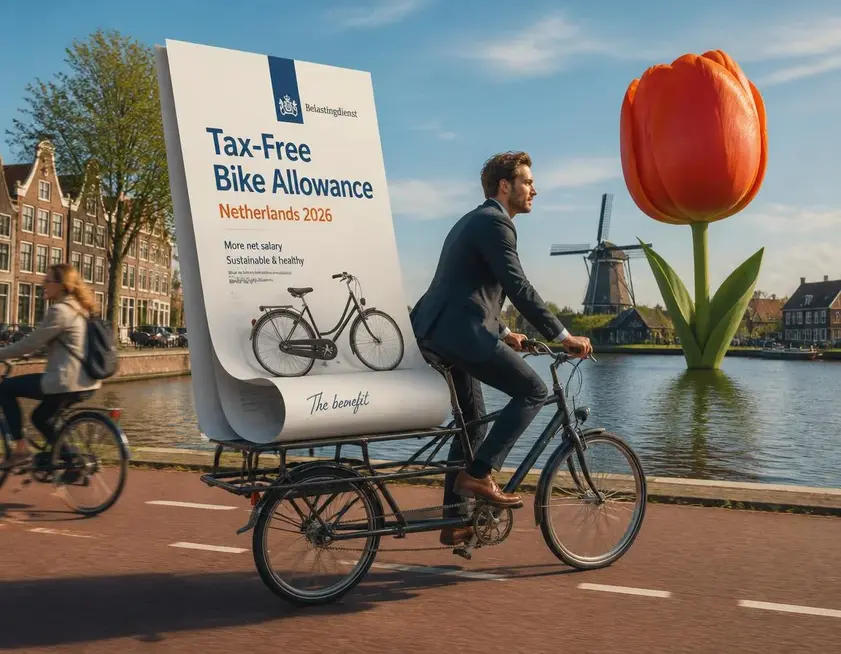
Tax-Free Bike Allowance Netherlands 2026

Tax-Free Bike Allowance Netherlands 2026 (Fietsvergoeding): What You Can Actually Get
The short version
Cycling to work on your own bike or e-bike? Your employer may pay up to €0.25 per kilometre tax-free in 2026, raised from €0.23 in mid-2026 and retroactive to 1 January. It is a ceiling, not a right: your contract or CAO decides what you get. Inside a company bike scheme (fietsplan) that allowance stops for that bike and you pay 7% bijtelling instead. Below: the yearly amounts by commute, the double-dip rule, five questions to ask HR and what self-employed riders can deduct.
Let us start with a confession: “tax-free bike allowance” is not one official thing in the Netherlands. People use the phrase for three different pots of money, and mixing them up is how you end up with wrong numbers in your head, or worse, in a payslip dispute. There is the tax-free kilometre reimbursement (fietsvergoeding) your employer can pay when you cycle to work on your own bike. There is the tax advantage baked into the company bike scheme, the fietsplan or fiets van de zaak. And there is the myth of a government cycle allowance that pays you per kilometre: that one is Belgian, not Dutch, and we come back to it below. Here is what actually exists in 2026, with the current figures and the maths for your own commute.
What counts as a tax-free bike allowance in 2026
The official version is the tax-free travel allowance, the reiskostenvergoeding, also called kilometervergoeding. Your employer may reimburse commuting and business kilometres up to €0.25 per kilometre without you paying a cent of tax on it. The vehicle makes no difference: a regular bike, an e-bike, a speed pedelec, a scooter, a car and walking all share the same ceiling. Cycle, and everyone calls it the bike allowance. The 2026 ceiling is confirmed by Rijksoverheid’s kilometre allowance Q&A and by the Belastingdienst’s fietsplan page, which states that commuting counts as business kilometres.
The 2026 change: €0.23 became €0.25
Through 2024 and 2025 the ceiling sat at €0.23. In mid-2026 the cabinet raised it to €0.25 by policy decision (beleidsbesluit), ahead of the Belastingplan 2027 and to support employees’ purchasing power, with retroactive effect from 1 January 2026. Official pages date the announcement slightly differently, between late May and 1 July, so employers updated at different moments. What matters for you: the tax-free ceiling for the whole of 2026 is €0.25 per kilometre. If you were paid €0.23 from January, your employer may pay the €0.02 difference tax-free with a later payslip, as the Belastingdienst explains for employers, but there is no obligation. At 10 km each way (4,400 km a year) that catch-up is worth up to €88 for 2026.
- 2023€0.21per km, up from €0.19 in 2022
- 2024€0.23+€0.02
- 2025€0.23unchanged
- 2026€0.25mid-year decision, retroactive to 01/01/2026
Maximum tax-free kilometre allowance in the Netherlands, 2023 to 2026.
A ceiling, not a right
This is the part most guides skip. Nobody is entitled to €0.25 per km. The rate is the maximum your employer may pay tax-free; whether you get anything at all, and how much, lives in your employment contract or CAO (collective labour agreement). Some employers pay the full rate, some pay €0.15, some pay a flat €30 a month, and some pay nothing and point at your gross salary. Check your contract before you budget around this money.
Four more mechanics worth knowing:
- Above €0.25 it is taxed. If your employer pays more per kilometre, the part above €0.25 counts as wages and is taxed.
- You cannot claim it yourself. Employees cannot deduct commuting costs on their own tax return. The Belastingdienst says so explicitly; the only route is a tax-free reimbursement from your employer.
- Business trips count too, not just home-to-work kilometres.
- A fixed monthly amount is allowed instead of counting kilometres, but it has to match your real travel days. A flat sum for days you work from home is not tax-free, which matters if you are hybrid.
How much you can receive tax-free, by commute
The formula is simple: one-way kilometres × 2 × travel days × €0.25. We use 220 travel days a year for a full-time worker, which is five days a week over about 44 working weeks after holidays and leave. Your employer’s payroll may use a different number, so treat the table as a planning tool. The right-hand column shows a hybrid week of three days, or 132 days a year.
| Commute (one way) | Km per year (220 days) | Tax-free at €0.25/km (220 days) | Per month (÷12) | Hybrid: 3 days a week (132 days) |
|---|---|---|---|---|
| 3 km | 1,320 | €330 | €27.50 | €198 |
| 5 km | 2,200 | €550 | €45.83 | €330 |
| 7.5 km | 3,300 | €825 | €68.75 | €495 |
| 10 km | 4,400 | €1,100 | €91.67 | €660 |
| 15 km | 6,600 | €1,650 | €137.50 | €990 |
Annual tax-free bike allowance in the Netherlands in 2026, at €0.25 per kilometre. Maximum amounts: your employer decides what is actually paid.
The point is not the exact number, it is the order of magnitude. On a normal Dutch commute, the tax-free allowance covers a serious slice of an e-bike’s running costs, and sometimes the whole purchase, spread over a few years. Our guide to what an e-bike costs in the Netherlands is the other half of that calculation: a reliable commuter e-bike typically costs €1,800 to €2,700.
And yes, this is the allowance that makes a cheaper e-bike almost self-funding. If the budget is tight, start with our picks of the best budget e-bikes under €1,500: at 7.5 km each way and the full €825 a year, one of those pays itself off in about two years. Buying second-hand instead? Our second-hand e-bike buying guide covers what to check.
The double-dip rule: allowance or company bike, not both
Here is the trap that catches people mid-scheme. Once your employer gives you a company bike under a fietsplan, they may no longer pay you a tax-free kilometre allowance for the business kilometres you ride on that bike, and commuting counts as business kilometres. The Belastingdienst’s fietsplan page is explicit about this. Allowances for days you come in by train or car can continue; the cycling kilometres on the company bike are covered by the 7% bijtelling deal instead.
The same logic blocks a second combination: a tax-free purchase reimbursement on top of a company bike, for the same bicycle. The tax office reads that as double-dipping, and it wins that argument every time.
Why this matters more than people think: on a 10 km commute, the allowance you give up is worth up to €1,100 a year. That is often more than the entire tax advantage of the scheme. Run both sides before you sign anything. We do that comparison with full numbers in our company e-bike scheme guide and our e-bike lease guide for employees.
Company bike vs kilometre allowance: which leaves you better off?
The quick version: the longer your commute and the more your employer pays per kilometre, the better your own bike plus the allowance looks. The shorter your commute, or the stingier your employer, the better the company bike looks. In our worked example from the company scheme guide (a €2,500 e-bike on an €80-a-month gross lease against roughly €90 a month for buying privately, insurance and servicing included, 220 travel days), the crossover sits at about 4 km each way in the middle tax bracket: roughly 3.6 km at 35.75% and 4.6 km at 49.50%.
| Own bike + tax-free allowance | Company bike (fietsplan) | |
|---|---|---|
| Who owns the bike | You | Employer or lease company |
| Upfront cost | Full price (€1,800–€2,700 for a reliable commuter e-bike; sound budget models from about €1,500) | Nothing, or a small deposit |
| Tax treatment | Nothing on the allowance up to €0.25/km | 7% of the price added to taxable pay each year |
| Tax-free km allowance on this bike | Yes, that is the whole point | No, stopped by the double-dip rule |
| Monthly cost (€2,500 e-bike, our example) | About €90 a month incl. insurance and servicing, minus any allowance you receive | About €48–€57 a month net, service and theft cover included |
| Service & theft insurance | Your invoice, your problem | Usually bundled in the lease fee |
| Changing jobs | Nothing happens | Lease needs transfer, buy-out or return |
| Usually best for | Commutes of roughly 4 km+ with an employer paying the full rate | Short commutes, or employers paying no or a low allowance |
The two tax-free routes side by side, 2026 rules.
Neither option is wrong. Own bike plus allowance means ownership and freedom. The company bike means one net amount a month with the worry outsourced. If your employer offers both a scheme and a full allowance, do the two-column maths on your own kilometres: that single calculation is the whole game. New to the country and still mapping the bike landscape? Our best e-bike for expats guide and our overview of buying an electric bike in the Netherlands pair well with this page.
The 7% bijtelling, in one table
If the company bike wins, this is the only tax you will meet: each year, 7% of the bike’s recommended consumer price (including VAT) is added to your taxable salary, and you pay income tax on that slice. No logbook, no commute requirement, unlimited private use. A second company bike carries its own 7%. Genuine shared or hub bikes that stand at your home no more than about 10% of the time carry no bijtelling at all, a rule confirmed for 2026.
| E-bike consumer price | Bijtelling (7%/year) | Net at 35.75% | Net at 37.56% | Net at 49.50% |
|---|---|---|---|---|
| €1,500 | €105/year | €3.13/month | €3.29/month | €4.33/month |
| €2,500 | €175/year | €5.21/month | €5.48/month | €7.22/month |
| €3,500 | €245/year | €7.30/month | €7.67/month | €10.11/month |
| €5,000 | €350/year | €10.43/month | €10.96/month | €14.44/month |
Tax on the bijtelling only, by bike price and 2026 box 1 bracket (35.75% up to €38,883, 37.56% up to €78,426, 49.50% above). The lease fee itself is separate.
Read the right-hand columns as the price of a very good deal: even a €5,000 electric cargo bike costs you under €15 a month in tax. The bigger money sits in how the lease fee itself is paid, gross or net, and that is the next section. One practical note from the contract small print: most all-in leases require a serious lock, and insurers are picky about approvals. These are the ART-approved locks Dutch thieves actually respect.
Three employer tricks that make it cheaper still
1. The WKR route: a €0 bike
The werkkostenregeling (WKR) gives every employer a tax-free staff-budget pot: in 2026, 2.00% of the payroll sum up to €400,000, and 1.18% above it. An employer can park the bike’s bijtelling, or in some constructions the whole bike, in that free space as final-levy wage (eindheffingsloon), and then the bike costs you precisely nothing. Smaller companies with room in the pot do this; run out of space and the excess costs the employer 80% in end levy, which is exactly why not everyone offers it. The Belastingdienst’s WKR page has the official mechanics.
2. Gross-net salary exchange
You swap gross salary for the bike, so the money never meets income tax. On a €2,500 e-bike the saving is roughly €894 at the 35.75% rate, €939 at 37.56% and €1,238 at 49.50%, leaving a net cost of about €1,260 to €1,610 for a bike you own outright from day one. The catch: in most constructions the full bike price then uses your employer’s WKR free space, so payroll has to be enthusiastic too.
3. The interest-free loan
The quiet favourite. Your employer lends you the purchase price, interest-free and tax-free, you buy your own e-bike and keep ownership, and you repay the loan from your tax-free kilometre allowance. The Belastingdienst’s own example: a €2,500 loan, 20 km a day (round trip) at €0.25 per km is €5.00 a day, or €100 a month over 20 working days, so the loan is repaid in 25 months. On our 220-day, 10 km-each-way maths it takes about two and a quarter years. After that the allowance is pure profit. Business.gov.nl lists this among the five official company-bicycle constructions, which makes it an easy one to raise with HR.
Self-employed? Your “allowance” is a deduction
ZZP’ers do not get an allowance; they get a choice between two routes, and you pick one per bike.
Route 1: your private bike, used for business. For business trips on your own bicycle or e-bike you may deduct €0.25 per kilometre from your profit in 2026 (2025: €0.23). That flat rate covers all costs: the Belastingdienst’s 2026 page says you may not deduct insurance, repairs or other costs separately on top of it.
Route 2: a business-owned bike. Buy the bike through your business and it becomes an asset. You depreciate the purchase (up to 20% a year), deduct insurance, repairs and accessories, reclaim the VAT with a correction for private use, and add the familiar 7% bijtelling to your profit only if you also ride privately. Because you deduct the real costs here, you do not also claim €0.25 per kilometre for that bike: that would count the same costs twice.
Investment deductions stack on top of route 2. The KIA applies once your yearly investments pass €2,900, with a 28% deduction on investments between €2,901 and €71,683 (Belastingdienst KIA table 2026), and qualifying electric cargo bikes sit on the 2026 Milieulijst for MIA. Check the exact conditions there before you order, and run the mix past your accountant. We keep the full walkthrough, with a worked cargo-bike example, in our e-bike subsidy and incentives overview. If a cargo bike is on your shortlist, start with our 2026 cargo e-bike comparison.
Five questions to ask HR before you sign
Most bike-allowance surprises come from a question nobody asked. Put these to payroll or HR, ideally in writing:
- Do we pay a cycling allowance at all, and at what rate? Full €0.25, a lower rate or a flat monthly sum? Where is it written: contract, CAO or staff handbook?
- Has the 2026 rate been raised to €0.25 with retroactive effect? If you were paid €0.23 from January, ask whether the €0.02 catch-up is coming. Employers may pay it, but do not have to.
- How is it calculated if I work from home some days? Actual kilometres per travel day, or a fixed amount, and what happens in weeks you do not commute?
- If I join the fietsplan, from which payslip does my cycling allowance stop? And does it continue on days I travel by train or car? Ask to see the net effect on a payslip before you sign.
- Is the bijtelling covered by the WKR free space? If yes, the bike costs you €0 in tax. Also ask what happens to the lease if you change jobs or take unpaid leave.
Dutch terms you will meet in your contract and on your payslip
| Dutch term | What it means |
|---|---|
| Fietsvergoeding / kilometervergoeding | Per-kilometre allowance for cycling; up to €0.25 tax-free in 2026 |
| Reiskostenvergoeding | The general travel allowance, for any means of transport |
| Onbelast / gericht vrijgesteld | The tax-free part of an allowance |
| Fietsplan / leasefiets / fiets van de zaak | Company bike scheme; stops the cycling allowance on that bike |
| Bijtelling | The 7% of the bike’s price added to your taxable pay each year |
| Vrije ruimte (WKR) | The employer’s tax-free budget for perks, which can make the bike €0 |
| Eigen bijdrage | Your own contribution for private use; it reduces the bijtelling, never below zero |
Pitfalls we see every year
- Budgeting an allowance you were never promised. The €0.25 is a tax ceiling, not a right. Your contract or CAO decides what you actually receive.
- Being confused by a mid-2026 payslip correction. The rise from €0.23 to €0.25 was retroactive. If your employer applied it, expect a catch-up of €0.02 per kilometre: up to €88 for a full year at 4,400 km. That is money in, not a mistake. If your employer did not, you are not owed it automatically.
- Quoting Belgian numbers. The “€0.37 per km bike allowance 2026” you will meet online is Belgium’s tax-free bicycle allowance, which comes with an annual cap of roughly €3,700. The Dutch ceiling is €0.25.
- Forgetting the double-dip rule mid-year. Switch into a fietsplan in September and payroll must stop your cycling allowance from that point. Ask them to show the net effect before you sign.
- Assuming a speed pedelec is taxed differently. For the bijtelling it is just a bike. On the road it is a moped with a licence plate, insurance, an AM licence (or a car licence) and helmet duty. Our speed pedelec rules piece keeps those lines straight.
- Ignoring the theft maths. Neither an allowance nor a scheme replaces cover, and e-bike theft in the Netherlands is common enough to insure against. Our e-bike insurance guide prices the options.
Line up the allowance, the scheme and the insurance, and the Dutch system quietly pays for a shocking amount of your riding. That is the whole trick: there is no big national grant, just a stack of small, legal, well-designed rules, and now you know exactly where they sit. For the full stack, including municipal cargo-bike pots and the Wmo route for medical needs, see our subsidy overview, check the wider rules & regulations hub, and glance at the live deals page before you commit to anything.
FAQs
How much tax-free bike allowance can I get in the Netherlands in 2026?
Up to €0.25 per kilometre for commuting and business trips on your own bike or e-bike, but only if your employer chooses to pay it. The rate is a tax ceiling, not a legal right: your employment contract or CAO decides the actual amount. At 220 travel days a year, a 10 km one-way commute is worth up to €1,100 tax-free in 2026.
Does my employer have to pay me €0.25 per km for cycling to work?
No. €0.25 per km is the maximum an employer may pay tax-free, not a minimum. Whether you get it, and how much, depends on your employment contract, your CAO or company policy. Anything above €0.25 per km is taxed as wages, and you cannot deduct commuting costs on your own tax return instead.
Does the €0.25 per km allowance apply to e-bikes and speed pedelecs?
Yes. The ceiling is the same for every means of transport: bicycle, e-bike, speed pedelec, scooter, car or on foot. An e-bike commute earns the same tax-free rate as a regular bike. It only covers your own bike, not kilometres ridden on a company bike inside a fietsplan.
When did the Dutch bike allowance rise to €0.25, and was it retroactive?
The cabinet raised the tax-free kilometre allowance from €0.23 to €0.25 in mid-2026 through a policy decision ahead of the Belastingplan 2027, with retroactive effect from 1 January 2026. Employers may pay the €0.02 difference per km tax-free for kilometres already paid at €0.23, but they are not obliged to.
Can I combine a company e-bike with the tax-free kilometre allowance?
Not for the kilometres you ride on the company bike. Inside a fietsplan (company bike scheme) your employer may not pay a tax-free cycling allowance for that bike, because the 7% bijtelling already covers its use. Allowances for days you travel by train or car can continue, and an interest-free employer loan repaid from the allowance on your own bike is a separate, allowed construction.
Is there a government bike allowance I can apply for myself in 2026?
No. The Netherlands has no national consumer cycle allowance or e-bike grant in 2026, and employees cannot deduct commuting costs on their own tax return. The per-kilometre money always runs through an employer, and the self-employed version is a tax deduction of €0.25 per business kilometre, not a payout. The €0.37 per km figure circulating online is the Belgian bicycle allowance. Local exceptions exist for businesses and medical needs through municipalities and the Wmo.
Figures checked on 27/10/2026 against Rijksoverheid, the Belastingdienst, Business.gov.nl and RVO. This is general information, not personal tax advice: check your own situation with your employer’s payroll or the Belastingdienst.