E-Bike Subsidy Netherlands 2026

E-Bike Subsidy Netherlands 2026: What You Can Actually Claim
The short version
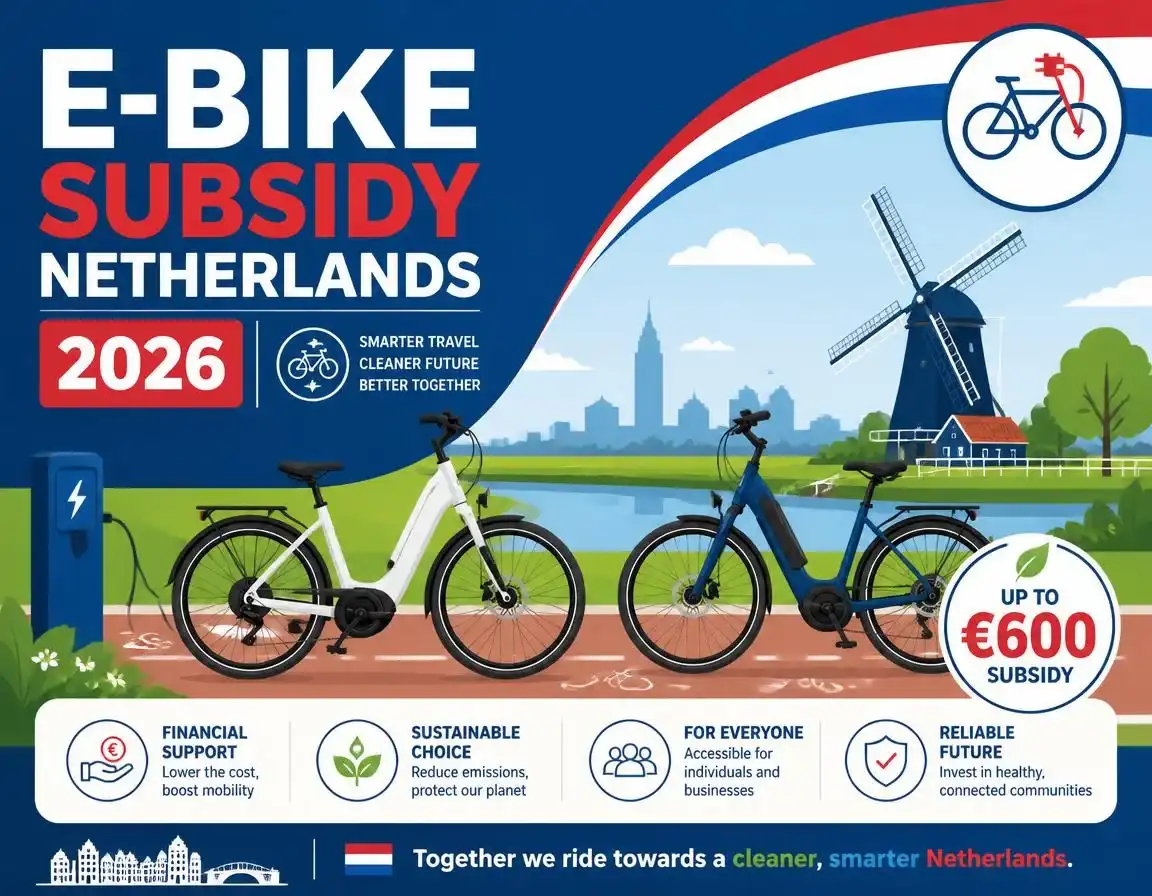
There is no national e-bike subsidy in the Netherlands in 2026. No pot of money, no application form. What exists is better than most people think: the fiets van de zaak cuts a €2,000 e-bike to about €4–€5 a month in tax, self-employed riders stack VAT, KIA and MIA deductions, and some municipalities chip in for cargo bikes or medical needs. Below, we walk through every legal route to pay less, with real 2026 numbers.
The honest answer: there is no national e-bike subsidy in 2026
Let’s get the disappointing part out of the way first, because you deserve a straight answer. In 2026 the Netherlands has no national purchase subsidy for e-bikes. There is no application form, no national pot, no rebate at the till. Not for a 25 km/h city e-bike, not for a speed pedelec, and not for a private electric cargo bike.
If a webshop tells you otherwise — usually with a banner promising “€300 to €750 for Dutch residents” — read the small print. In our experience those claims are recycled from French, Italian or Spanish schemes, or from local pilots that ended years ago. The two places worth checking are your own gemeente’s website and the national overview of cycling incentives kept by RVO, the Netherlands Enterprise Agency. Notice what sits on that page: tax benefits for employers and entrepreneurs, not a consumer grant.
So where does the public cycling money go? Into the tax system (the next section), into employer schemes, and into local pots aimed at businesses, city logistics and health. Provinces do hold real cycling budgets — Groningen reserved €120,000 for its Fietscommunity in 2026, and the Utrecht cycling region set aside €5 million for 2025–2026 — but that money funds cycle paths and projects, not your purchase. Understanding that is half the battle: the Dutch “subsidy” is almost always a tax rule wearing a disguise.
Fiets van de zaak: the Dutch “subsidy” hiding in your payslip
The closest thing the Netherlands has to an e-bike subsidy has sat inside payslips since 2020: the fiets van de zaak. Your employer buys or leases the bike, you ride it everywhere, and the tax office treats it as a small benefit in kind. You add 7% of the consumer price per year to your taxable income, and that’s it. The Belastingdienst’s own worked example uses exactly this logic.
Three details make it unusually generous compared with a company car:
- You may use the bike privately without any limit, and you are not required to commute on it.
- The 7% is a flat rate. It does not matter whether you ride 5 or 5,000 kilometres.
- Your employer can choose to swallow the bijtelling itself and settle it as final-levy wage inside the free space of the Work-Related Costs Scheme (WKR). Then the bike costs you precisely €0.
Two updates matter for 2026. From 1 January 2026 the bijtelling for genuine shared bikes (deelfietsen) was scrapped entirely, and it also became clear this year that a second company bike falls under the same friendly 7% rule instead of being taxed as full salary. One warning though: you cannot combine a fiets van de zaak with a separate tax-free purchase reimbursement for the same bike. The tax office sees that as double-dipping.
What a company e-bike costs you per month in 2026
Here is the maths on the 7% rule. A €2,000 e-bike produces a bijtelling of €140 per year. Taxed at the lower-bracket rate (just under 37%) that is about €52 a year, so roughly €4.30 a month. In the top bracket (49.5%) it is about €69 a year. Over a typical three-year plan you pay €156 to €208 for a bike that would cost €2,000 privately — and employers often throw in insurance and maintenance.
| E-bike price (incl. VAT) | Bijtelling (7%) per year | Tax per year at ~37% | Tax per year at 49.5% | Per month at ~37% |
|---|---|---|---|---|
| €1,500 | €105 | ~€39 | ~€52 | ~€3.25 |
| €2,000 | €140 | ~€52 | ~€69 | ~€4.35 |
| €3,000 | €210 | ~€78 | ~€104 | ~€6.50 |
| €4,500 (electric cargo bike) | €315 | ~€117 | ~€156 | ~€9.75 |
Not sure what a fair price is in the first place? Our guide to what an e-bike actually costs in the Netherlands breaks down the market, and if the budget is tight our pick of the best budget e-bikes under €1,500 keeps the bijtelling tiny too.
Four more employer routes, ranked by how much they save you
Business.gov.nl lists five company-bicycle schemes in total. Besides the 7% rule, these four are the ones worth raising with HR:
| Route | What happens | Your net cost on €2,000 | Best for |
|---|---|---|---|
| 7% bijtelling | Employer owns the bike; 7% of the price is added to your taxable income each year | ~€156 over 3 years | Anyone whose employer already has a bike plan |
| WKR final levy (eindheffing) | Employer taxes the bijtelling itself inside its free space (2% of the first €400,000 of payroll in 2026) | €0 | Smaller companies with free space left |
| Gross-net salary exchange | You swap gross salary for a bike allowance; you only lose the net amount | ~€1,200 at a 40% marginal rate | Employers without a bike plan |
| Tax-free kilometre allowance | €0.25 per km tax-free in 2026 (raised from €0.23 by a spring-2026 policy decision, backdated to 1 January) paid against your own bike or a loan | Up to ~€440 a year tax-free on an 8 km daily commute | Commuters buying privately |
| Interest-free employer loan | Employer lends the purchase price; you repay it from the tax-free kilometre allowance | €0 upfront, repaid from allowance | Spreading the cost without interest |
Self-employed or running a business? Your e-bike is an asset
If you work from an eenmanszaak or bv, the game changes completely. Buy the e-bike through the business and you can deduct the purchase price through depreciation (up to 20% a year), deduct running costs such as insurance and repairs, and reclaim the VAT, with a correction for private use. Private riding on that business bike adds the same 7% bijtelling to your profit, which is usually a bargain trade.
On top of that sit the investment deductions. The 2026 KIA table kicks in once your yearly investments pass €2,901, with a 28% credit in the first band. And electric cargo bikes appear on the 2026 Milieulijst, which unlocks MIA at 36% on top of KIA and VAT deduction. Since 2025 the old €4,000 minimum spend was replaced by a weight test: the cargo bike must weigh at least 75 kg empty. One change for 2026 worth knowing: Vamil — the accelerated-depreciation scheme — no longer applies to a standard cargo bike. From this year it’s reserved for cargo bikes fitted with at least 400 Wp of solar panels, which qualify for a higher 45% MIA rate plus Vamil instead.
Rough example: a €6,000 electric cargo bike (excl. VAT) bought by a zzp’er
- VAT: 21% back, so about €1,260, corrected for private kilometres.
- KIA: 28% of €6,000 = €1,680 extra deduction, worth roughly €620 at a 37% rate.
- MIA: 36% of €6,000 = €2,160 extra deduction, worth roughly €800 at a 37% rate.
- Vamil: not available on a standard cargo bike since 2026 — only models fitted with at least 400 Wp of solar panels still qualify, at 45% MIA plus Vamil instead of the 36% used here.
- Bijtelling: 7% per year only if you also ride it privately.
Add it up and the first-year advantage lands somewhere between €1,400 and €2,700 depending on your tax rate. Illustrative numbers — run the exact mix past your bookkeeper before ordering.
One boundary to keep in mind: all of this applies to machines that legally count as what they claim to be. A regular e-bike supports to 25 km/h with a 250 W motor, while a speed pedelec is registered as a moped with a licence plate, insurance and an AM licence. Our rundown of Dutch e-bike laws for 2026 and the rules & regulations hub keep those lines clear, because a mislabelled “speed e-bike” can void both your tax position and your insurance.
Municipal and provincial schemes: cargo bikes, businesses and medical needs
Local government is where the last real purchase money lives, and it is aimed at two groups: entrepreneurs and people who need a bike for health reasons.
For entrepreneurs, Amsterdam has run a municipal scheme covering electric bikes, cargo bikes and speed pedelecs used for business, reimbursing up to €3,000 per bike with a minimum spend of €2,250. Rounds open and close quickly, so check the current status on the city’s site before you order. The bigger driver behind these pots is the zero-emission city logistics zones that started in around fifteen Dutch cities on 1 January 2025: if you deliver inside one, an electric cargo bike is often the cheapest compliant vehicle you can buy, and several municipalities sweeten that switch.
For everyone else, provinces fund infrastructure rather than purchases, and national money flows the same way. So the practical habit is this: before buying a cargo bike, search your gemeente’s site for “subsidie elektrische bakfiets” or “fietssubsidie”, skim the RVO subsidy finder, and ask two local dealers — they track the rounds better than anyone.
Wmo: when an e-bike becomes a medical provision
There is one route through which a Dutch resident can receive an electric bike almost for free, and it is not a subsidy at all. If illness, disability or age makes normal cycling impossible, your municipality can provide an adapted or electric bicycle through the Wmo as a mobility provision, in loan or as a partial contribution. Municipalities have grown cautious after court rulings on e-bike claims, so a solid medical motivation matters.
The cost side is friendly: the national Wmo personal contribution for 2026 is capped at €21.80 per month, the so-called subscription rate, no matter how much you use the provision. Applications run through your local Wmo desk — Amsterdam’s adapted-bicycle page is a good template of what to expect.
What changes in 2026 and 2027
- 01/01/2026 The bijtelling for genuine shared bikes (deelfietsen) disappears, making employer-sponsored shared e-bikes tax-free.
- 01/01/2026 The WKR free space stays at 2% over the first €400,000 of payroll (1.18% above), which is what funds €0 company bikes.
- 01/01/2026 The Wmo personal contribution rises to €21.80 per month.
- 01/01/2026 The tax-free kilometre allowance rises from €0.23 to €0.25 per km, confirmed retroactively by a policy decision in spring 2026, as Rijksoverheid confirmed.
- Autumn 2026 The cabinet plans to send its helmet bill for e-bike and fatbike riders under 18 to parliament, aiming for entry into force in 2027 — see the cabinet’s helmet plan. Until then no general helmet duty applies; here is where helmets actually stand in the Netherlands.
- Still absent A national purchase subsidy for private e-bike buyers. Nothing is scheduled in the current budget cycle.
Stacking it up: what riders actually pay
A few habits we’ve learned from testing these routes with readers and local dealers. Run the employer maths before you pay privately, even a gross-net exchange beats most “discounts”. If you have a business, buy through the business and keep the paperwork tidy. Before ordering a cargo bike, spend twenty minutes on your gemeente’s site, because local rounds are real money when they are open. And if you do buy privately, time it well: compare models in our e-bike comparison hub and glance at the live e-bike deals before you commit, since a €300 price cut beats any subsidy that does not exist.
FAQs
Is there a national e-bike subsidy in the Netherlands in 2026?
No. There is no national purchase subsidy or rebate for private buyers this year. The support that exists runs through the tax system: the fiets van de zaak with its 7% bijtelling, employer schemes under the WKR, business deductions like KIA, MIA and Vamil, and local provisions such as municipal cargo-bike schemes or a Wmo bike for medical needs.
Can my employer give me an e-bike completely tax-free?
Sometimes. If your employer settles the 7% bijtelling as final-levy wage inside its WKR free space, or provides the bike within that space, you pay nothing. More often you pay a few euros a month through the bijtelling, or roughly a third less through a gross-net salary exchange. Combining a fiets van de zaak with a separate tax-free purchase reimbursement for the same bike is not allowed.
Is there subsidy for an electric cargo bike?
For businesses, yes: a qualifying electric cargo bike sits on the 2026 Milieulijst for 36% MIA, combinable with KIA and VAT deduction, and Amsterdam has run a business scheme worth up to €3,000 per bike. Vamil no longer applies to a standard cargo bike from 2026 — only models with at least 400 Wp of solar panels qualify for that, at a higher 45% MIA rate. For private buyers there is usually nothing, unless you need the bike for medical reasons, in which case your municipality can provide one through the Wmo.