Best e-bike rain cover in the Netherlands

Accessories & storage · Buyer’s guide
Best E-Bike Rain Cover in the Netherlands: The 2026 Guide
The short version
Rain falls on about 185 days a year in the Netherlands, so a parked e-bike spends a lot of its life wet. A good rain cover keeps the saddle, display and chain drier and slows rust and UV fading. But a cover traps moisture too if you use it badly, and nothing fixes a bike that’s left soaking wet for weeks. Below you’ll find which of the four cover types you actually need, how to pick the size and waterproof rating, what to pay in 2026 and when a shed beats a cover.
Why Dutch rain is hard on a parked e-bike
Park your e-bike outside in Amsterdam, Utrecht or anywhere else in the country and it will meet rain on a lot of days. KNMI’s long-term averages for De Bilt (1991–2020 climate table) count about 186 days a year with at least 0.1 mm of rain and about 132 days with at least 1 mm. The ANWB’s count is a little higher, at 192 rainy days. Either way, it’s more than one day in two.
The trend matters too, though not quite how you might expect. According to the national climate adaptation portal, annual rainfall rose by 26% between 1910 and 2022, with winters getting wetter fastest, but the number of rain days has hardly changed. What changed is intensity: days with more than 50 mm of rain are up 85% since 1951. Yearly totals still swing a lot (2003 and 2018 were very dry), so it’s best to think of it as heavier showers rather than steadily more rain. Add wind that pushes showers sideways under carports and through the gaps in bike sheds, and “dry parking” often just means “less wet parking”.
That matters more for an e-bike than for an old omafiets. You’ve got battery contacts, a display, motor cables and a finish you paid good money for, and none of them like sitting damp for weeks.
A rain cover won’t stop the rain. What it does is cut the number of wet hours your bike sits through between rides, and that parked, damp time is where most of the wear happens.
Can you leave an e-bike outside in the rain?
Yes. Riding in the rain is normal use, not abuse. E-bike motors, batteries and displays are built for wet weather: current Bosch displays such as the Purion 400 and Kiox 500 are rated IP55 (protected against splashes and water jets), older ones IP54, and Shimano describes its STEPS parts as waterproofed for wet-weather riding. Our guide to washing an e-bike explains what IP ratings mean in plain English. The catch is that a rating applies to a component, not the whole bike, and very few batteries are rated for immersion, so don’t assume yours is one of them.
Three things still cause real damage:
- Standing and deep water. Seals handle spray, not submersion. A flooded street is a no-go, however good your cover or motor rating is.
- Pressure washers. A hard jet forces water past seals that rain would never breach. The safe way to clean a bike is in our guide on whether you can wash an e-bike.
- Time. Parked damp and not moving for weeks, you get a rusty chain, stiff bolts, corroded battery contacts, a mouldy saddle and UV-faded plastics. Road salt makes it worse in winter (the wash guide has a section on winter salt care). It’s slow damage, and it’s the expensive kind.
So the job of an e-bike rain cover is simple: cut the wet hours while the bike stands still. The rest of this guide is about doing that without creating new problems.
The four types of e-bike rain cover, compared
Search for a rain cover in Dutch shops and you’ll find four very different products. It’s worth knowing which one you need before you spend anything:
| Option | Typical price (2026) | Best for | Watch out for |
|---|---|---|---|
| Waterproof bike cover (fietshoes) | €15 – €60 | Daily street, yard or balcony parking | Thin fabric flaps, tears and traps condensation |
| Bike tent / storage tent (opbergtent) | €60 – €200 | Gardens and alley yards, 1–3 bikes depending on size | Floor space, anchoring in wind, and never charging inside a closed tent |
| Shed, box or hangar (fietsenberging) | €500 – €1,500+ | Long-term weather and theft protection | Local planning rules, delivery and assembly costs |
| Cargo rain tent (regentent, regenhuif) | roughly €150 – €400 | Keeping children and cargo dry while riding | Model-specific fit, and wind catching it |
1. Waterproof bike covers (fietshoezen)
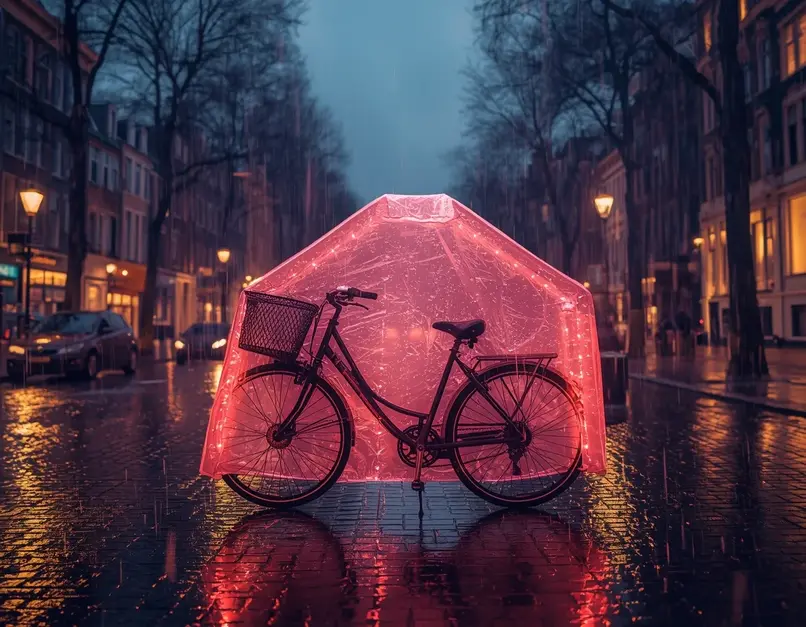
The classic, and what most people mean by an e-bike rain cover: a shaped hood of coated polyester that drops over the bike in ten seconds. It’s the right choice for daily street or yard parking and the cheapest way to keep a saddle dry enough to sit on. Basic universal covers (usually around 200 × 70 × 110 cm) cost roughly €20 to €25, while the ANWB webshop sells a 420D cover rated at 3,000 mm or more with lock holes for €44.99. The buying criteria below matter more than the brand on the bag.
2. Bike tents and shelters (opbergtenten)
A freestanding fabric garage with a zip door, usually fitting one to three bikes. Handy if you have a garden, an alley yard or a strip of driveway but no shed. The Bo-Camp Bike Shelter costs about €70 and the E-Bike Shelter Plus about €100; the Plus has a removable groundsheet and an opening for a cable. Don’t read that as permission to charge inside, though. As our cold weather guide explains, batteries should charge indoors at room temperature, on a hard surface, under a working smoke alarm, not in a closed fabric tent. Tents also need anchoring in wind and eat floor space.
3. Sheds, boxes and hangars (fietsenbergingen)
The endgame: full weather and theft protection in one. Retailer prices run from about €500 for a wooden shed to around €600 for a metal bike box with a rack, and €1,250 to €1,300 for bigger or sturdier models, before delivery and assembly. Check the rules before you order. A back garden is usually simple, but front gardens are stricter and some local plans cap structures there at about 1 metre. Start with the Omgevingsloket and your gemeente. If you rent and already have a dry bike cage, skip this tier entirely.
4. The rain cover you ride under (regentent)
A Dutch special. In cargo bike country, “rain cover” often means the zip-up rain tent over a bakfiets box that keeps children and groceries dry while you ride. These are model-specific and pricey (Urban Arrow’s Regenhuif Plus is listed at €379), and they belong on the bike rather than over it. If that’s the product you came for, our 2026 cargo e-bike guide covers the bikes these tents fit. Parking a cargo bike for the night is a different job, and a dedicated cargo bike cover (roughly €70 to €120) handles that.
| Dutch | English | Where you’ll see it |
|---|---|---|
| fietshoes | bike cover | Webshops, ANWB, bike shops |
| regenhuif, regentent | rain hood or tent for a cargo bike | Cargo bike dealers |
| opbergtent, fietstent | storage tent | Camping and DIY shops |
| fietsenberging, fietsenschuur | bike shed | DIY stores, garden centres |
| waterkolom | water column (waterproof rating) | Product specs, in mm |
How to choose: size, waterproof rating and the small details
Get the size right
A cover that’s too small leaves wheels and mudguards wet. One that’s too big flaps in wind and pools water on top of your saddle. Measure your bike from front wheel tip to rear wheel tip and add 5–10 cm (2–4 in). The ANWB gives the same advice for its covers. Then use this table:
| Your bike | Typical length | Cover length to look for |
|---|---|---|
| Folding e-bike | 150 – 175 cm | 160 – 185 cm |
| City e-bike | 180 – 195 cm | 190 – 205 cm (a 200 cm universal cover fits most) |
| Trekking or hybrid e-bike with rack | 190 – 205 cm | 200 – 215 cm |
| Fatbike e-bike | 190 – 210 cm, extra wide | 200 – 220 cm, with a wider cut; check the stated width against tyres and bars |
| Two-wheel cargo e-bike | 220 – 260 cm | Dedicated cargo cover, usually 260 – 280 cm |
Typical lengths vary by model, so measure your own bike. Many universal covers are about 200 × 70 × 110 cm, and covers sold for e-bikes and fatbikes are often wider, around 200 × 90 × 100 cm.
Height matters too: the cover should reach below both axles so wind can’t lift it, but not drag on the ground where it wicks up puddle water.
Read the water column properly
Waterproofness is given as a water column (waterkolom) in millimetres: the height of water a fabric can hold before it seeps through. As a rule of thumb for the Netherlands, the ladder looks like this:
- Under 1,500 mm: shower-proof at best. Fine for a covered balcony, not for a street.
- 2,000 – 3,000 mm: the sweet spot for Dutch weather, autumn storms included. Covers rated at 3,000 mm or more are easy to find for under €50.
- 5,000 mm and up: worth paying for in coastal provinces, or if the bike stands outside for weeks at a time.
Seams matter as much as fabric, because water enters through stitch holes first. Look for taped or welded seams and a PU or PVC coating on the inside of the cloth.
Six details worth paying for
- Vents or breathable panels. The single biggest anti-rust feature. More on this in the condensation section.
- Lock eyelets or grommets. They let you run a lock through the cover without uncovering the bike.
- A buckle strap plus elastic hem. Stops the cover sailing off in an October gust.
- UV-stable fabric. Cheap covers crack and fade after a couple of summers of sun.
- A soft inner lining. Grit caught between cover and paint makes its own scratches every time the wind moves it.
- A storage bag. Somewhere to put the cover when it’s dry, instead of crumpled behind the door.
Fabric weight tells you a lot in one number. 210D Oxford is the basic grade you’ll see on cheap universal covers, and 300D to 420D is the heavier range on better ones (the ANWB cover above is 420D). Heavier fabric lasts longer, but the waterproofing comes from the coating and the seams, so check those separately.
The condensation trap: how a cover quietly rusts an e-bike
Here’s the part most buyers miss. A cover doesn’t cause rust, trapped water does. On a clear night, warm damp air under a sealed cover meets a cold frame and turns to dew on the metal. Without vents that moisture has nowhere to go, so it cycles wet-dry-wet on your chain, bolts and battery contacts for months. Cover a soaking bike and you seal all that surface water in with it. The ANWB’s own advice on its covers is not to put one on a wet bike and to clear standing water off the top.
The fix is habit more than hardware:
- Wipe off the worst and let a soaked bike drip dry under an overhang before you cover it. An hour or so is a sensible minimum.
- Choose a vented cover and keep the vents open, not folded flat against the fabric.
- On dry days, lift or loosen the cover for an hour so the bike can breathe.
- Take the battery and display inside in winter. Cold only cuts your range temporarily; the real risks are charging a frozen pack and storing one empty, as our e-bike battery cold weather guide explains. If the bike stands for weeks, store the pack at 30–60% charge (storage rules here).
- Wipe the battery contacts dry before charging, and let a cold battery warm up first. Our guide on how to charge an e-bike battery correctly walks through the routine.
Do this and a cover slows rust down a lot. Skip it and you’ve built a small, private sauna for your drivetrain.
Wind, straps and thieves: covering up in public
Dutch wind will test every seam you paid for. Fit the strap under the frame or front wheel, click the buckle, and make sure the elastic hem sits below the axles so gusts get nothing to lift. A cover that flaps all night wears thin at the mirrors and bars within a season.
On theft, a cover helps a bit: it hides the model and the battery from passing opportunists, and with e-bike theft as common as it is in the Netherlands, not advertising what you own has some value. But concealment is not security. Lock eyelets let you secure the cover, but your lock still has to go through the frame and round something fixed. Insurers such as the ANWB have asked for two ART-2 (or higher) locks on e-bikes since March 2024, and our best e-bike lock guide lists the ones that survive real attacks. A GPS tracker generally keeps reporting under fabric (see our e-bike GPS tracker roundup). If your insurer has conditions on outdoor parking, check the small print first; our e-bike insurance guide covers what policies typically expect.
Riding in the rain: what a cover can’t do
A rain cover protects a parked bike. For the ride itself you want other kit: full-length mudguards, a decent rain jacket and trousers, and luggage that’s properly waterproof. Our pannier guide separates the truly dry bags from the ones that merely claim to be, and our waterproof phone mount picks keep navigation alive in a downpour.
Two more tips. Wet cobbles, tram rails and painted road markings get slippery, so take them upright and slowly. Brakes also need more distance in the wet, and rim and roller brakes need the most (our roller brake vs disc brake guide shows how they compare). Squeeze the levers gently at a safe moment to dry the surfaces, and give the chain a wipe when you get home.
What an e-bike rain cover costs in the Netherlands (2026)
These prices come from Dutch webshop and retailer listings seen in October 2026. This is the ladder:
The sweet spot for a city e-bike that lives outside daily is €35 to €50: enough for a heavier fabric, taped seams, lock holes and a proper strap. Covers under about €25 are usually thin 210D fabric, which is fine for a covered balcony and less so for a street in February. Past €60 for a single-bike cover, look for a specific reason, such as cargo size or heavier fabric.
One number for perspective: a new battery from a brand-name maker lists at roughly €420 to €830 for popular 500–750 Wh packs (here’s what e-bike battery replacement costs), and a routine service isn’t free either (see our e-bike service cost overview). A €40 cover that adds a year to both pays for itself several times over.
Cover care, and bike care after a wet week
Covers are low maintenance, not zero maintenance. Rinse off bird lime and street grit a few times a year, let the cover dry fully before folding it, and check the strap and seams each autumn before the storm season starts.
The bike underneath deserves two minutes a week in winter:
- Wipe the chain and re-lubricate every few wet weeks. A dry chain rusts faster than one with a thin film of wet-weather lube.
- Check battery contacts and the display mount for white or green corrosion.
- Look for rust blooms on rack bolts and the kickstand spring. Caught early, they’re a five-minute fix.
- Squeeze the brakes and spin the wheels to hear anything gritty.
If you ride on salted roads, rinse the salt off gently rather than leaving it under the cover; the winter salt care routine shows how. If rust or wear gets ahead of you, a shop visit is nearly always cheaper than a replacement part later. Our guides on e-bike spare parts in the Netherlands and e-bike repair shops in Amsterdam can point you in the right direction.
Quick buy checklist
- Measured bike length plus 5–10 cm, hem below the axles
- Water column of 2,000 mm or more, taped or welded seams
- Vents, buckle strap, elastic hem and lock eyelets
- 300D fabric or heavier for daily outdoor use
- A drip-dry spot under an overhang before covering
FAQs
Can I put a rain cover on a wet e-bike?
Not for long. Wipe off the worst of it, wheel the bike under an overhang and let it drip dry before you cover it, and use a vented cover so leftover moisture can escape. Water trapped under a sealed cover keeps the frame, chain and battery contacts damp, and that wet-dry cycling is what starts rust. The ANWB’s own guidance for its covers says the same: don’t put the cover on a wet bike and clear standing water off the top.
Is an e-bike rain cover waterproof enough for Dutch storms?
If it has a water column of 2,000 to 3,000 mm with taped or welded seams, yes, and that covers normal Dutch weather including autumn storms. Covers rated at 3,000 mm or more, like the 420D one sold by the ANWB, are easy to find for under €50. In open, coastal or very exposed spots, go for 5,000 mm and check that the strap and hem can hold in hard gusts. Seams and straps are usually the weak points, not the fabric.
Does a rain cover protect my e-bike against theft?
A little. It hides the model and battery from passing opportunists, and lock holes let you secure the cover too. But a cover is concealment, not a lock: your lock has to go through the frame and round something fixed. Combine the cover with two ART-2 locks, a GPS tracker and sensible parking, and it becomes one useful layer in a bigger set-up.
Checked on 28 October 2026 against KNMI, the national climate adaptation portal, the ANWB and Dutch retailer listings. Prices and ratings vary by shop and model, so confirm the details before you buy.