E-Bike for International Students in the Netherlands

E-Bike for International Students in the Netherlands: Subscribe, Rent or Buy in 2026?
The short version
An e-bike is the fastest way to survive Dutch student life, but the cheapest route depends on how long you stay. On cash alone, buying a used or refurbished e-bike (€700–€1,000) overtakes a Swapfiets-style subscription (roughly €65 a month) after about five months. Allowing for the hassle and risk of buying and reselling, the realistic break-even is nine to twelve months. Stay shorter and subscribing is the easier choice — repairs and theft replacement are included, though a theft surcharge applies. Stay longer and buying wins, if you insure it and lock it with two ART locks. Skip street bargains at half price: that is stolen stock. Budget €10–€18 a month for theft insurance.
Every September, hundreds of thousands of international students land in the Netherlands and face the same three-week scramble: housing, bank account, bike. The bike is the one that shapes your daily life most, and in 2026 the question is rarely “bike or no bike” but “electric or not, and how do I pay for it without crying?” We’ve priced every realistic route — subscription, rental, used, refurbished, new — against a student budget and a student timescale, because a one-semester exchange student and a four-year bachelor student should not make the same choice.
Why students go electric (and when they shouldn’t)
You’re in good company: RIVM’s 2025 survey found that e-bike use among 18-to-24-year-olds in the Netherlands jumped from 8% to 27% between 2021 and 2025. But let’s be honest first: the Netherlands is flat, and for a three-kilometre hop to a campus building a €150 second-hand omafiets is genuinely hard to beat. An e-bike earns its keep in four very student-specific situations: your campus or internship sits eight kilometres or more away; you ride into that classic Dutch headwind twice a day; you work evening shifts and come home in the dark and cold; or you carry things — laptops, lab gear, weekly groceries, a younger sibling’s weekend bag.
In those cases the e-bike isn’t a luxury, it’s the difference between arriving ready to work and arriving as a damp, annoyed hedgehog. It also replaces costs you’d otherwise pay: an OV-fiets is €4.80 per 24 hours, and a monthly public-transport top-up for cross-city trips adds up fast. One charge of a 450 Wh battery costs under fifteen cents of electricity.
Rent, subscribe or buy? The five routes compared
| Route | Typical 2026 cost | What’s included | Best for |
|---|---|---|---|
| E-bike subscription (Swapfiets and similar) | ~€65/mo (Power 1), ~€80/mo (Power 7); varies by city and plan length; student discount with a valid student ID | Repairs, maintenance, theft replacement (surcharge applies); monthly cancellation with one month’s notice; one-off sign-up fee | Stays under ~9 months, or anyone who wants zero hassle and no upfront cash |
| Short-term rental / OV-fiets | €4.80 per 24 h (OV-fiets, 2026); shop rentals higher | Nothing long-term; OV-fiets needs a personal OV-chipkaart and availability varies by station | Occasional use, first weeks before you decide |
| Used, private seller | €500–€1,500 on Marktplaats and expat groups; less at municipal fietsdepots | Nothing — you own everything, including the risks | Confident buyers staying 1+ years who can check a bike |
| Certified refurbished | €700–€1,000 | 12-month warranty, tested battery with capacity in writing | First-time e-bike owners who want used prices with new-bike sleep |
| New budget e-bike | €706–€1,006 (band we tracked in autumn 2026) | Full manufacturer warranty | Four-year students who’ll resell at graduation |
The subscription route deserves more respect than it gets in bike forums. Yes, €65 a month sounds like a lot against an €800 purchase. But it bundles the three things students are worst at budgeting: repairs, maintenance and theft. Read the small print though. Theft replacement only applies if the bike was double-locked, and it comes with a surcharge — Swapfiets’ own comparison page lists €250 on its city bike, so check the figure for the e-bike tiers before you sign. Students can claim a discount by ticking the student box at checkout with a valid student ID, and e-bikes are only offered in selected service areas, so check your city first.
The uninsured alternative is worse. When your own bike disappears from a rack in Amsterdam without cover, your semester budget disappears with it.
The 24-month cost maths
Here’s the model we run with students who ask us “what would you do?”. Two things move the answer: how long you’ll stay, and what could go wrong. First, the cumulative cash cost of each route for a used e-bike bought well at €750:
| Length of stay | Subscription (~€65/mo) | Own a used e-bike (€750) | Cash gap |
|---|---|---|---|
| 6 months | €390 | ≈ €360 | ≈ €30 in favour of owning |
| 12 months | €780 | ≈ €580 | ≈ €200 |
| 18 months | €1,170 | ≈ €790 | ≈ €380 |
| 24 months | €1,560 | ≈ €1,030 | ≈ €530 |
Net cost over 24 months, by route (modelled)
Our modelled example, September 2026 assumptions. Bought at €750 (used), €900 (refurbished) and €850 (new, promo price); resale after 24 months at 55%, 60% and 50%. Owned routes add theft insurance at €12/month, a €100 ART lock, and servicing at the typical €90 a year plus €60 a year of wear parts. Subscription assumes €65 a month with no theft. Even if a used bike resold for only 40% of its price, owning would still come out about €420 cheaper over 24 months.
Read the numbers with one variable in mind: time. On cash alone, ownership overtakes the subscription at roughly month five. But that leaves out things a subscription genuinely absorbs: finding and inspecting a bike, a battery failing (€250–€900), a brake bill, an insurance excess if the bike is stolen, and selling the bike during exam season. So we’d treat months nine to twelve as the realistic break-even. Below that, subscribe. Beyond a year, it isn’t close. The break-even moves earlier if you buy from a motivated expat doing a “leaving NL” sale, and later if your bike gets stolen uninsured — which, in a student city, is not a hypothetical.
Best budget picks for students in 2026
If you’re buying, these are the shelves we’d actually shop, all inside the legal 250 W / 25 km/h box:
- Eleglide T1 Step-Thru (€706–€970 depending on promo): 450 Wh battery, 50 Nm rear hub, step-through frame that suits city stopping and starting. We’ve tracked it as low as €706 this year; set an alert rather than trusting any screenshot.
- Decathlon Elops 900 E (€999–€1,300 depending on frame and promotion): 417 Wh under-rack battery and, crucially for students, a physical Dutch store network for warranty and parts, with ten-year spare-parts availability on the range. We saw the low-frame version at €1,006 during the August–September 2026 promotion.
- Certified refurbished mid-drives (€700–€1,000): yesterday’s Bosch or Shimano Steps bike with a 12-month warranty and a written battery test. The best ride quality per euro anywhere under €1,500.
One warning specific to the used market in 2026: check the brand’s situation before you fall in love. Accell Group — parent of Sparta, Batavus, Koga and Babboe — was declared bankrupt on 11 August 2026, and by 23 September sixty parties had approached the receivers about restarting parts of the business, so nobody yet knows which brands will survive. Bike shops say most parts (tyres, chains, brake pads, Bosch and Shimano drive units) are generic and still available, so a used Sparta or Batavus isn’t a write-off. But frame-specific parts and dealer warranty are uncertain, which is worth a discount on the asking price. Our best budget e-bikes under €1,000 guide has the full shortlist and the brand note, and our second-hand buying guide covers depreciation curves by age.
Theft-proofing in student cities
Now the uncomfortable chapter. Police recorded 86,950 reported bicycle thefts in 2025 (a provisional CBS figure), the fourth yearly rise in a row, and the real number is far higher: the Rijksoverheid says only about a quarter of thefts are reported, and the CBS victim survey has put the true total in the hundreds of thousands. Per head of population, Amsterdam, Nijmegen, Utrecht and Delft all rank among the worst hotspots (2023 data). Amsterdam alone logged 10,810 bicycle-theft reports in 2024, and police say most thefts happen near stations late in the evening — exactly where a student parks after a night out.
The system that works, in order of cost:
- Two locks, always. The built-in frame lock plus a separate ART-approved chain or U-lock (€80–€150) through frame and wheel to something fixed. ANWB has required a second ART lock on insured e-bikes since March 2024, and other insurers set similar conditions, so read your policy. A plug-in chain clipped into your ringslot does not count.
- Theft insurance, €10–€18 a month on a typical student e-bike — cheap against an €800 loss, and void without the approved locks, so keep the receipts. Our e-bike insurance guide compares the tiers.
- Battery and display in your bag. A battery-less e-bike is worth little to a thief, and Amsterdam police reported a rise in e-bike battery theft in 2025 precisely because batteries are valuable and easy to detach. Replacements cost €250–€900.
- Park like a local. Official stallingen over random street furniture. Guarded stallings are free for the first 24 hours and then cost roughly €0.75–€1.35 a day depending on the city and location (Utrecht’s current rates), and cities cap how long a bike may stay in one public spot: Amsterdam’s published policy is two weeks around stations and six weeks elsewhere inside the A10, so check the signs. Wrongly parked bikes go to the municipal fietsdepot, where retrieval costs about €25 (Utrecht charges €26.50 in 2026).
- A €35 Bluetooth tag hidden in the frame if your bike is under €1,500 — subscription GPS trackers make sense on €4,500 machines, not on student budgets. Our GPS tracker guide runs the three-year cost maths, and the lock guide has the ART ratings explained.
Used e-bike checks: the ten minutes that save your semester
| Check | How | Walk away if… |
|---|---|---|
| Stolen-bike register | Frame or chip number into the RDW’s Fietsdiefstalregister (free; English guide on government.nl’s stolen-bicycles page). A clean result isn’t proof: only bikes reported stolen since 2008 appear, and only about one theft in four is reported | Hit in the register, or frame number scratched out |
| Paperwork | Original receipt; name matches seller’s ID | No receipt, “lost” keys, no battery key |
| Battery health | Cycle count on display, dealer diagnostic, full-charge test ride under load | Bars collapse on the first bridge; casing dents or corrosion |
| Motor & tuning | Assist only when pedalling, cuts out cleanly at 25 km/h, no error codes | Support beyond 25 km/h — a tuned bike risks a €320 fine and seizure |
| Wear items | Brake pads, tyres, chain, gears on the test ride | Seller refuses a test ride or meets only at a station |
| Payment | Cash or an instant bank transfer in person, after the test ride, against a written receipt with the seller’s name, address and the frame number | Any payment link sent cold before you’ve seen the bike |
Two student-specific sourcing tips. First, hunt “moving sale” and “leaving NL” listings in expat Facebook groups and on university noticeboards: the biggest windows are June to August and late December, when departing internationals sell well-kept bikes fast, often with receipt and box. A seller fleeing the country has zero incentive to pass on stolen goods. Second, some municipalities resell unclaimed fietsdepot bikes cheaply — check your city’s depot page — though e-bikes turn up rarely and unclaimed bikes are no guarantee of clean history, so run the frame number first.
The rules in 60 seconds
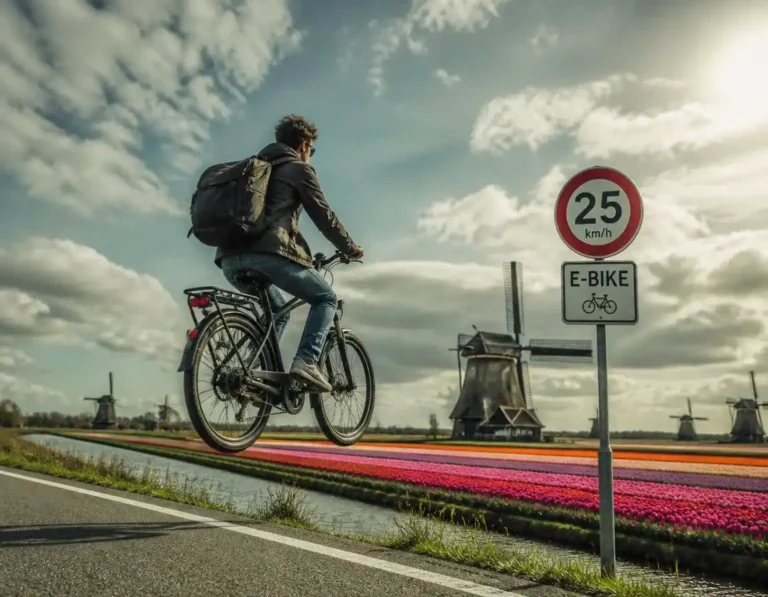
A legal Dutch e-bike has a 250 W motor, assistance that stops at 25 km/h, and no throttle acting as the main control (a 6 km/h walk assist is fine). Inside that box it’s an ordinary bicycle: no licence, no number plate, no compulsory insurance, no helmet duty in 2026, and no minimum age. You don’t need a BSN to buy one, though most theft-insurance policies want a Dutch address, and iDEAL payments need a Dutch bank account — sort both in your first weeks. Anything faster or more powerful is a speed pedelec or moped: plate, AM licence, mandatory helmet and WA insurance, a completely different legal animal.
Two developments on the horizon: enforcement against tuned bikes and over-powered imports tightened through 2026, with city bans and fines already being handed out, and a helmet mandate for under-18s on e-bikes is targeted for 1 September 2027 — not law yet, per the Rijksoverheid, and irrelevant to most students, but worth knowing if your sibling is joining you. Our Dutch e-bike laws guide tracks both.
✅ The one-paragraph answer
Here for a semester or two (under about nine months)? Subscribe, ride, hand it back, keep your peace of mind. A year or longer? Buy a refurbished mid-drive or a promo-priced budget bike around €700–€1,000, insure it for €10–€18 a month, lock it with two ART-approved locks, check the frame number, and resell it to the next intake of students in the June window. Either way, you’ll wonder how anyone ever wrote an essay about Dutch cycling culture without simply living it.
Frequently asked questions
Do international students need a licence or insurance to ride an e-bike in the Netherlands?
No. A legal e-bike — 250 W motor, assistance cutting out at 25 km/h — is an ordinary bicycle: no licence, no number plate, no mandatory insurance and no helmet duty in 2026. You do not even need a BSN to buy one. Theft insurance is optional but sensible in student cities, and most policies require an ART-approved lock and a Dutch address.
Is it cheaper to subscribe or buy an e-bike as a student?
On cash alone, buying overtakes a subscription after roughly five months: a Swapfiets-style e-bike at about €65 a month costs about €780 over twelve, against roughly €580 to own a well-bought €750 used bike once you count insurance, a lock, servicing and resale. But a subscription needs no upfront cash, includes repairs and theft replacement (with a surcharge if the bike is stolen), and involves no selling. Allowing for the time and risk of buying, treat months nine to twelve as the realistic break-even: subscribe for shorter stays, buy for anything longer, and resell before you fly home.
How do I avoid buying a stolen e-bike on Marktplaats?
Check the frame number in the national stolen-bicycle register before money moves, but remember a clean result isn’t proof: only about one in four thefts is reported. Ask for the original purchase receipt, and meet at the seller’s home address rather than a station or car park. Refuse any “new” bike at half price with no box or paperwork — that is how stolen stock clears. Pay in person after a test ride, against a written receipt, and never through a payment link the seller sends.