E-Bike Laws Netherlands 2026

E-Bike Laws Netherlands 2026: Rules, Fines & What’s Changing
I’ve ridden Dutch fietspaden long enough to know the feeling: you’re happily cruising past a canal, then a friend asks “wait, is your bike even legal here?” Short version — yes, if it behaves like a bicycle. But 2026 is the year the Netherlands got properly serious about fat bikes, throttles and tuned motors, with two cities already handing out real fines, a minister with a name and a timetable, and a helmet law working its way through parliament. Here’s every rule that matters, in plain English.
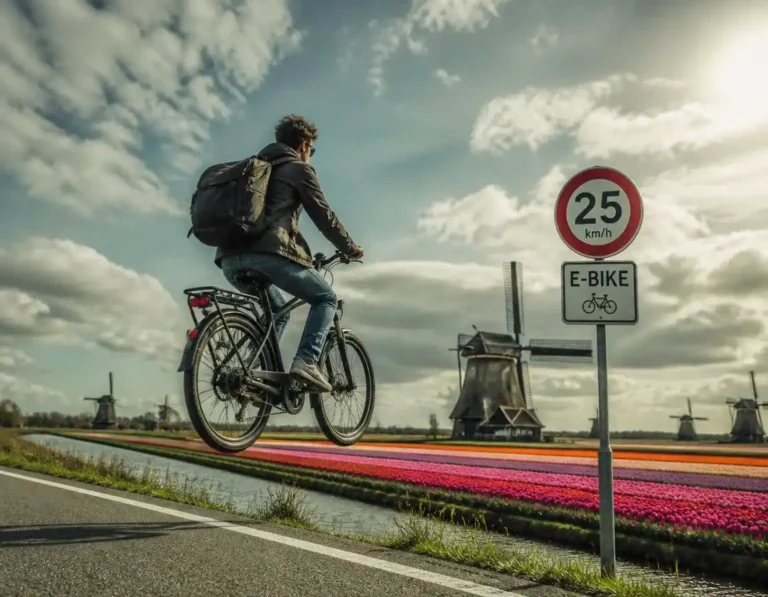
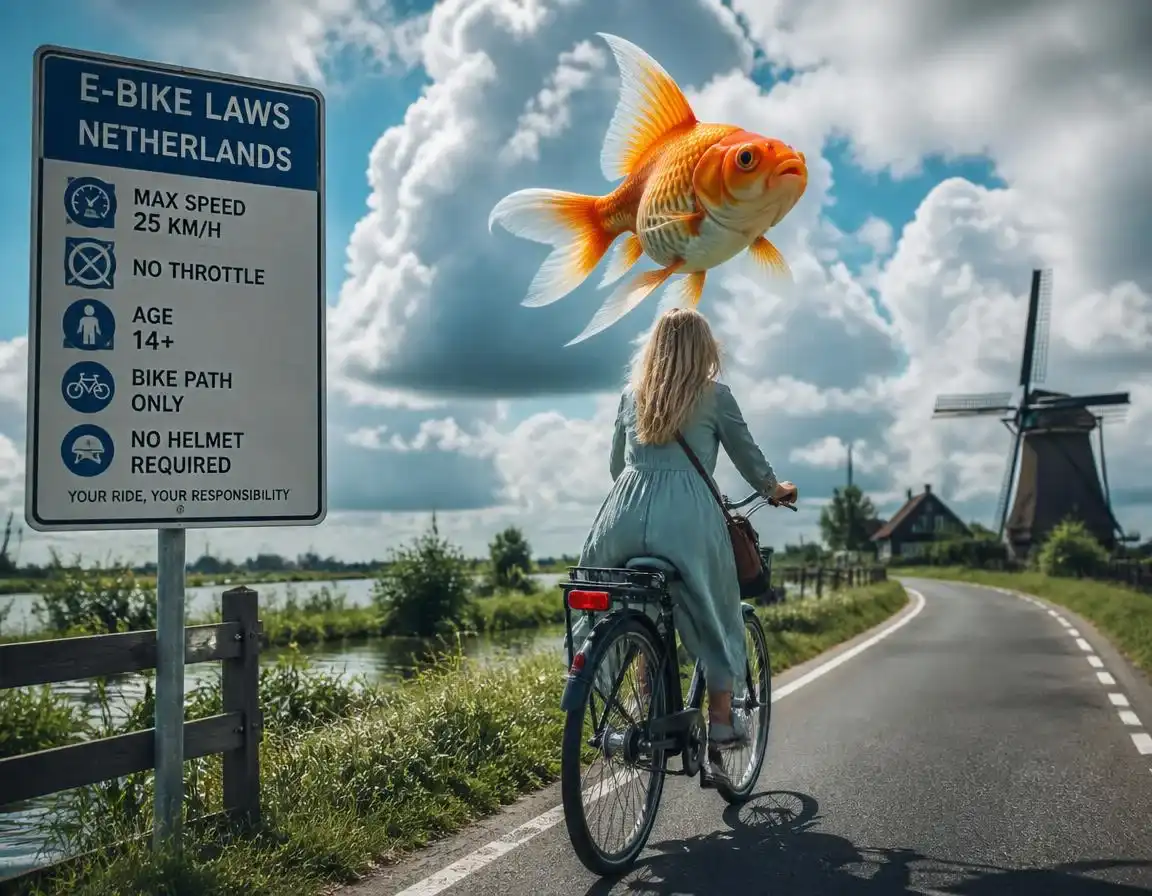
The whole Dutch e-bike law fits on a beer mat: motor no bigger than 250 watts continuous, assistance cuts off at 25 km/h (about 15.5 mph), and the motor only helps while you pedal — a throttle may only work as a 6 km/h walk assist. Meet those three and your e-bike or fat bike is a bicycle: no helmet law, no licence, no insurance, no number plate, no minimum age.
Step over any of those limits and the law stops smiling: your bike is reclassified as a moped (bromfiets), with the helmet, AM licence, yellow plate, insurance and age-16 minimum that come with it — and police are actively checking in 2026. The official rules are published on rijksoverheid.nl, and everything below is what they mean in practice.
🚲 The Three Classes: E-Bike, Fat Bike, Speed Pedelec
Dutch law doesn’t actually care what your bike looks like — chunky tyres, step-through frame, whatever. It cares about the three numbers above. That’s why a compliant fat bike is just an e-bike, and a fast one is suddenly a moped:
| Rule | 🚲 E-bike / legal fat bike | ⚡ Speed pedelec (45 km/h) | 🚫 Tuned / over-powered bike |
|---|---|---|---|
| Legal class | Bicycle | Moped (bromfiets) | Moped — but unregistered (illegal) |
| Motor / assist | 250 W · cuts at 25 km/h | Up to 45 km/h | Often 500–1,200 W or >25 km/h |
| Helmet | Not required | Mandatory (NTA 8776) | Mandatory (moped rules apply) |
| Licence | None | AM (or B) | AM — and the bike needs registering |
| Plate / insurance | None / none | Yellow plate / WA insurance | Required — you’ll have neither |
| Minimum age | None | 16 | 16 (and still illegal as ridden) |
The quick test police use: if it assists past 25 km/h, or the throttle pulls you above walking pace (6 km/h) without pedalling — it’s a moped, and riding it as a bicycle is an offence. A genuinely certified pedelec should carry an EN 15194 mark (the EU standard for electrically assisted cycles) — worth asking about if a shop can’t confirm it.
The green zone is a bicycle. Past the needle’s stop, you’re in moped territory — with moped paperwork you almost certainly don’t have.
🛣️ Where You Can (and Must) Ride
A legal e-bike rides exactly where a bicycle rides — and on the Netherlands that’s a lot of tarmac. Where a cycle path is mandatory (fietspad or the blue-sign verplicht fietspad), you must use it; riding on the road beside it gets you a fine just like any cyclist. Speed pedelecs are the odd ones out: legally mopeds, so they belong on the moped lane/path (bromfietspad) or the carriageway where none exists — never the ordinary cycle path. And one rule that catches tourists every single day: using your phone while riding is a €170 fine in 2026, e-bike or not.
All cycle paths, roads and (most) parks. Must-have equipment: working front & rear lights (steady beam only — blinking lights aren’t legal on Dutch cycle paths, a common mistake for bikes bought abroad), reflectors, bell and brakes — police run lighting checks, especially near schools.
Moped lane or road, NTA 8776 helmet, yellow plate, AM licence, WA insurance, age 16+. Think of it as a light moped that happens to pedal.
Legally an unregistered moped riding where it shouldn’t — the combination that triggers the €320 fine, confiscation on repeats, and insurance headaches after any accident.
👮 The 2026 Crackdown: What Actually Changed
Here’s the nuance most “new e-bike law” headlines miss: the national law itself barely changed — the enforcement did. Why now? Look at the injury numbers infrastructure minister Vincent Karremans gave MPs this year: Dutch hospitals recorded zero fat-bike-related injuries in 2020; by 2024 that had climbed to 301 nationwide, and half of the injured riders were between 12 and 17 years old. That single statistic explains most of what follows.
The rules themselves still descend from the same EU pedelec framework as always, but after the fat bike boom of 2021–2025, police and councils started applying them with real teeth: roadside wattage and speed checks, school-zone inspections, throttle checks and more confiscations. Chip-tuning kits already became illegal to sell in 2024, and shops must now be able to prove their bikes are 250 W-compliant.
On the ground, this isn’t just paperwork. Within three weeks of the Vondelpark ban starting, Amsterdam had already issued 39 fines and handed out 94 warnings. Barendrecht police ran a similar push on school routes, checking kids’ fat bikes on the way to class — during the campaign’s launch, in front of the infrastructure minister, officers pulled a throttle-fitted fat bike off a 12-year-old and sent him to school on foot. Amsterdam and Houten are separately piloting a 20 km/h cycle-path speed limit — Houten since 8 June, Amsterdam from September 2026 — though no fines apply during the trial itself; it’s a data-gathering exercise on rider behaviour, not yet an enforceable rule. Municipalities can’t rewrite national law — but 2026 is the year they started using every legal tool they already had.
💶 The 2026 Fines Table (the Numbers That Hurt)
| Offence | 2026 fine / consequence |
|---|---|
| Riding a tuned / over-powered e-bike or fat bike | €310–€320; bike can be confiscated on a second stop within 2 years |
| Caught in an accident on a tuned bike | Not insured as a cyclist — you can carry the damage costs yourself |
| Fat bike in a banned zone (Amsterdam’s Vondelpark, 16+) | €115 (€57.50 for riders aged 12–15; under-12s aren’t fined — parents are informed instead) |
| Fat bike in Enschede’s banned shopping-centre zone | €115, enforced Mon–Sat 10:00–18:00, Thu to 21:00, Sun 12:00–17:00 |
| Speed pedelec ridden without an approved helmet | around €100–€130 (the future under-18 e-bike helmet fine hasn’t been set yet) |
| Using a phone while cycling | €170 |
| Ignoring a mandatory cycle path | €75 |
| Cycling on a motorway (yes, really) | €200 |
| No working lights / reflectors after dark | Standard cyclist lighting fine — checked more often in 2026 |
Fine amounts as reported by rijksoverheid.nl, municipal sources and the 2026 Dutch traffic-fine schedule; amounts are indexed annually, so treat euros as “at time of writing”. For context on how seriously this is enforced: police issued 248,020 fines nationwide for phone use while cycling or driving in 2025 alone — up 50% on the year before — and roadside detection cameras are set to rise to 50 by the end of 2026.
🏞️ Fat Bikes: Legal, Banned, or Both?
.jpg?width=1200)
Both, depending on the postcode. Nationally there is still no fat bike ban — a compliant fat bike is an e-bike, full stop, with all the freedoms that brings. But two cities have already drawn their own lines on the map. Enschede got there first: since 11 March 2026, fat bikes (tyres wider than 7 cm, wheels under 27 inches) have been banned from the pedestrianised shopping centre during opening hours only — Monday to Saturday 10:00–18:00, Thursday to 21:00, Sunday 12:00–17:00 — with a €115 fine for anyone who ignores the signs. Amsterdam followed on 11 May 2026 with the Vondelpark ban, and within three weeks the city had issued 39 fines and 94 warnings there alone. A nationwide council survey (342 municipalities asked, 246 replied) found almost 30 are now weighing similar local bans of their own — though only Enschede and Amsterdam have actually gone ahead so far.
It isn’t settled law, either. A fat bike importer has taken Enschede to court, arguing the 7 cm tyre-width definition is arbitrary, and the case is being watched nationally as a test of whether these local bans survive a legal challenge. In the meantime, some sellers have started marketing “skinnybikes” — the same fat bike, with tyres trimmed to just under 7 cm — specifically to dodge the rule, which says a lot about how enforceable a tyre-width ban really is in practice.
Meanwhile the national conversation is about riders, not just tyres: a minimum age of 14 has been proposed by parliament (legally awkward, since researchers keep concluding a fat bike can’t be cleanly distinguished from a regular e-bike), and minister Karremans has confirmed a national helmet mandate for every rider under 18 is targeted for September 2027, with the formal bill going to the Tweede Kamer in autumn 2026. If you’re buying for a teenager today, budget for a good helmet now — don’t wait for the law to decide it for you.
🔧 “Opvoeren”: Why Tuning Is the Fastest Way to Lose a Bike
The Dutch have a word for it — opvoeren — and in 2026 it’s the single biggest reason e-bikes get seized. Unlock the controller, fit a 500 W hub motor, or leave an imported throttle active and your bicycle has quietly become an unregistered moped: no plate, no insurance, no type approval. Police can fine you on the spot, confiscate on repeats, and after an accident your insurer treats you as an uninsured motorist. It’s also why the second-hand market is full of “bargains” that are actually liabilities — if a deal assists past 25 km/h on the test ride, walk away. (Our ebykes.nl buyer guides — 🔜 Choosing a Legal E-Bike in the Netherlands🔜 The Fat Bike Buyer’s Checklist🔜 Speed Pedelec Guide NL — will walk you through spotting one before you pay; in the meantime, the ebykes.nl homepage is the place to watch for them.)
🪖 Helmets & Age: What’s Law in 2026 vs What’s Coming
| Rider / bike | Helmet in 2026 | Minimum age in 2026 | On the way |
|---|---|---|---|
| Adult on legal e-bike / fat bike | Not required (always sensible) | None | — |
| Under-18 on e-bike / fat bike | Not required yet | None yet | Helmet mandate targeted for Sept 2027 (bill to parliament autumn 2026); age-14 floor proposed separately |
| Speed pedelec (any age) | Mandatory — NTA 8776 helmet (~€100–€130 fine if not worn) | 16 (AM licence) | — |
Status as of September 2026: the under-18 helmet rule is government policy in motion, not yet law — infrastructure minister Vincent Karremans confirmed the September 2027 target in parliament. The traffic rules themselves sit in the national rulebook (RVV 1990 on wetten.overheid.nl).
🧳 Tourists & Rentals: The 60-Second Compliance Check
.jpg?width=1200)
Proper rental fleets are compliant 25 km/h pedelecs. Mystery-brand “45 km/h city bikes” from random listings are your €320 souvenir.
Use mandatory cycle paths, overtake on the left, and assume every tram gap is personally designed to steal your front wheel.
€170 for a glance at maps mid-ride. Pull over, check, go — the canals aren’t going anywhere.
Lighting fines are the quiet tourist tax of Dutch cycling. Front white, rear red, steady beam, no excuses.
Not law yet for under-18s, but with September 2027 coming and Dutch traffic being what it is — just do it.
If your rental pulls away without pedalling, it’s misclassified. Swap it before a police check swaps your holiday budget.
❓ E-Bike Laws Netherlands 2026: FAQs
Is a helmet mandatory on an e-bike in the Netherlands in 2026?
Only for speed pedelecs (the 45 km/h class), which need an approved NTA 8776 helmet — riding without one costs roughly €100–€130. Regular e-bikes and compliant fat bikes have no helmet law in 2026. Infrastructure minister Vincent Karremans has confirmed the government is targeting September 2027 for a national helmet mandate covering every rider under 18 on an e-bike, fat bike or other light electric vehicle, with the formal bill going to parliament in autumn 2026.
Are fat bikes legal in the Netherlands in 2026?
Yes, nationally. A fat bike is a legal e-bike if the motor is 250 W continuous, assistance cuts off at 25 km/h and any throttle works only up to 6 km/h walk assist. Exceed any of that and it is legally an unregistered moped. Two cities have gone further with local bans — Enschede’s shopping-centre ban has applied since 11 March 2026, and Amsterdam’s Vondelpark ban since 11 May 2026 — and nearly 30 more municipalities are considering rules of their own.
What is the fine for a tuned (opgevoerde) e-bike in the Netherlands?
Riding a tuned or over-powered e-bike or fat bike brings a fine of around €310–€320, and the bike can be confiscated if you are stopped again within two years. Because the bike is legally an uninsured moped, you can also carry accident costs yourself. Selling chip-tuning kits has been illegal since 2024, and police have run dedicated checks through 2026 — including school-route stops on children’s fat bikes.
Do tourists need a Dutch licence to ride a rented e-bike?
No — nationality doesn’t change the rules. A rented e-bike or fat bike that meets the 250 W / 25 km/h / pedal-assist-only conditions is legally a bicycle for anyone riding it, tourist or resident. Stick to reputable rental shops (an EN 15194 certification is a good sign), and the same lighting, bell and “phone in your pocket” rules apply to you as to everyone else on the fietspad.
What actually happens if the police stop you on a tuned e-bike or fat bike?
Officers typically check the display or motor rating and test the assisted top speed on the spot. If your bike is within limits, you’re free to go. If it isn’t, expect an on-the-spot fine of around €310–€320 — and, as happened during a 2026 school-route check in Barendrecht, the bike itself can be confiscated, especially on a second stop within two years.