How Much Does It Cost to Charge an E-Bike in 2026

How Much Does It Cost to Charge an E-Bike in 2026?
The short version
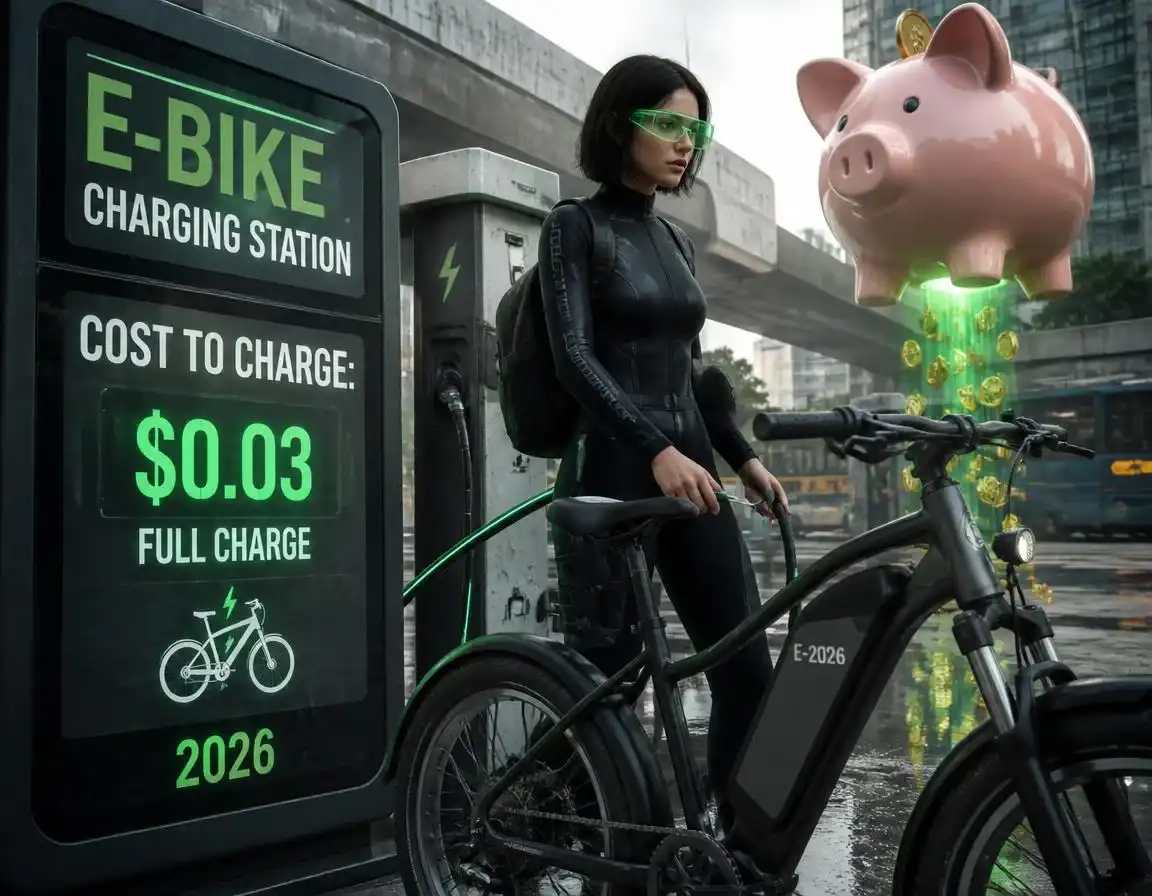
A full e-bike charge costs about €0.10 to €0.23 in the Netherlands in October 2026, depending on battery size (400 to 750 Wh) and your tariff (€0.25 to €0.31 per kWh). A typical 500 Wh pack costs €0.13 to €0.16, and your meter records roughly 10% more because of charger losses. That is 0.1 to 0.3 cent per kilometre, or about €7 a year for a 4,000 km commute. The cost most people miss is battery wear: about €0.40 to €1.20 per full cycle, several times the electricity. Even with wear added, an e-bike costs about 1 cent per kilometre. The calculator, tables and saving tips are below.
We get asked this at almost every bike test, usually half-joking, as if the answer might be a trap. It isn’t. Charging an e-bike costs so little that most riders spend more on a coffee along the way. But “cheap” isn’t a number, and the honest number has two parts: the few cents you pay your energy supplier, and the battery wear that never shows up on a bill. Here are both, using October 2026 Dutch prices.
What a full charge costs in 2026
Your battery label gives the capacity in watt-hours (Wh). Divide by 1,000 to get kilowatt-hours, multiply by your price per kWh, and you have the cost of a full charge.
Battery Wh ÷ 1,000 × price per kWh = cost per full charge
| Battery size | At €0.25/kWh | At €0.28/kWh | At €0.31/kWh | At the meter, €0.28 (+10%) | Typical real-world range |
|---|---|---|---|---|---|
| 400 Wh | €0.10 | €0.11 | €0.12 | €0.12 | 48–97 km |
| 500 Wh | €0.13 | €0.14 | €0.16 | €0.15 | 64–129 km |
| 625 Wh | €0.16 | €0.18 | €0.19 | €0.19 | 80–161 km |
| 750 Wh | €0.19 | €0.21 | €0.23 | €0.23 | 97–177 km |
Where does your own rate sit? The CBS put the average Dutch household electricity price at about €0.25 per kWh in June 2026, as the ANWB’s price overview reports. Contracts signed in October 2026 cost more: new contracts average roughly €0.30 per kWh all-in, and offers run from about €0.26 to €0.37. Older fixed contracts can still sit lower. If you don’t know what you pay, check your last energy bill. The all-in price per kWh is the only number you need.
Roughly €0.11 of every kWh is energy tax. The 2026 rate is €0.11085 per kWh including VAT, according to Milieu Centraal. That matters later, because it puts a floor under even the cheapest dynamic hour.
Work out your own charging cost
Change the numbers to match your bike and your contract. The defaults describe a 500 Wh pack, a €0.28 tariff and a 4,000 km commuter.
E-bike charging cost calculator
Everything runs in your browser. Nothing is sent anywhere.
All-in cost per kilometre: –. Equal to about –. Electricity includes roughly 10% charger loss. Wear is the pack price divided by its cycles. Packs also age with time, so for light riders the real wear per year is higher than shown.
How much electricity an e-bike uses: cost per kilometre and per year
Per kilometre, an e-bike sips. Take the real-world ranges in our battery lifespan guide for a 500 Wh pack and consumption works out at about 3 to 5 Wh per kilometre in eco, 4 to 8 in tour and 6 to 12 in turbo, on flat but windy Dutch routes. A cargo bike with children aboard sits at the top of that range or above it. From here on, every figure includes the 10% charger loss, because that is what your meter records.
| Assist mode | Energy use | Electricity per 100 km at €0.28/kWh | Range of a 500 Wh pack |
|---|---|---|---|
| Eco | about 3–5 Wh/km | €0.09–€0.15 | 97–161 km |
| Tour or normal | about 4–8 Wh/km | €0.12–€0.25 | 64–113 km |
| Turbo or boost | about 6–12 Wh/km | €0.18–€0.37 | 40–81 km |
Cold weather nudges these numbers up. Range drops by roughly 20 to 40% near freezing, and your cost per kilometre rises with it. That is temporary, and it still stays under a cent per kilometre. Now scale it to a year:
Yearly charging electricity by rider type
At €0.28/kWh including 10% charger loss. Energy use: 6 Wh/km for the first three riders, 10 for cargo, 8 for delivery. Battery wear not included.
A daily commuter pays about the price of two coffees a year for electricity. That 4,000 km adds up to roughly 48 full charges, so about one a week. The same bike on the three-year budget in our e-bike cost guide shows €15 to €25 of electricity, the smallest line by far. A “full charge cycle” counts capacity used, not plugs inserted. Two half-empty top-ups equal one cycle, so short daily top-ups don’t multiply the cost. Our guide to how long an e-bike battery lasts walks through the cycle maths.
The cost nobody bills you for: battery wear
Most charging-cost articles stop at the electricity, and that misses the bigger half. Every full cycle ages the pack a little, and the pack is the most expensive part of the bike. Spread its price over its cycle life and you get the true price of a charge.
The numbers: Dutch retailers listed the Bosch PowerTube 500 Wh at €419 to €599 in September 2026, shops often sell below list, and the Consumentenbond puts new packs at €250 to €900 overall. Fitting is often free where you buy the pack and roughly €30 to €80 for an in-frame pack at a workshop. Our battery replacement cost guide has the brand-by-brand table. A cared-for lithium-ion pack gives 500 to 1,000 full cycles before it fades to 70 to 80% of its capacity. Divide one by the other and a new 500 Wh pack carries about €0.40 to €1.20 of wear per full charge, with roughly €0.70 as the middle case. Against €0.14 of electricity, that is about five times as much in the middle case, and nearly nine times at the worst end.
One caveat. Packs age with time as well as cycles, so a weekend rider’s real wear per charge is higher than this arithmetic suggests. The calculator above lets you test different pack prices and cycle counts.
This changes what is worth optimising. Charging in the cheapest hour of a dynamic contract saves a few cents. Stretching a €510 pack from 600 to 900 cycles cuts the wear per charge from about €0.85 to about €0.57, and that is where the real money sits. Living between 20% and 80%, keeping the pack out of heat and frost and using the original charger all add cycles. The habits are in our guide to how to charge an e-bike battery correctly. When the pack does fade, repair versus replacement compares a cell rebuild at €330 to €590 with a new pack, including Bosch’s position that it advises against opening its batteries.
E-bike charging compared with other ways to travel
The absolute number matters less than the comparison. Energy cost per kilometre, October 2026 Dutch prices:
| Vehicle | Energy use | Energy cost per km | Notes |
|---|---|---|---|
| E-bike, electricity only | 4–8 Wh/km | €0.001–€0.0025 (0.1–0.25 cent) | Tour assist at €0.28/kWh, charger loss included |
| E-bike, including battery wear | n/a | about €0.01 (0.3–2 cents) | Pack price spread over its cycles and real-world range |
| Electric car, home charging | 15–18 kWh/100 km | about €0.04–€0.05 | Roughly 25 times the e-bike’s electricity per km |
| Petrol car, 6–7 l/100 km | n/a | about €0.15–€0.19 | Euro95 at €2.45–€2.72 per litre, fuel only |
| Petrol moped or scooter | about 2.5 l/100 km | about €0.06–€0.07 | Fuel only, before maintenance |
Even with battery wear counted, an e-bike covers a kilometre for roughly a sixteenth of what a petrol car burns in fuel alone. If you are weighing up the switch, our e-bike versus regular bike comparison and the full e-bike cost guide put charging next to purchase price, service and insurance.
Where and when you charge changes the price
Fixed, variable or dynamic: what your contract does
On a fixed or standard variable contract every hour costs the same, so charge whenever it suits you. On a dynamic contract the price follows the hourly market. Sunny spring and summer middays can push the market price close to zero or below, while the early evening is usually the dearest window of the day.
Is it cheaper to charge an e-bike at night?
Only on a dynamic contract, and only by a few cents. Even in the cheapest hour you still pay energy tax of about €0.11 per kWh including VAT, so your price rarely falls much below that. For a 500 Wh pack, the gap between the best and worst hour is cents per charge. There is also a safety catch: the cheap night hours fall while you’re asleep, and the Dutch fire service advises charging while you are awake and at home. A midday charge on a weekend, or one after you get in, beats a timer set for 03:00.
Solar panels and the end of saldering on 1 January 2027
Until 31 December 2026, the salderingsregeling still lets you net the power you feed in against the power you draw, kWh for kWh over the year. While it runs, it makes little difference when your e-bike charges. A kWh from your roof is worth the same whether you use it at noon or export it and take one back in the evening. Some suppliers do charge feed-in costs, so check yours.
From 1 January 2027 the netting stops. A kWh you use yourself then saves your full price of roughly €0.30, while a kWh you export earns only a feed-in payment, usually far lower. From then on, charging while the panels are producing is worth planning. One 500 Wh charge won’t move your bill much, but putting it at midday costs nothing.
Charging away from home
The cheapest tariff is someone else’s, so ask before you plug in. Offices, sports canteens, holiday parks and campsite service blocks often have a socket or a dedicated e-bike charging point, and a few charge a small fee. If your bike comes through the company e-bike scheme, ask facilities whether the bike shed has sockets.
A compact 2 A charger in your pannier fills a 500 Wh Bosch pack in about 7.5 hours, against about 4.5 hours on a 4 A standard charger. A second charger for your desk is about €90 for a Bosch 2 A, and Dutch webshops list original chargers at roughly €65 to €130 in 2026. Chargers are matched to the drive system and pack, not the bike brand. A Bosch charger won’t charge a Shimano pack, and Bosch’s older System 2 and newer Smart System chargers don’t mix either. Our charger replacement guide covers which charger fits which system.
Six habits that cut your charging bill
- Charge in the cheap window if you have one. On a dynamic contract, or with solar panels, aim for midday while you’re home. On a fixed contract, ignore this and charge when you get in.
- Live between 20% and 80%. Partial charges cost the same per Wh but wear the pack less, so your cost per kilometre drops over the battery’s life. Fill it to 100% before a long ride, just don’t park it full for days. This is the biggest saving on the page.
- Let a hot or frozen pack reach room temperature first. Give a hot pack about twenty minutes. After a freezing ride, give it a couple of hours indoors. Bosch rates charging between 0 and 40 °C, and charging a frozen pack can damage the cells for good.
- Use the original charger. The charge profile is matched to your pack. Lookalike chargers are a fire and warranty risk, not a saving.
- Spend less energy per kilometre. Correct tyre pressure, a clean chain and eco assist into the wind cut Wh/km more than any tariff trick. Our tyre guide explains why soft tyres quietly eat range.
- Unplug when it is full. Standby draw is pennies, but a pack parked at 100% for weeks ages faster than one that is ridden and topped up, and Bosch advises against leaving a pack connected to the charger in storage.
One safety note outranks every saving. Charge on a hard, non-flammable surface in a room with a working smoke alarm, stay at home while it charges, and retire any charger that rattles, smells hot or has a split cable. Battery-caused building fires in the Netherlands roughly doubled between 2019 and 2024, according to Stichting Salvage. Brandweer Nederland, RAI Vereniging, BOVAG and the ANWB launched the national “Ik laad accuraat” campaign on 30 September 2025 to push original chargers and safer charging habits, and the fire service’s safe-charging advice is the best single page to read. A 15-cent charge is only cheap if the hallway is still standing tomorrow.
Frequently asked questions
How much does it cost to fully charge an e-bike in the Netherlands in 2026?
About €0.10 to €0.23 for a full charge in October 2026, depending on battery size and contract. At €0.25 to €0.31 per kWh, a 400 Wh pack costs €0.10 to €0.12, a 500 Wh pack €0.13 to €0.16, a 625 Wh pack €0.16 to €0.19 and a 750 Wh pack €0.19 to €0.23. Add roughly 10% for charger losses, which your meter records but the battery never stores.
How much does it cost to charge an e-bike per year in the Netherlands?
For a commuter riding 4,000 km a year at 6 Wh per kilometre and €0.28 per kWh, about €7 of electricity, which is roughly one full 500 Wh charge a week. A weekend rider doing 1,500 km pays about €3, a cargo bike on 8,000 km about €25 and a delivery rider on 15,000 km about €37. That works out at roughly 0.1 to 0.3 cent per kilometre, including about 10% charger loss.
Does battery wear cost more than the electricity?
Yes, by a wide margin. A new 500 Wh pack lists at roughly €420 to €600 and typically gives 500 to 1,000 full cycles, which works out at about €0.40 to €1.20 of wear per charge, against €0.13 to €0.16 of electricity. A commuter riding 4,000 km a year pays about €7 for electricity and about €33 for wear. Charging habits matter more than tariffs: staying between 20% and 80%, keeping the pack out of heat and frost and using the original charger all add cycles.
Run the calculator once with your own numbers. If the electricity comes to under €10 a year, stop thinking about it and put the attention where the money is: the battery habits above, and a decent lock.
Sources and checks
Checked on 16 October 2026. Tariffs and fuel prices move, so treat the figures as a snapshot. Electricity prices: Energievergelijk.nl (new contracts, 16 October 2026) and ANWB (CBS June 2026 average). Energy tax: Milieu Centraal. Saldering: Rijksoverheid. Euro95 pump prices: TopGear Nederland, citing the EU Weekly Oil Bulletin and UnitedConsumers for September 2026. Battery prices, cycle life and charger prices come from our own battery replacement cost guide and charger replacement guide.