How to Transport an E-Bike by Train in the Netherlands

How to Transport an E-Bike by Train in the Netherlands: 2026 Rules, Costs and Workarounds
Can you take an e-bike on a train in the Netherlands?
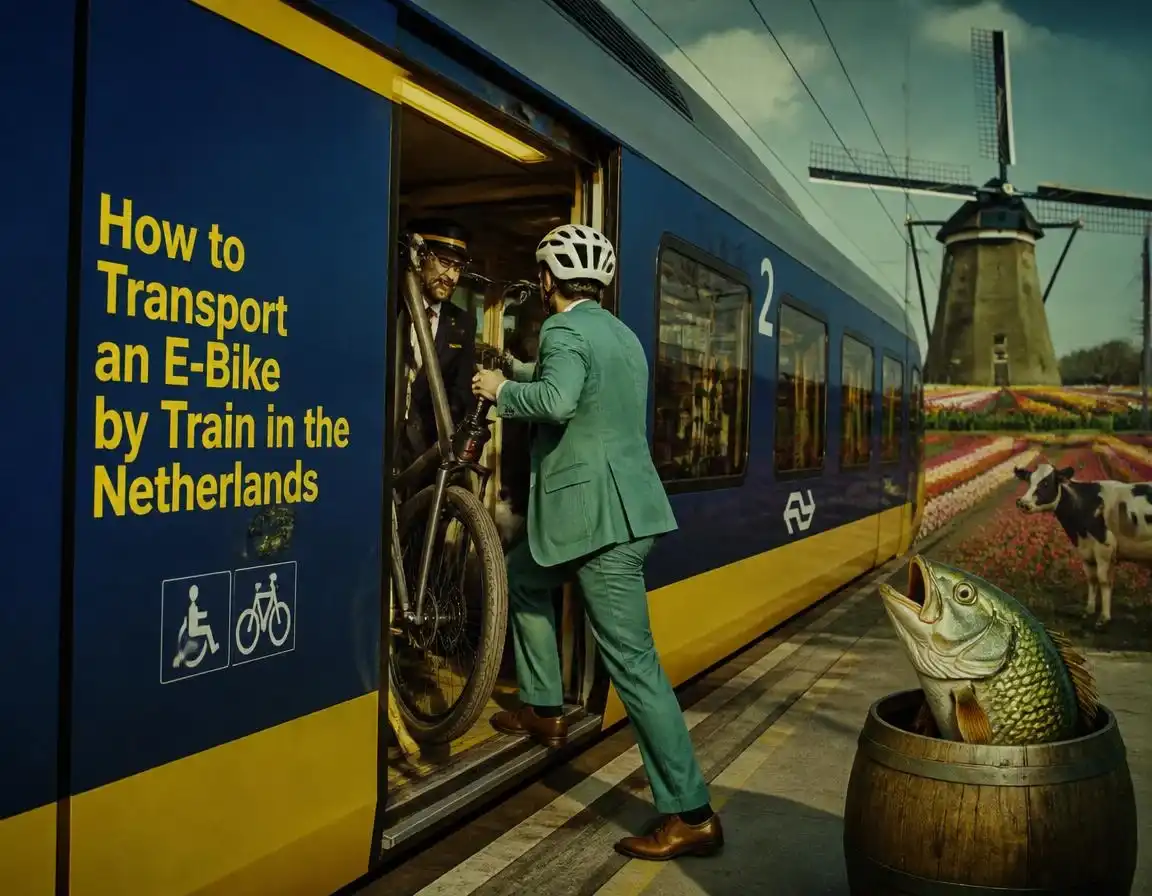
Yes, with three conditions. Your bike has to be a legal e-bike: a 250 W motor, assistance that cuts out at 25 km/h, and any throttle limited to a 6 km/h walk assist. That’s the definition in the Rijksoverheid’s e-bike rules and in our e-bike laws guide for 2026. You have to travel off-peak, or on a day when NS lifts the restriction. And you need a Fietskaart Dal bike ticket on top of your own travel ticket. Meet all three and NS treats your e-bike like a regular bicycle on domestic trains.
Miss one and it goes wrong quickly. Turn up at 08:15 on a Tuesday and the conductor can turn you away, because the weekday peaks are closed to bikes. Bring a speed pedelec (assistance up to 45 km/h) and you have a moped, which isn’t a bicycle to NS or anyone else. Our speed pedelec rules guide explains the class, and the e-bike speed limit guide shows where the line sits. Cargo bikes and trailers aren’t allowed at all.
Crossing a border is a different game. International carriers set their own battery limits, dimensions and booking rules, and some of them rule out most modern e-bikes. Most English-language guides skip that part, so there’s a carrier-by-carrier table further down. First, the domestic rules.
Fietskaart Dal: price, time windows and how to buy it
The ticket you need is the Fietskaart Dal, the off-peak bike ticket. In 2026 it costs €8.50 per bike per day. You need it on top of your own ticket every time, including at weekends and in July and August, when the time limits fall away but the ticket doesn’t. You can buy it online, in the NS app, or at a ticket machine or service desk at the station. Load the e-ticket into the app or print it. If you buy it at the station as a single-use chip card, you pay €1.60 extra, so buy it in the app before you leave.
On weekdays your bike can travel 09:00 to 16:00 and 18:30 to 06:30. That closes the 06:30 to 09:00 and 16:00 to 18:30 peaks. At weekends, on public holidays and throughout July and August there are no time limits. The exception is King’s Day (27 April, or 26 April when the 27th is a Sunday). NS lists it as the one public holiday that doesn’t get the all-day rule, so the normal off-peak windows apply. Check the NS planner for that date before you plan around it.
A few rules on the day save arguments with conductors:
- One bike per traveller. Your partner’s e-bike needs their own ticket and their own space.
- Board through the doors with the bike symbol. That’s where the bike spaces are, and the doors show how many bikes fit.
- Take your bags off the bike before you load it. NS asks for this so the space stays workable for everyone.
- Bike spaces full? Wait for the next train and follow staff instructions. Plan for a later train when you book a tight connection, because on busy routes a full rack is normal.
The conductor has the last word on whether a bike can come aboard. Being polite and having your ticket ready helps more than arguing the rules.
Which bikes NS allows and which it refuses
NS draws the line by bike type, not by whether there’s a motor. This is the domestic picture:
| Bike type | On NS domestic trains? | What you need |
|---|---|---|
| Regular, racing or mountain bike | Yes, off-peak (all day at weekends, on holidays except King’s Day, and in July and August) | Fietskaart Dal, €8.50/day |
| E-bike (25 km/h, 250 W) | Same windows as a regular bike | Fietskaart Dal, €8.50/day |
| Dismantled bike | Same windows | Fietskaart Dal, €8.50/day |
| Legal fatbike | NS doesn’t name fatbikes. It’s an e-bike in law, so it rides under the same windows if it fits the rack | Fietskaart Dal, €8.50/day |
| Folding e-bike, fully folded, under 45 × 86 × 80 cm | All day, peak hours included | Nothing. Free, and it goes in a luggage space |
| Folding e-bike over that size (folded or unfolded) | Off-peak only, like any e-bike | Fietskaart Dal, €8.50/day |
| Speed pedelec (45 km/h) | No | Legally a moped. NS’s bike rules cover regular and electric bikes only |
| Cargo bike, bike trailer, hand cart | No | Refused on NS trains |
| Tandem, tricycle or recumbent used as a mobility aid | All day, free | Must meet NS’s mobility-aid conditions |
The folding e-bike loophole
This is the most useful rule in the article. A fully folded bike smaller than 45 × 86 × 80 cm travels free all day, peak hours included, with no Fietskaart Dal. For a daily commuter that changes everything. You can ride the 08:15 with the rest of the office. NS asks you to put a folded bike in a luggage space rather than a bike space.
Measure your folded bike before you buy, don’t assume. NS gives the limit as 45 × 86 × 80 cm without saying which side is which, so check all three dimensions against all three limits. Compact folders such as the Brompton Electric fold well inside it. Some bigger 20-inch folders come out longer than 86 cm folded, and then you’re back to the Fietskaart Dal and the off-peak windows. A bike over the limit counts as oversize whether you fold it or not, so there’s no gain from carrying it half-open.
Price and weight matter too. Our folding e-bike category has compact models from about €2,800, weighing roughly 13.5 to 19 kg, and anything over about 20 kg gets hard to lift up stairs or onto a train. An employer scheme can soften the price, so see our guides to the company e-bike scheme and e-bike leasing for employees.
Why speed pedelecs and cargo bikes fail at the door
A speed pedelec assists up to 45 km/h, which makes it a moped under Dutch law, with the plate, AM licence, insurance and helmet that go with that. NS’s bike rules list regular and electric bikes, and NS International names speed pedelecs among the bikes it refuses on international trains. Plan as if a speed pedelec can’t come aboard. Cargo bikes fail for a plainer reason: they don’t fit the racks, and NS excludes cargo bikes, trailers and hand carts. If you’re weighing one up for school runs, our cargo e-bike guide is worth a read. Just plan your train trips around leaving it at home.
Fatbikes sit in between. A compliant fatbike is legally an e-bike (see our fatbike rules guide), so domestically it rides under the normal windows if it fits. Internationally it gets singled out, as you’ll see below.
Metro, tram, bus and regional trains
Leave the NS network and the rules split by operator. I’ve listed what I could confirm and left out anything I couldn’t, because these conditions change and operators don’t all publish them clearly. Check the operator’s own page before you rely on any of it.
| Service | Full-size e-bike | What to check |
|---|---|---|
| NS trains | Yes, off-peak with a Fietskaart Dal | See the windows above |
| NS buses | No | NS says there’s no space for bikes |
| Amsterdam metro and tram 26 (GVB) | Generally yes outside peak hours, with room for two bikes | Current ticket and times. GVB has said it is looking at fatbikes on the metro and tram 26 |
| Rotterdam metro (RET) | Generally yes outside peak hours, using the bike spaces in the carriages | Event days, when bikes are often banned |
| Other trams and buses | Mostly no | Some operators let compact folded folding bikes on board |
| Arriva, Keolis and other regional train operators | Differs by operator | Their own bike tickets and time limits. Don’t assume a Fietskaart Dal covers them |
The practical summary: your e-bike’s real enemy in Dutch cities isn’t the train, it’s the tram. Plan the station-to-door leg around a folding bike, an OV-fiets or simply riding.
Taking an e-bike on international trains: rules per carrier
NS says domestic cyclists aren’t allowed on the ICE, Eurostar or Nightjet, so your Fietskaart Dal stops being useful the moment you step onto one of those. Eurocity Direct and EuroCity work differently: you buy an international bike ticket from NS International. Each carrier then sets its own conditions, and the surprise for most e-bike owners is the battery. The ICE only takes e-bikes with a built-in battery of up to 250 Wh, and it refuses e-bikes with a removable battery. Most modern packs are 300 to 750 Wh, with 400 to 500 Wh the common range, and most are removable. Check your battery’s spec plate before you book anything.
| Carrier / route | E-bike allowed? | Key conditions | Bike spaces |
|---|---|---|---|
| Eurocity Direct and EuroCity (Belgium) | Yes | International bike ticket; battery must stay in or on the bike; folded folding bikes travel free as luggage; fatbikes, speed pedelecs and cargo bikes refused; no bikes to or from Brussel Centraal, Congres or Kapellekerk. NS International says bike spaces can’t be reserved, while NS’s domestic page mentions a reservation in peak hours and in July and August, so check at booking | 12 (Eurocity Direct), 8 (EuroCity) |
| ICE (Germany) | Only with a built-in battery of 250 Wh or less | Bike ticket plus a free, mandatory reservation, both from Deutsche Bahn; battery stays on the bike; no charging on board; removable-battery e-bikes refused; fatbikes only if the 40–60 mm tyre fits the rack; folded folding bikes travel as luggage | 8 |
| Eurostar, direct to London | Not assembled | Folded folding bike, or a dismantled bike fully packed in a cover with its longest side at most 85 cm, plus one bag and one piece of hand luggage; an electric folding bike must be folded and packed; no charging in stations or on board; fatbikes and speed pedelecs refused | Luggage only |
| Eurostar, Brussels to London | Assembled bikes possible | Reserve the bike space with Eurostar by email. NS International suggests Eurocity Direct to Brussels, then Eurostar, with two separate bike tickets | Limited per train |
| Eurostar to France | Packed only | Wheels off, in a bike cover of 135 × 85 × 30 cm; folded folding bikes count as hand luggage up to 75 × 53 × 30 cm | Luggage only |
| TGV (France) | Boxed on most services | Wheels off, cover up to 120 × 90 cm, bike plus cover up to 32 kg, name label on the bag. Assembled bikes only on the few TGVs with a bike carriage, with a reservation of about €10 per trip from SNCF | Few, or luggage only |
| Nightjet (Austria, Switzerland) | Yes, if it fits | Up to 185 cm long, 110 cm high and 60 cm wide, 28-inch wheels, tyres up to 4.2 cm, up to 30 kg; bike ticket plus mandatory reservation, booked by phone, at a counter or through an agent (not online); no charging on board. Without a bike carriage, only dismantled bikes packed up to 90 × 60 × 40 cm | 6 on the direct services from Amsterdam |
Source: NS International’s bike conditions per train, checked 10 October 2026. Conditions change, so confirm on the NS International bike page before you book.
Two things stand out in the small print. First, weight and tyre limits quietly exclude e-bikes even where the word “e-bike” is allowed. A 27 kg e-bike on 50 mm tyres fails the Nightjet’s 30 kg and 4.2 cm tests, and the same bike fails the ICE’s battery rule. Second, spaces are scarce. Six places on a direct Nightjet from Amsterdam go quickly, and you can’t book them online. A bike ticket is also no guarantee of a place on a Belgian train: if the spaces are full, your bike waits for the next one, and May to September is the busy stretch.
For most cross-border trips with a full-size e-bike, my honest advice is to check the Eurocity route first and rent at the other end for everything else. If you’re newer to the country, our guide to e-bike rental in Amsterdam shows what renting looks like.
Battery safety at stations and on board
The rules differ by carrier, but they point the same way. The ICE, Eurostar and Nightjet don’t allow charging on board, and Eurostar extends that to its stations. On the ICE and Eurocity the battery has to stay on the bike for the whole journey, so “I’ll carry the pack in my backpack” isn’t a plan. A damaged lithium cell is a fire in a sealed steel tube. Fires are rare per battery, but they’re concentrated in packs that are damaged, modified or charged badly.
Your side of the deal is simple:
- Don’t travel on a damaged battery. Swelling, cracks, a crash-damaged case or a pack that runs hot means the bike stays home until a dealer has checked it.
- Charge at home or at work, not at the station. Our guide on how to charge an e-bike battery correctly covers the habits that keep a pack healthy, and the Dutch fire brigade’s safe-charging advice covers the fire side.
- Take the battery with you when you park. It’s one of the most expensive parts on the bike, and thieves target loose batteries. See our guide to battery replacement costs for what losing one costs.
Four workarounds that beat the rules
🔑 1 · OV-fiets or OV-ebike at the other end
Leave your e-bike at home and rent at the arrival station. An OV-fiets costs €4.80 per 24 hours, and an OV-ebike costs €13.50, with €5 a day extra after three days and a seven-day maximum. You need a personal OV-chipkaart with the free OV-fiets subscription, you can’t reserve, and the OV-ebike is currently at only four stations, so check the NS app first.
🧳 2 · A folding e-bike as luggage
Folded under 45 × 86 × 80 cm it rides free all day on NS trains, peak hours included. The cost is the bike itself, from about €2,800. It pays off most for daily commuters who have to travel in the peaks.
🏪 3 · Rent at your destination
City shops stock compliant 25 km/h pedelecs by the day or week. Our guides to e-bike rental in Amsterdam and e-bikes for international students compare the realistic options and prices.
4 · Park it at the station and lock it properly. Sometimes the smartest way to “transport” an e-bike by train is not to. On many big stations NS gives you the first 24 hours of supervised bike parking free, and later days cost roughly €0.75 to €1.35 at the rates we’ve seen in Utrecht. Stations are still theft hotspots, though. Our piece on how common e-bike theft is has the numbers. If you go this way, budget for a serious lock (our best e-bike lock guide covers what survives an angle grinder) and think about a tracker from our GPS tracker roundup.
What each option costs per day
Read the chart as door-to-door thinking, not just ticket prices. The Fietskaart Dal’s €8.50 makes sense when the e-bike you bring is the one you want at the other end: your own saddle, your own child seat, your own lock. The OV-fiets at €4.80 is cheaper and skips every peak-hour and full-rack headache, but you ride a basic station bike. The OV-ebike adds assistance for €13.50 and a bit of availability risk. The folding e-bike is free per trip, but the bike starts around €2,800.
For a commuter the sums look like this. A Fietskaart Dal on all 220 working days would come to about €1,870 a year, which is my own arithmetic, not an NS figure. But the Dal can’t get you on a peak-hour train at all, and that’s the folding bike’s real selling point. Here’s how I’d choose:
| Your situation | Best fit | Why |
|---|---|---|
| Daily commuter who has to travel in the peaks | Folding e-bike under 45 × 86 × 80 cm | The only option that rides at any hour, and it’s free per trip |
| Day trip on your own e-bike, off-peak or at the weekend | Fietskaart Dal | €8.50 and your own bike at both ends |
| One-way trip, visitor, or peak-hour trip without a folder | OV-fiets or OV-ebike | Rent at the far station, with no space or timing limits |
| Cross-border trip | Check the carrier table first | Eurocity to Belgium is the easiest. The ICE and the direct Eurostar usually rule out a standard e-bike |
Your first e-bike and train trip: an eight-step checklist
- Confirm your bike’s class. 250 W, assistance cutting at 25 km/h, and any throttle only a 6 km/h walk assist? Then it’s a bicycle and this guide applies. Anything faster is a moped and stays home.
- Pick an off-peak train on weekdays (09:00 to 16:00 or after 18:30), or any train at weekends, on holidays and in July and August. Treat King’s Day like a weekday.
- Buy the Fietskaart Dal (€8.50) in the NS app before you leave home, next to your own ticket. At the station as a chip card it costs €1.60 more.
- Strip the bike: bags and crates off before you reach the doors.
- Board through the doors with the bike symbol and use a bike space. A folded folder goes in a luggage space.
- Racks full? Step back and wait. Follow staff instructions and take the next train.
- At the destination, ride straight off, or use supervised parking with the battery taken with you.
- Crossing a border? Re-check the carrier table above and book the bike space well ahead, especially the Nightjet’s six places.
FAQs
Can I take my e-bike on a Dutch train during peak hours?
Not with a Fietskaart Dal. On weekdays your bike can travel between 09:00 and 16:00 and between 18:30 and 06:30. At weekends, on public holidays (except King’s Day) and throughout July and August it can travel all day. The one way onto a peak-hour train is a folding bike folded smaller than 45 × 86 × 80 cm, which travels free as luggage at any hour.
How much does it cost to take an e-bike on the train in the Netherlands in 2026?
A Fietskaart Dal costs €8.50 per bike per day on top of your own travel ticket, and you need it at weekends and in July and August too. Buying it at the station as a single-use chip card costs €1.60 extra. A fully folded folding bike under 45 × 86 × 80 cm travels free. International trains charge their own bike tickets, and the Fietskaart Dal is not valid on ICE, Eurostar or Nightjet.
Can I take an e-bike on the ICE to Germany or the Eurostar to London?
On the ICE, only an e-bike with a built-in battery of 250 Wh or less, which must stay on the bike, with a bike ticket and a free reservation from Deutsche Bahn. Removable batteries are refused, so most modern e-bikes can’t go. On the direct Eurostar between Amsterdam or Rotterdam and London, only folded or dismantled bikes packed in a cover are allowed. Assembled bikes are only possible between Brussels and London, so many riders take Eurocity Direct to Brussels first.