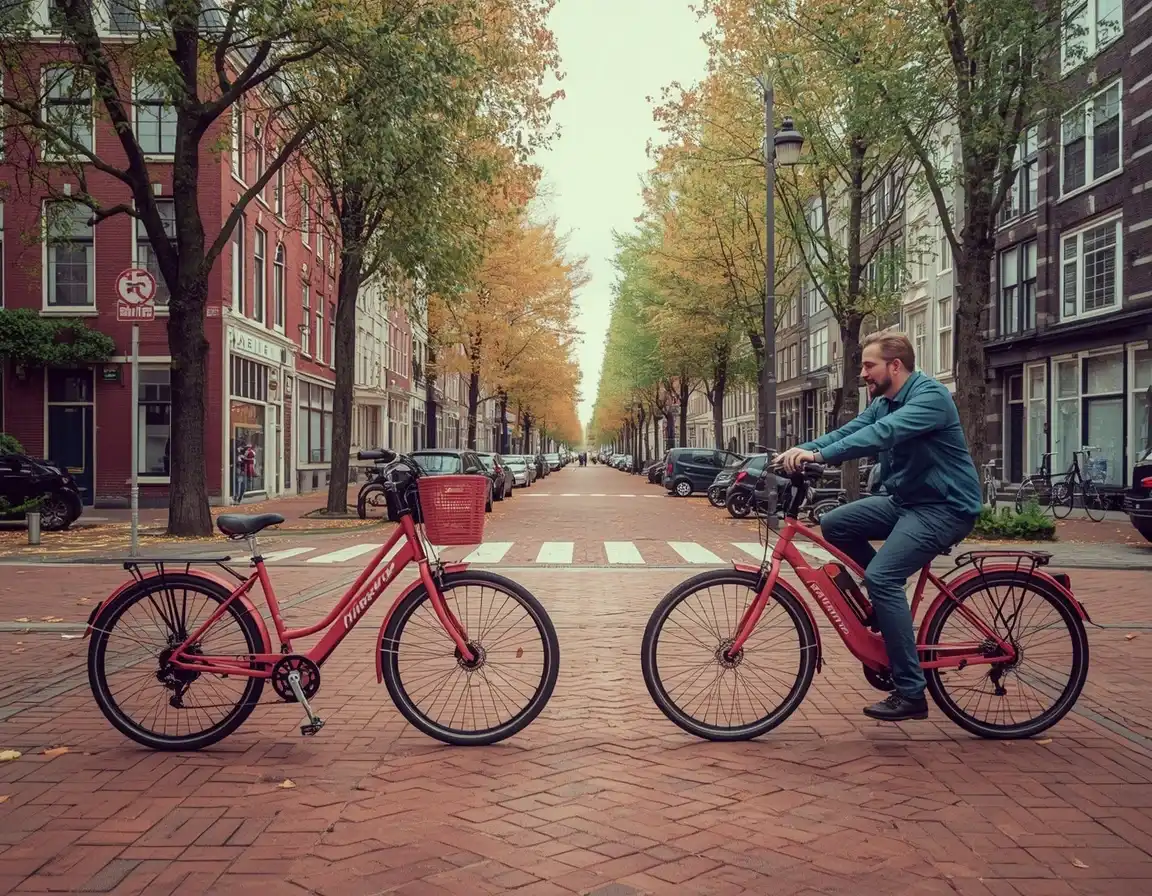
E-bike vs regular bike in the Netherlands

Commuting · Netherlands · 2026
E-bike vs regular bike in the Netherlands: which one wins your commute?
The short version
For commutes under 5 km, a regular bike is hard to beat: cheap, light, and just as quick door to door. From about 5 km up, the e-bike takes over the Dutch commute. You save 10–15 minutes per trip, your shirt stays dry, and headwind stops being a personal attack. The catch is €2,000+ extra up front — unless your employer’s bike scheme turns it into a €5-a-month machine. Below: real numbers on speed, sweat, health and three-year costs.
The Netherlands counts roughly 24 million bicycles for about 18 million people, and we pedalled 19.1 billion kilometres in 2023 alone — an average of 1,065 km per person, up from 902 km a decade earlier. A fast-growing slice of those kilometres is electric: 43% of Dutch cyclists aged 12 and over now ride an e-bike at least some of the time, and around half of the new bikes sold in recent years have been electric. The commute is where the shift shows most. Roughly a quarter to a third of Dutch home–work trips are cycled, and that share holds up far better at 5–10 km than at 10–15 km — exactly the gap the e-bike is closing, since Dutch e-bike owners routinely cover trips that would feel like too much on a regular bike.
So the interesting question is not “are e-bikes popular?”. It is: for your commute, your budget and your work shirt, which bike is the better pick in 2026? That is exactly what we compare below.
⏱️ Speed and commute time: what the motor actually buys you
Let’s start with the difference you feel every single day: time. Door to door in town, most commuters average about 14–17 km/h on a regular bike. On an e-bike we typically see 18–22 km/h over the same route. Not because the motor pushes you to 25 km/h everywhere — traffic lights, corners and school groups don’t care about your motor — but because you pull away faster, hold your speed into headwind, and reach every junction with fresher legs.
| One-way distance | Regular bike (14–17 km/h) | E-bike (18–22 km/h) | Saved per return trip |
|---|---|---|---|
| 5 km | about 20 min | about 15 min | about 10 min |
| 10 km | about 40 min | about 30 min | about 20 min |
| 15 km | about 60 min | about 45 min | about 30 min |
Three nuances matter here. One: on a legal Dutch e-bike the motor support cuts out at 25 km/h, and above that speed it’s all you — our guide to where the e-bike speed limit actually sits explains the motor-versus-legs distinction. Two: under about 3 km the gap nearly disappears, because traffic lights eat most of the trip anyway. Three: the savings compound brutally in your favour. Ten minutes saved each way on a 10 km commute is about 20 minutes a day — close to 70 hours a year if you ride four or five days a week. That is almost two working weeks, handed back to you before 09:00.
💦 The sweat factor: arrive as a person, not a puddle
Nobody lists “arrives dripping” as a skill, yet plenty of Dutch commutes end exactly like that between May and September. On a regular bike, your effort is fixed by distance, wind and how late you are running. On an e-bike, effort is a dial: support up when you’re in work clothes, support down when you want a training ride.
This is the most underrated difference in the whole comparison. If your workplace has a shower and you enjoy training, sweat is a feature. If you wear a shirt, carry a laptop bag and have a stand-up at 08:45, sweat is a tax on every single trip — and the e-bike simply cancels it. In winter the roles flip a little: a regular bike keeps you warm without overheating, while e-bike riders sometimes arrive too fresh and need an extra layer.
❤️ Health and fitness: yes, an e-bike commute still counts
Short answer: yes, e-bike commuting is real exercise. Just a different dose. At a relaxed 16–19 km/h, published estimates put e-bike riding at roughly 175–400 kcal per hour depending on your body weight, against roughly double that on a conventional bike at the same speed — the exact numbers move a lot with weight, wind and how much assistance you use. Dutch and Belgian health research has also found heart rates only around 10 beats per minute lower on a pedelec than on a regular bike in comparable conditions. Either way, that lands squarely in the moderate-intensity zone that health guidelines ask you to hit each week.
The twist is behavioural. E-bike owners tend to ride more often, over longer distances and in worse weather, because the bike removes the excuses — Belgian research found average trip length roughly doubles once someone switches from a regular bike to an e-bike. Weekly activity totals therefore often end up level — or better — than on a regular bike that stays in the shed on windy Fridays. The best exercise is the one that survives contact with a rainy Tuesday.
Want more burn on an e-bike? Ride eco mode, switch support off for the last three kilometres, or stand up on every bridge. Want less effort on a regular bike? There is no less.
🌬️ Rain, headwind and the “flat country” myth
Two weather myths about Dutch cycling, corrected. Myth one: it rains constantly. Reality: the KNMI counts precipitation on an average of 192 days a year (at least 0.3 mm) — annoying, but most showers are brief, and both bikes get equally wet. Rain is not the deciding factor here; proper mudguards and a good jacket are.
Myth two: the country is flat, so who needs a motor? Reality: the Netherlands is flat but windy, and polder headwind does not care about your calf muscles. Add the bridges and viaducts of Amsterdam, Rotterdam and Utrecht, plus every flyover across the A2 and A12, and a “flat” commute has plenty of moments where 250 watts feels like a friend. This is exactly where an e-bike stops being a luxury and starts being a tool: same wind, same bridge, half the drama. A regular bike answers headwind with character building, which is lovely until you’re 44 and running late.
💰 The real three-year cost comparison
Here is where the regular bike fights back hard. Purchase price is only the opening move; the three-year total is the real game.
| Cost item | Regular city bike | E-bike (25 km/h pedelec) |
|---|---|---|
| Buy new, decent quality | €500–€900 | €1,800–€3,000 (average dealer price in 2026: €2,350–€2,700) |
| “Fuel” per 100 km | your own ~3,500 kcal | about €0.25 in electricity |
| Servicing per year | €60–€100 | €150–€250 |
| Insurance per year | optional, roughly €30–€60 | from ~€35 theft-only; €70–€240 for fuller cover on pricier bikes |
| Insurer-approved locks | one ART-2/3 lock, €40–€90 | two ART-2+ locks, €80–€160 |
| The big surprise | none, really | battery replacement €400–€680 around year 4–6 |
| Three-year total, private purchase | about €1,000–€1,200 | about €3,000–€3,500 |
| Three-year total, company plan | not applicable | about €160–€250 in tax, service often included |
Prices are indicative 2026 figures and move with frame, battery size and dealer.
A full charge of a typical 500 Wh battery costs around €0.20 at current Dutch electricity prices and covers 60–100 km. Charging habits matter more for battery lifespan than for your wallet — charge it correctly and the pack easily reaches 500–1,000 cycles.
Read privately, an e-bike costs roughly three times what a regular bike costs over three years, mostly through purchase price and depreciation. Electricity is almost laughably cheap; servicing, insurance and that eventual battery swap are not. Our full breakdown of what an e-bike really costs in the Netherlands and of battery replacement prices goes deeper if you want the fine print.
Then the tax twist that changes everything:
- Company bike (fiets van de zaak): you pay tax on 7% of the consumer price per year. A €2,500 e-bike works out at roughly €5–€7 a month net, often with servicing and theft insurance included — the Belastingdienst’s own fietsplan example uses exactly this maths.
- Your own bike: employers may pay up to €0.25 per kilometre tax-free in 2026, raised from €0.23 and backdated to 1 January 2026, as Rijksoverheid’s kilometre allowance page confirms. On a 12 km daily return trip that is around €640 a year, tax-free — enough to cover most of the e-bike premium on its own.
- No stacking: a company bike ends your tax-free kilometre allowance for the commute on the days you use it. Compare both sides before you sign, and run the numbers in our e-bike lease guide and our overview of every 2026 subsidy and tax route.
📜 Dutch rules and tax tricks that shape your commute in 2026
The legal side is refreshingly simple for a standard e-bike: motor no bigger than 250 W continuous, support cutting out at 25 km/h, and a throttle allowed only as a 6 km/h walk assist. Stay inside those lines and your e-bike is legally a bicycle — no helmet, no licence, no number plate, no insurance, no minimum age. Step outside them and the bike becomes an unapproved moped, which brings fines and the risk of seizure. Our 2026 Dutch e-bike law overview and helmet guide keep all of this current.
A speed pedelec (45 km/h) belongs to that moped class straight from the factory: AM licence from age 16, certified helmet, WA liability insurance and RDW registration are mandatory, and you ride moped infrastructure. For 20–40 km commutes it is a genuine option, but a niche one — CBS counted 35,400 speed pedelecs on 1 January 2025, up 6.5% on the year before, with growth slowing sharply from over 20% a year around 2020.
One item on the horizon is worth knowing before you buy: a national helmet requirement for e-bike riders under 18 is being worked towards, with September 2027 mentioned as a target, though the legislation still has to pass parliament. A handful of Dutch municipalities have also been trialling advisory (non-mandatory) lower speed limits on their busiest cycle paths — check locally if this affects your route, since these are pilots rather than a nationwide rule.
🔒 Theft, parking and insurance: the boring stuff that matters
The unpleasant chapter. Dutch police registered 86,950 bicycle thefts in 2025, about 45% more than in 2021, and e-bikes are among the favourite targets for thieves. Weight matters too, just not in the thief’s disfavour: an e-bike of 25–30 kg is a workout to carry up stairs, where a 17–20 kg regular bike is merely annoying.
The practical checklist we give every commuter:
- Two ART-2+ rated locks on an e-bike. Most Dutch insurers, ANWB included, require this for a payout on higher-value bikes — see our test of the best e-bike locks in the Netherlands.
- Insurance is not legally required on a 25 km/h e-bike, but theft-only cover starts around €3 a month. Our e-bike insurance guide compares the real 2026 premiums.
- A hidden GPS tracker turns many stolen-bike stories into recovered-bike stories.
- At work, ask about monitored or indoor parking. A €3,000 bike left on an open street for eight hours is a donation with extra steps.
🧭 So which bike fits your commute?
| Your commute looks like… | Our pick | Why |
|---|---|---|
| Under 5 km, mostly flat | Regular bike | The time gap is a few minutes; cheaper, lighter, zero charging |
| 5–15 km | E-bike | 10–30 minutes saved per day, dry shirt, headwind neutralised |
| 15–30 km | E-bike, or a speed pedelec if you accept the moped rules | A regular bike turns the trip into a sport session, not a commute |
| Office clothes, no shower at work | E-bike | Effort is a dial you control |
| Training is the whole point | Regular bike, or e-bike in eco mode | Roughly double the calorie burn of an e-bike at the same speed, no shortcuts |
| Kids and crates along the way | Cargo e-bike | The weight is exactly why the motor exists — see the best cargo e-bikes of 2026 |
| Budget under €1,000 | A good second-hand regular bike, or a careful e-bike pick | Check the sub-€1,000 e-bikes, the best budget e-bikes under €1,500 or our second-hand e-bike buying guide |
Our honest takeaway after years of testing both: the regular bike wins on price and purity, while the e-bike wins on almost everything that happens between 5 and 15 km from your front door. If your commute sits in that band and you ride it four or five days a week, an e-bike pays you back in hours, dry shirts and headwind-free winters — doubly so through an employer scheme, and our pick of the best e-bikes for expats is a solid starting point if you’re new to Dutch traffic. If your commute is a 3 km hop across a city centre, save your money and enjoy the exercise.
Either way, choose the bike that makes you look forward to the ride. That is the one you will actually use, and use beats theory every single morning.
❓ FAQs
How much faster is an e-bike really on a Dutch commute?
Typically 4–6 km/h faster door to door in town: about 18–22 km/h against 14–17 km/h on a regular bike. On a 10 km trip that saves roughly 10 minutes each way, so about 20 minutes a day and close to 70 hours a year on a four-to-five-day commute week. Under about 3 km the advantage almost vanishes, because traffic lights and junctions dominate the trip.
Does an e-bike commute still count as exercise?
Yes. At a relaxed pace, e-bike riding burns roughly half to two-thirds of what conventional cycling burns at the same speed, with the exact figure depending heavily on body weight and how much assistance you use, and heart rates run only around 10 beats per minute lower in comparable conditions. That is still moderate intensity, the kind health guidelines recommend. Because e-bike owners ride more often and over longer distances, weekly activity totals frequently end up equal to or higher than on a regular bike.
Can my employer make my commuting e-bike almost free?
Often, yes. Through the fiets van de zaak you pay tax on just 7% of the consumer price per year — about €5–€7 a month on a €2,000–€2,500 e-bike — and some employers absorb even that via the WKR free space. The alternative is keeping your own bike and receiving up to €0.25 per kilometre tax-free in 2026. You cannot combine both on the same kilometres, so compare the two before you sign.