E-Bike Won’t Turn On? A Step-by-Step Troubleshooting Guide

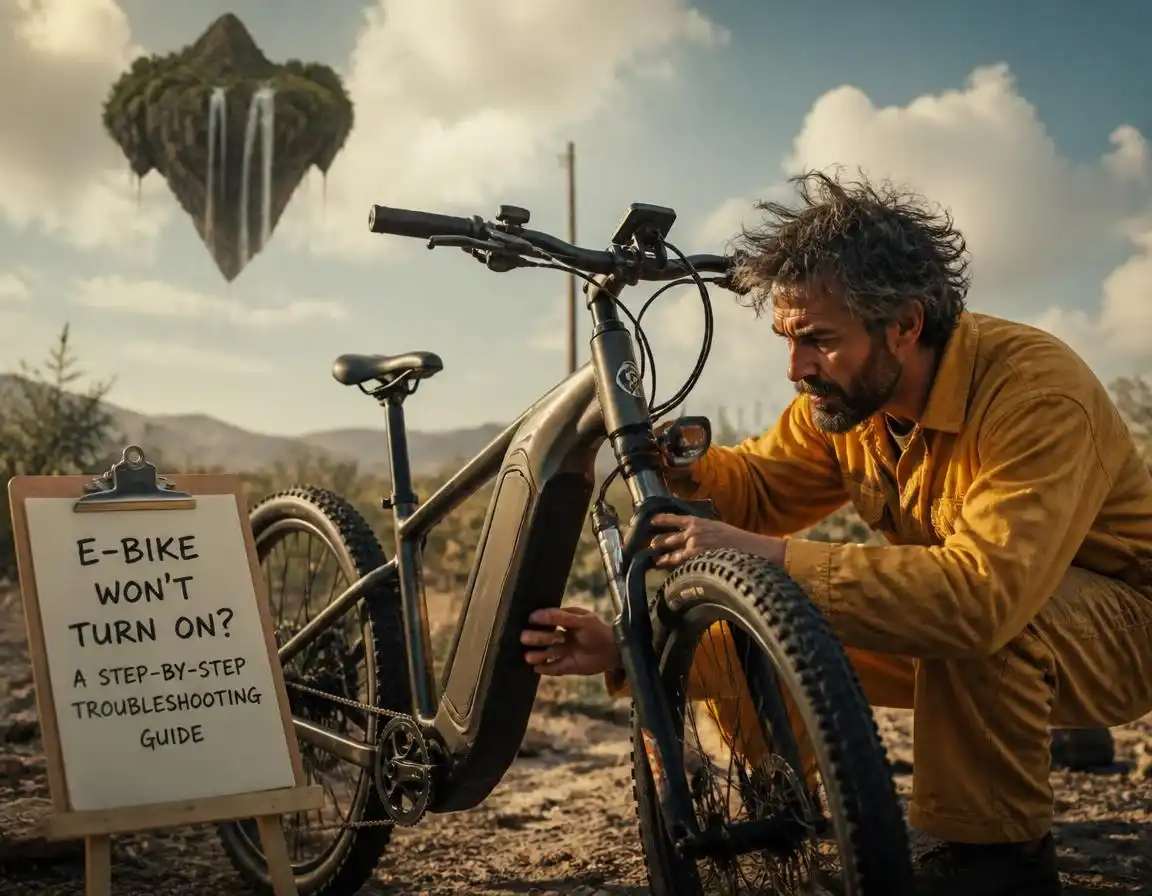
E-Bike Won't Turn On? A Step-by-Step Troubleshooting Guide
Nine times out of ten, an e-bike that won't switch on is not broken — it is protecting itself. A flat or deeply discharged battery, a loose contact, a stuck brake sensor or a confused BMS causes most no-power complaints. Work from the cheapest cause upwards: charge it properly, reseat the battery, clean the contacts, read any error code. If that fails, this guide walks you through the rest, with typical Dutch repair prices.
If your e-bike won't turn on and you're staring at a blank display wondering whether you've just inherited a very expensive garden ornament, take a breath first. We've worked through this exact problem on Bosch, Shimano, Bafang and hub-motor bikes across every fault family below, and the honest truth is that a genuinely dead motor or controller is rare. Most "no power" cases trace back to one of a handful of causes, and this guide is built to get you there in the right order, without guessing or paying for a diagnostic you didn't need.
First: what does "won't turn on" actually mean?
Walk into any workshop with a "dead" e-bike and the mechanic's first question is not "what brand is it?" but "what does it do when you press the button?" That one question splits every no-power fault into three families, and each family has its own fix list. Find your row below and jump straight to the matching section.
| What you see | Most likely culprits | Go to |
|---|---|---|
| Completely dead: no display, no LEDs, nothing at all | Empty or sleeping battery, dead charger, dirty contacts, blown inline fuse | Battery & charger |
| Display lights up, but the motor gives zero assist | Brake cut-off sensor, speed-sensor magnet, error code, near-empty battery | Display on, no assist |
| Works sometimes, then dies over bumps, in rain or when cold | Loose connector, corroded contacts, water ingress, chafed wiring | Wiring & cut-offs |
If you are not sure which row you belong in, start at the top of the next section anyway. The 60-second checks are safe on every e-bike, every brand, every age.
The 60-second checks (do these before anything else)
- Ask the battery directly. Almost every removable pack has its own small button and a row of LEDs. Press it. If LEDs light up, the battery holds charge and the fault sits somewhere downstream — display, wiring or controller. If nothing lights, the battery or the charger is your suspect and you can skip half of this article.
- Reseat and lock the pack. Take the battery out, glance at the contacts, click it back in and turn the key fully. A surprising number of "dead" e-bikes were simply half-clicked into place after a kerb bump or a rough ride over cobbles.
- Read the charger light. The little LED on the charger brick tells you more than any display:
| Charger light | What it usually means |
|---|---|
| Solid red or orange | Charging normally — leave it alone and let it finish |
| Green | Pack full — or, if you know the pack was empty, the charger cannot see the battery at all |
| No light at all | Charger, socket or cable is dead; try a different wall socket first |
| Flashing or alternating colours | Fault signal: pack too hot, too cold or too empty for charging; check your manual |
- Let the brake levers spring back. Most e-bikes have motor cut-off sensors in the brake levers. A lever that sticks a millimetre from its rest position keeps the cut-off engaged. Push each lever out and let it snap back twice.
- Wipe the contacts. With the battery out, wipe the metal contacts on both pack and bike with a dry cloth. Dutch rain and road spray leave a thin film that blocks current beautifully.
- Do a hard reset. Switch the bike off, remove the battery, wait ten to fifteen minutes so the battery management system fully powers down, then refit and try again. This clears a surprising amount of electronic grumpiness.
If the display stays dark: battery and charger diagnostics
Still nothing? Now we get serious, and the battery is first in the dock — it is the cause in the large majority of completely dead e-bikes.
Deep discharge: the silent killer
A lithium-ion pack that sits at zero percent for weeks drops below the voltage floor its electronics need to wake up. The BMS then shuts the pack down for its own protection, and no amount of button-pressing changes that. The fix to try: connect the original charger and leave it connected for up to 24 hours in a dry room at room temperature, even if nothing seems to happen. A deeply discharged pack can wake up slowly. If the battery's own LEDs remain dark after a full day, the cells or the BMS are damaged, and you are looking at a professional rebuild or a replacement — our guide to what a replacement battery costs in the Netherlands has the current 2026 prices.
This is exactly why we keep repeating ourselves about storage in our guide on how to charge an e-bike battery correctly: never park a pack empty, and check a stored battery every two to three months.
Cold weather paralysis
Below roughly 0 °C many battery management systems simply refuse to charge, and range feels much shorter on the road. If your bike died or refused to charge on a freezing January morning, bring the pack inside and let it warm to room temperature before you judge it. Never charge a frozen battery — that one habit alone saves packs.
Charger or battery? Splitting the blame
A charger with no light, a rattle inside, or a faint burnt smell is a dead charger. Test the other way round too: a healthy pack on a known-good charger of the exact same model should show charging within a minute. Only ever borrow or buy a genuine charger of the identical model; voltage and charge profile are matched to your pack, and a lookalike bargain charger is how warranties and batteries die together. Our accessories guide covers what to look for in a genuine replacement.
The optional multimeter check
If you own a multimeter, set it to DC volts and touch the probes to the battery's main terminals. A healthy 36 V pack reads somewhere between about 36 and 42 V; a 48 V pack between about 48 and 54 V. A reading far below the nominal voltage on the label confirms deep discharge or dead cells. What you should never do is open the pack or probe inside it — there is enough current in there to do real harm. If the numbers confuse you, skip them and hand the pack to a shop.
Display on, but the motor gives nothing? Follow this path
A lit display is good news in disguise: the battery is delivering power, so the fault sits in a sensor, a safety cut-off or the software. Work through these in order.
- Read the screen before you touch anything. An error code changes the whole diagnosis — jump to the table below.
- Test the brake cut-offs. Push both levers out firmly and let them snap back. On bikes with accessible sensor plugs, unplug one cut-off at a time with the system off, then switch on: if assist returns with one sensor disconnected, you have found the sticky or failed one.
- Check the speed-sensor magnet. A small magnet on a rear-wheel spoke has to pass the sensor at roughly 5 to 8 mm. Knocked magnets — after a wheel removal or a fall — cause cut-outs and speed-sensor codes. Spin the wheel and watch the gap.
- Switch on with the pedals free. Shimano systems calibrate their torque sensor at start-up. Switching on with a foot on a pedal, or with the crank pressed against a wall or lock, triggers a start-up warning and sometimes no assist at all. Switch off, clear the cranks, switch on again.
- Respect the empty tank. A pack at its last percent may still light a display while the system withholds assist to protect the cells. Charge before you condemn anything.
Error codes worth knowing
Codes are the system talking to you. Write the number down before it disappears, check your manual, and use this table for the ones we meet most often on Dutch bikes.
| System | Code | Meaning | First move |
|---|---|---|---|
| Bosch (legacy) | 410 | Control buttons stuck or blocked | Clean and dry the buttons, restart |
| Bosch (legacy) | 414 | Display connection interrupted | Reseat the display, clean its contacts |
| Bosch (legacy) | 503 | Speed sensor error | Check magnet alignment and sensor cable |
| Bosch (legacy) | 530 | Battery authentication / communication error | Reseat and lock the battery; dealer if it returns |
| Bosch (legacy) | 540 | Drive unit outside safe temperature range | Let it cool down or warm up, then retry |
| Shimano STEPS | E010 | General system error | Restart with no pressure on the pedals, reseat battery |
| Shimano STEPS | E020 | Battery and motor lose communication | Lock the battery firmly, clean contacts, check for trapped cables |
| Shimano STEPS | W013 | Sensor start-up not finished | Switch on with both cranks completely free |
| Bafang | 06 / 07 | Battery voltage too low / too high | Charge properly; dealer check if it repeats |
| Bafang | 21 | Speed signal fault | Magnet and sensor alignment |
| Bafang | 30 | Display communication fault | Check the display cable at both ends |
A code that disappears after a clean restart is a warning. A code that returns every ride is a part asking to be replaced, and a dealer diagnostic tool reads the extended codes behind the short ones in minutes.
Rain, puddles and flooded streets: the water protocol
E-bike systems shrug off rain — they are built for it — but they are not built for submersion. A dipped cargo bike, a flooded street in autumn, a canal-side accident: that is when water becomes the answer to "why won't it turn on?". If yours got properly wet or went under, follow this order and do not skip steps:
- Do not switch it on and do not plug it in. Powering or charging a wet system is how small water damage becomes total write-off damage.
- Remove the battery and dry its casing and the cradle contacts with a clean, dry cloth.
- Stand the bike somewhere warm and dry for 24 to 48 hours. A hallway is fine; a radiator or hair dryer is not, because fast heat drives moisture deeper and stresses seals.
- Inspect the connectors for white or green crust. Clean corrosion with a dry brush or cloth, then protect the contacts with a thin film of technical Vaseline.
- Only then refit the battery and try a normal start.
If the bike was fully submerged, or the pack shows swelling, smell or residue around its seams, stop: that battery goes to a certified collection point, not in your bin or back on the bike. The Dutch government explains where you can hand in dead batteries and e-bike packs — any bike shop or municipal waste point takes them.
Wiring, connectors and the cut-offs nobody remembers
Intermittent faults — fine on Tuesday, dead on Wednesday, alive again after you kick the stand — are almost always mechanical: a connector that vibrated loose or a contact that corroded. Here is where we look first, in order of how often each one pays off.
- The display plug. On removable displays the contact block on the stem corrodes and loosens. Reseat it and clean the pins.
- The motor cable plug at the chainstay, which people forget to reconnect properly after a puncture repair.
- Chafed cables on cargo and delivery bikes, where loads and racks rub the same centimetre of loom every day.
- An inline fuse on some hub-motor bikes, hidden in a rubber cap on the battery lead. Swap it for one of the identical rating.
- The wiggle test: with the system switched on, gently wiggle each connector. A flicker of life tells you exactly which one is guilty.
And a very Dutch one: mice. A bike stored in a shed over winter is a nesting opportunity, and rodents chew cable insulation with real enthusiasm. If a stored bike wakes up dead with ragged wiring, that is your answer — and one more reason to follow the power-on ritual in our second-hand e-bike buying guide before paying for any used bike.
When it's the controller or the motor
Two boxes on an e-bike are sealed for good reasons: the controller (the bike's brain, usually a aluminium box or bag near the motor or battery) and the motor itself. Typical controller signatures: display alive, no assist, no sensor cause found, sometimes a faint burnt smell, often after a soak or a bump. Typical motor signatures: internal-fault or communication codes that survive every reset, grinding or clicking from the drive, or assist that cuts out only when the motor is hot.
Both are dealer jobs. Opening them yourself voids the warranty, and a mid-drive motor contains voltages and tolerances that do not forgive kitchen-table surgery. A diagnostic session at a dealer pinpoints the faulty box quickly, and knowing the prices below makes the quote less scary.
What fixes cost in the Netherlands (2026)
These are the ranges we see and hear from Dutch dealers in 2026. Always ask for a written quote before work starts, and ask whether the diagnostic fee is deducted from the repair — at many shops it is.
| Fix | Typical price, NL 2026 |
|---|---|
| Diagnostic session at a shop | €25–€50 (often waived if you repair there) |
| Brake cut-off sensor adjusted or replaced | €0–€40 |
| Speed sensor or magnet replaced | €20–€60 fitted |
| Genuine replacement charger | €60–€150 |
| Display unit replaced | €90–€300 |
| Controller replaced, fitted | €120–€450 |
| New branded battery, 500–750 Wh | €420–€830, plus €30–€80 fitting for in-frame packs |
| Professional re-celling (revisie) of your old pack | €200–€500 |
| Mid-drive motor replaced, fitted | €400–€900 depending on system |
Battery prices move with capacity and brand, so check our full breakdown of e-bike battery replacement costs in the Netherlands before you accept any quote — shops regularly sell below list price.
The 10-minute routine that stops most no-power mornings
- Store at 30–60% and check a standing bike every two to three months. A forgotten pack that drifts to zero is a pack that dies.
- Live in the 20–80% window for daily commuting; fill to 100% only before long rides. Our charging guide explains why partial charges do not harm modern packs at all.
- Wipe the contacts monthly in the wet season and keep a thin film of technical Vaseline on them.
- Dry the battery compartment with a cloth before refitting the pack after a soaked ride.
- Keep firmware current at the annual service; updates fix communication bugs that show up as dead bikes.
- One charger only: the original, or a genuine identical replacement. Borrowed lookalikes are a classic cause of slowly cooked packs.
Battery habits matter more than brand badges — we explain the lifespan maths, from 500 to 1,000 full cycles, in our piece on how long e-bike batteries really last.
Fix it at home or hand it over?
| Safe and sensible at home | Hand to the shop |
|---|---|
| Charging, reseating and locking the battery | Anything inside a sealed battery pack |
| Cleaning contacts and plugs | Opening the motor or controller |
| Hard resets and firmware updates via the official app | Error codes that survive a clean restart |
| Brake lever spring-back and magnet alignment | Any bike that was fully submerged |
| Swapping an identical inline fuse or genuine charger | Burnt smells, swollen packs, damaged insulation |
| The wiggle test on external connectors | Anything still under warranty — DIY opening voids it |
In Amsterdam and unsure where to go? Our roundup of e-bike repair shops in Amsterdam lists workshops that diagnose Bosch, Shimano, Yamaha and Bafang systems properly, instead of guessing at your expense.
FAQs
My e-bike display lights up but I get no pedal assist. Is the motor dead?
Almost certainly not. A lit display means the battery is delivering power, so the fault sits in a sensor or a safety cut-off. The usual suspects are a brake lever that does not spring fully back, a speed-sensor magnet that slipped out of alignment, an error code waiting on the screen, or a battery so low that the system withholds assist. Work through those four in order. If a code stays after a clean restart with no pressure on the pedals, a dealer diagnostic tool pinpoints the part in minutes.
Can an e-bike battery recover after months in the shed at zero charge?
Sometimes. A pack left empty drops below the voltage floor of its BMS and goes to sleep. Plug in the original charger, even if nothing seems to happen, and leave it connected for up to 24 hours in a dry room at room temperature; a deeply discharged pack can wake slowly. If the battery's own LEDs still show nothing afterwards, the cells or the BMS are damaged, and your options are a professional rebuild with new cells (€200–€500) or a replacement pack. Storing at 30–60% and checking every two to three months prevents this entirely.
Is it worth repairing an e-bike that won't turn on, or should I replace the bike?
Compare the quote with the value of the bike and the age of its system. Sensor, charger, display and controller repairs usually make sense on any quality frame, and a new branded battery of €420–€830 keeps a good bike going for another five years or more. The maths turns when the bike is eight to ten years old and the motor system is no longer supported, because parts get scarce. In that case a repair quote above roughly half the price of a decent new machine — see our pick of budget e-bikes under €1500 — is your signal to start shopping instead.