E-Bike Speed Limit in the Netherlands

E-Bike Speed Limit in the Netherlands: 2026 Rules for Every Class
The short version
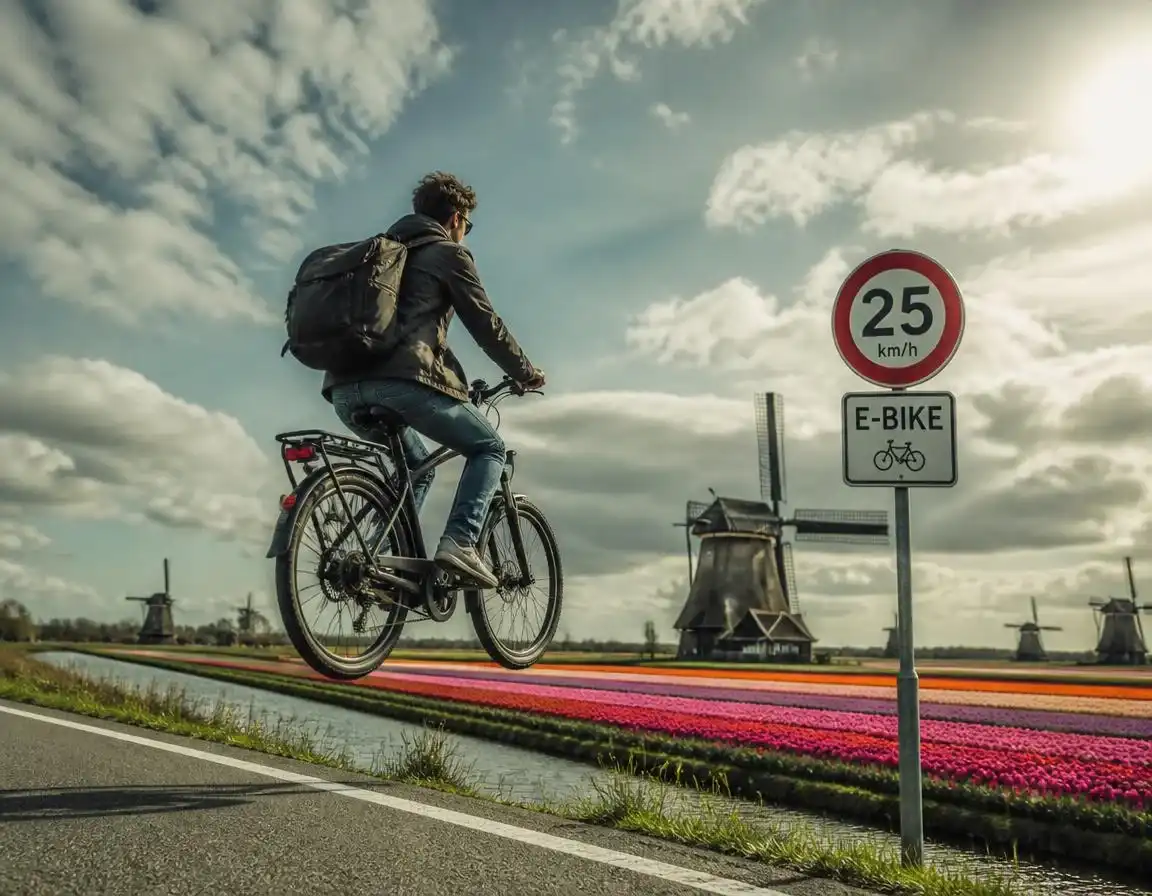
In the Netherlands, a normal e-bike's motor may assist you up to 25 km/h — no licence, no plate, no helmet. Speed pedelecs reach 45 km/h but count as mopeds: helmet, AM licence, yellow plate and insurance are all mandatory. Tuned e-bikes are illegal mopeds, and the base police fine is €320 — with separate penalties stacking on top for each extra thing that's missing, like insurance or a licence. And from 2027, riders under 18 need a helmet on any e-bike. Here is every limit, fine and 2026 change, plainly explained.
Ask five people about the e-bike speed limit in the Netherlands and you get five answers. Some say 25 km/h, some say 45, some mention a helmet rule that does not exist yet. We test and compare e-bikes for a living, and we get these questions every week in our inbox. So here is the whole picture in one place — the Dutch e-bike law that actually applies to your bike, not the version that gets passed around online: what the limits are, which bike falls in which box, what happens if you cheat, and what changes in 2026 and 2027.
The three e-bike speed classes, at a glance
Dutch law does not really care what your bike looks like. It cares about two numbers: how fast the motor assists you, and how powerful that motor is. Those two numbers sort every electric two-wheeler into one of three boxes, and each box comes with its own rulebook.
| E-bike / fatbike (pedelec) | Speed pedelec | Tuned e-bike | |
|---|---|---|---|
| Motor support cuts off at | 25 km/h | 45 km/h | Above 25 km/h (that is the problem) |
| Motor power | 250 W continuous rated power | Type-approved under EU moped rules | Often 500 W or more |
| Throttle without pedalling | Only up to 6 km/h (walk assist) | Allowed, but you must pedal for full support | Often unlimited — illegal |
| Legal status | Bicycle | Moped (bromfiets) | Unapproved moped |
| Helmet | Not required by law today | Mandatory (E-mark moped helmet or NTA 8776 helmet) | Mandatory in theory — but the bike is illegal anyway |
| Licence & minimum age | None, no minimum age | AM moped licence, from age 16 | None makes it legal |
| Plate & insurance | Not needed | Yellow moped plate + WA liability insurance | Missing both = extra trouble |
| Where you may ride | Everywhere a normal bicycle rides | Cycle/moped path or carriageway; never a plain cycle path | Nowhere on public roads |
Normal e-bikes and fatbikes: the 25 km/h rule
A legal Dutch e-bike is a bicycle with help. Three conditions keep it in the bicycle box. The motor assists only while you pedal, and only up to 25 km/h. Its continuous rated power stays at 250 W or below, though short peaks when pulling away are fine. And any throttle that works without pedalling must stop at 6 km/h, which is basically walking pace for pushing your bike out of a shed.
Meet those three and the rest is easy. No helmet, no licence, no number plate, no insurance, no minimum age. You ride where every other cyclist rides, including the mandatory cycle path when one is there. That is why a fatbike with chunky tyres is still "just" an e-bike under the law: wide rubber does not create a new vehicle class. We keep a running overview of all this in our full guide to Dutch e-bike laws for 2026 if you want the deeper version.
What exactly is limited: the motor, not you
This is the most misunderstood part of the e-bike speed limit in the Netherlands. Nothing stops you cycling 35 km/h downhill or sprinting past traffic with burning legs. The rule says the motor must stop adding power at 25 km/h. On a good day with a tailwind, our test riders cruise above the limit on leg power alone, completely legally.
The flip side matters too. If a bike keeps pushing you to 30, 35 or 40 km/h on motor power, it left the bicycle box the moment it was modified or imported. More on that below, because it is where people lose money.
The 6 km/h throttle detail nobody checks
Plenty of imported e-bikes and fatbikes ship with a thumb throttle that drives the bike without pedalling. In the Netherlands that throttle may only work up to 6 km/h. A throttle that pulls you to 20 km/h while you sip coffee turns the bike into a moped on paper — without the moped's plate, approval or insurance, which makes it an illegal one. If you buy online from outside the EU, check this before the bike arrives, not after.
Speed pedelecs: the 45 km/h class, with moped paperwork
A speed pedelec looks like a sleek e-bike but behaves like a light moped. The motor assists up to 45 km/h, and because of that the Netherlands files it under bromfiets. You can spot one by its yellow moped plate, its left-hand mirror and a rider in a helmet. The helmet may be an approved moped helmet (the E-mark in a circle) or a speed pedelec helmet carrying the NTA 8776:2016 mark, which is built for higher crash speeds.
The part most blogs get wrong is where a speed pedelec may ride, and how fast. It is not one number. Rijksoverheid's speed pedelec page splits it by road type, and so do we:
| Where you ride | Maximum speed | Notes |
|---|---|---|
| Carriageway (rijbaan) | 45 km/h | The default when no combined path exists |
| Combined cycle/moped path, outside built-up areas | 40 km/h | Shared with mopeds and snorfietsen |
| Combined cycle/moped path, inside built-up areas | 30 km/h | Yes, slower than your bike can go — that is the rule |
| Plain cycle path (fietspad) | Not allowed | Fineable, even when it feels like the natural choice |
Before you ride one, the checklist: you must be at least 16, hold an AM moped licence, carry the registration certificate, have WA liability insurance, and fit the bike with its yellow plate, left mirror, lights and reflectors. It is a commute machine, not a casual bike. For most people doing school runs and city errands, the 25 km/h class stays the smarter buy — we explain the price gaps in what an e-bike costs in the Netherlands.
Quick check before buying used: a second-hand speed pedelec must have a real yellow plate in the RDW register, and a second-hand "45 km/h fatbike" without one is not a bargain, it is a confiscation waiting to happen. Our second-hand e-bike buying guide walks through the checks step by step.
Tuned e-bikes and fatbikes: the €320 mistake — and what actually stacks on top
Here is the part we wish every teenager and every parent read twice. Chip your e-bike or fatbike so the motor supports past 25 km/h, and the bike becomes an unapproved moped. No type approval, no plate, no insurance. Riding it on public roads carries a base fine of €320 at the current rate published directly on Rijksoverheid's own e-bike Q&A — the figure was €290 in early 2024 and €310 later that year, because fines index upwards, so do not trust old forum posts still quoting €290 as current.
What most people do not realise: €320 is the fine for the unregistered-vehicle offence itself, not necessarily the whole bill. Because a tuned e-bike legally becomes an unapproved moped, each other requirement it is also missing can carry its own separate, additional penalty on top:
In practice, most riders stopped on a tuned e-bike are missing all three, since nobody insures, licenses or helmets-up for a bike they think is "just an e-bike" — which means the realistic total on a bad day can run well past €1,000, not the €320 headline figure alone. Enforcement has caught up with this too: police test suspect bikes on a roller bank at the roadside, which ends every "they will never notice" argument in about ninety seconds and has been in wider use since late 2024. The Openbaar Ministerie confirmed that more than 10,500 tuned fatbikes were confiscated in 2024 alone, and in November 2025 a court explicitly backed police seizure practice. Repeat riders face stacked fines and bikes being taken and destroyed. If you crash on a tuned bike, your insurance pays nothing, because legally you were driving an unapproved motor vehicle.
The kits themselves are closing off too. Using one on the road was always illegal; in March 2024 the cabinet announced a ban on possessing and using tuning kits on public roads, and a draft regulation that also outlawed tricks to dodge speed checks went to public consultation in March 2025. Shops and webshops selling "upgrade chips" for Dutch bikes are on the way out.
📍 Where enforcement is heaviest: station areas in Amsterdam, Rotterdam and Utrecht, and around secondary schools at closing time, come up repeatedly as enforcement hotspots in Dutch cycling press. If your teenager's commute passes through one of these, it is worth having the "is this bike actually legal" conversation before they hear it from a police officer instead.
What changes in 2026 and 2027
The national limits themselves — 25 and 45 km/h — are stable. What moves is enforcement and local experimentation. This is the timeline we are watching:
- 27/03/2024 Cabinet announces the ban on possessing and using e-bike tuning kits on public roads; first roller-bank fines follow that same winter.
- March 2025 Draft regulation published for consultation, adding a ban on devices that evade speed checks during inspections.
- 11/03/2026 Enschede bans fatbikes from the city centre during shopping hours, one of the first local "fatbike-free zones".
- 08/06/2026 Houten starts trialling an advisory 20 km/h limit on busy cycle paths; Amsterdam's matching trial begins in September 2026. Advisory for now — there is no national cycle-path speed law.
- 2027 (planned) National helmet requirement for all e-bike and fatbike riders under 18, per the cabinet's helmet plan; the proposal goes to parliament in autumn 2026.
So no, adults do not suddenly need a helmet on a 25 km/h e-bike, and no, cycle paths do not have a legal 20 km/h cap yet. Both ideas are in motion, though. If you ride with kids, buying good helmets now is cheap insurance against both accidents and next year's law. We broke the current helmet situation down in exactly when a helmet is required on an e-bike.
Which speed class should you actually buy?
Speed is a spec, not a goal. Match the class to your real routes:
- City errands and school runs, under 10 km: a 25 km/h city e-bike. Zero paperwork, and in town you rarely average above 20 km/h anyway. See our best budget e-bikes under €1,500 for solid picks.
- Commuting 10–20 km through town and polder: a trekking or hybrid e-bike, still in the 25 km/h class. Comfier position, better range, same freedom. Browse our e-bike model comparisons to shortlist by category.
- Commuting 20 km or more, mostly outside built-up areas: now a speed pedelec starts making sense — if your route has combined cycle/moped paths or quiet carriageway, and you accept the licence, plate, insurance and helmet. Inside town its 30 km/h path limit surprises people.
- Teenagers: a legal 25 km/h e-bike or fatbike, nothing tuned, helmet on from day one even though the law only catches up in 2027.
Two practical notes from our test bench. Riding flat-out at the 25 km/h support ceiling drains the battery noticeably faster than cruising at 20 km/h, so plan range accordingly — how long an e-bike battery lasts covers the numbers. And if a speed pedelec fits your commute, check whether your employer leases one under the bike scheme, and what e-bike subsidy and lease options for 2026 mean for your net cost. Questions on any of this? Our Rules & Regulations hub collects everything we publish on Dutch e-bike law.
FAQs
Can I ride faster than 25 km/h on a normal e-bike in the Netherlands?
Yes, on your own leg power. The e-bike speed limit in the Netherlands applies to motor support, not to you, so descending or sprinting past 25 km/h is perfectly legal. What is not legal is a motor that keeps assisting beyond 25 km/h, or a throttle that drives you above 6 km/h without pedalling. That bike is an unapproved moped, with the fines to match.
Do I need a licence, number plate or insurance for an e-bike here?
For a 25 km/h e-bike or fatbike: no, no and no. It is legally a bicycle. For a 45 km/h speed pedelec: yes to all three. You need an AM moped licence from age 16, a yellow moped plate on an RDW-registered bike, and WA liability insurance, plus a certified helmet and a left mirror.
What happens if police catch me on a tuned e-bike or fatbike?
A base fine of €320 at the current official rate, checked on a roadside roller bank if needed — but that is often just the starting number. Because the bike legally becomes an unapproved moped, separate additional fines can apply for each thing it is also missing: up to roughly €400 for no WA liability insurance, around €190 for riding without an AM moped licence, and around €100 for no approved helmet, meaning a fully non-compliant rider can realistically face well over €1,000 in total. Repeat offences bring further fines and confiscation, sometimes destruction, of the bike. Any crash damage is on you as well, because insurers do not cover unapproved motor vehicles. Removing the chip before you get stopped is the only cheap exit.