
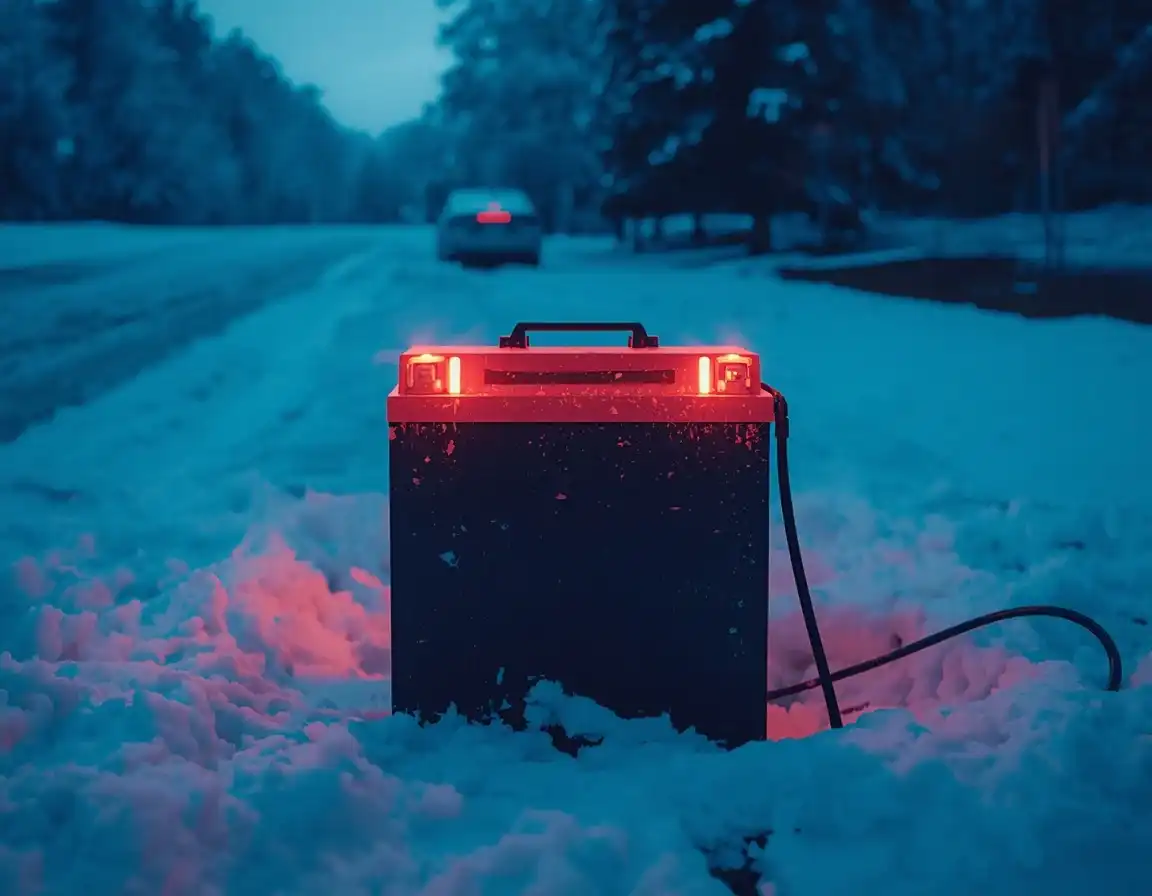
E-Bike Battery Cold Weather

E-Bike Battery Cold Weather: How Much Range You Really Lose (and How to Get It Back)
The short version
Cold doesn’t break your e-bike battery, it just makes it sluggish. Near 0°C you’ll get roughly 20–30% less range, around −10°C about 30–40% less, and in a normal Dutch winter more like 10–25% less. That loss is temporary and comes back once the pack warms up. The two things that do real damage are charging a frozen battery and leaving one empty for weeks. Keep the pack indoors, charge it at room temperature and store it at 30–60% if the bike’s standing, and winter shouldn’t noticeably shorten its life.
Why cold weather steals your e-bike battery range
A lithium-ion battery works by moving charged particles (lithium ions) through a liquid electrolyte between two electrodes, and that movement is your power. Cold thickens the electrolyte, a bit like honey straight out of the fridge. The ions move more slowly, the internal resistance of every cell goes up, and the voltage sags the moment the motor asks for current.
The battery management system (BMS) spots that sag and plays it safe. It cuts out earlier than it would in July, because pushing a cold cell hard is worse for it than pushing a warm one. The energy is still in there, it’s just harder to get out, which is why your display shows three bars when you expected five.
A few winter extras draw on the same pack too, so the battery isn’t the only thing eating your range:
- Tyres. Cold air contracts, so pressure drops and rolling resistance climbs without you noticing. Our e-bike tyre replacement guide has the pressure ranges by tyre width.
- Roads and air. Wet, salted or frosty tarmac is slower than dry asphalt, and cold air is denser, so headwinds hit harder.
- Lights. On most e-bikes with built-in lamps they run off the main battery. On a dark December ride they’re on the whole way, both directions.
- You. Thick clothes, stiffer bearings and a more cautious pace all add watts you never spent in summer.
One bit of good news: the pack warms up a little while you ride, so the range estimate often creeps back up after the first 20 minutes or so.
How much range does an e-bike lose in cold weather?
Brands tend to be vague about this, so here are realistic bands for a healthy lithium-ion pack at mixed assist levels, compared with a 20°C day. They fit the 20–30% near-freezing figure in our guide to how long an e-bike battery lasts.
| Air temperature | Usable range vs 20°C | What you’ll notice on the bike |
|---|---|---|
| 20°C | 100% | The baseline your display was set up for |
| 10°C | ± 90–95% | Barely anything; the first bar drops a bit quicker |
| 0°C | ± 70–80% | 20–30% less range; the indicator dips on hills and headwinds |
| −10°C | ± 60–70% | 30–40% less; plan shorter loops and use eco more |
| −20°C | ± 50% | The BMS may limit power; very rare in the Netherlands |
What that means for your bike
Easier to see with real numbers. Take the range you get on a mild 20°C day and read across:
| Your range at 20°C | Typical Dutch winter (2–6°C) | Around 0°C | Around −10°C |
|---|---|---|---|
| 40 km | 30–36 km | 28–32 km | 24–28 km |
| 60 km (about 37 miles) | 45–54 km | 42–48 km | 36–42 km |
| 80 km | 60–72 km | 56–64 km | 48–56 km |
| 100 km | 75–90 km | 70–80 km | 60–70 km |
These are estimates worked out from the bands above, not lab results. Log your own range over a few commutes and trust that over any table.
A Dutch winter reality check
Now put those bands next to the weather we actually get. The KNMI puts the long-term winter average in De Bilt at 3.9°C, and winter 2025–2026 came in at 4.8°C, which it called mild despite a cold, snowy January. De Bilt had 31 frost days that winter but only two days that stayed below freezing all day, and the lowest reading at a KNMI station was −11.6°C, in Eelde on 11 January. The numbers are in the KNMI winter 2025–2026 overview.
So most Dutch winter riding sits in the 0–7°C part of the table, not the −20°C row. On a typical January commute I’d expect you to lose 10–25% of your normal range, not the 50% you see quoted on forums, which usually comes from much colder countries. A bike that does 60 km in July will usually manage 45–54 km in January, and a 10 km commute each way sits comfortably inside that.
The exceptions are the proper cold snaps: a few days of all-day frost around −5 to −10°C, usually in January or February. That’s when the charging and storage habits below really earn their keep.
How cold is too cold to ride an e-bike?
There’s no official cut-off, but there are practical limits. Bosch’s battery care guidance is to charge and store the battery at room temperature and only put it on the bike just before you ride, and its advice is to avoid exposing the pack to temperatures below −10°C. That’s rare here: even in winter 2025–2026 the lowest KNMI reading was −11.6°C, recorded in Eelde on 11 January.
If you do ride in a hard frost, expect the BMS to cut power sooner, keep rides shorter and keep the battery indoors until you leave. An e-bike weighs roughly 22–26 kg, so pedalling home with no assist is hard work. Honestly, on icy mornings I’d worry about your tyres more than the battery. A studded winter tyre costs roughly €50–70, and the tyre guide explains what to look for.
Does cold weather damage an e-bike battery for good?
Not if you treat it sensibly. Soak a healthy battery at −5°C overnight, ride it, and the range is short. Bring the same pack indoors, let it reach about 20°C and test it again, and the capacity reads normal. That’s reversible physics, not wear. Normal ageing is a separate thing, and our guide to how long e-bike batteries last covers that curve.
Permanent winter damage comes from two habits, not from the weather:
- Charging below 0°C. This plates metallic lithium onto the anode. That lithium never returns to the chemistry, so the capacity is gone for good, and plating also raises the risk of an internal short. Many branded packs have a temperature monitor that refuses to charge outside 0–40°C, but I wouldn’t count on that, especially with older or no-name packs.
- Storing the pack empty. A battery left at 0% for weeks can drift below the voltage its electronics need to wake up, and that’s usually terminal.
Riding in the cold isn’t on that list. Ride all winter if you like. Charge and store the pack sensibly and it shouldn’t age noticeably faster.
Charging an e-bike battery in cold weather: the rules
Rule one, and the one that can actually cost you a battery: never charge a pack that’s below 0°C. Bosch only allows charging between 0°C and 40°C, with room temperature ideal, and cell makers say the same because charging a frozen lithium-ion cell is exactly how you get the lithium plating described above. Riding home through sleet is fine. Plugging in straight afterwards isn’t.
Rule two follows from it: let a cold pack warm up first. A battery that spent the day on a frozen bike needs a couple of hours at room temperature, both to warm through and to let condensation dry off the case and contacts. Put it on a hard, non-flammable surface while it waits, away from the radiator.
- 1Unlock and remove the pack when you park a frozen bike. It’s easier to carry in than a whole e-bike.
- 2Wait 1–2 hours at room temperature, on a hard surface, away from radiators. Let it warm through and dry off.
- 3Charge indoors with the original charger, under a working smoke alarm. Plug it into the battery first, then the wall, and unplug once it reaches the level you want.
| Do | Don’t |
|---|---|
| Charge at room temperature, 10–20°C is ideal | Charge in a freezing shed, garage or outdoor box |
| Let a cold-soaked pack warm up for 1–2 hours first | Plug in straight off a bike that stood outside all day |
| Use the charger that came with the bike | Borrow a lookalike charger from a mate (see our charger replacement guide if yours died) |
| Charge on a hard surface under a smoke alarm | Charge under a coat, on the bed, or in the hall that’s your only way out |
| Top up to around 80% after rides, and go to 100% only before a long one | Leave the pack sitting at 100% or 0% for weeks |
Two side notes. Charging above 0°C in a cold room won’t hurt the pack, it just takes longer. And the indoor rule doubles as fire-safety sense: battery fires are rare per battery but real, which is why the fire service, BOVAG, RAI Vereniging and the ANWB launched the national “Ik Laad Accuraat” campaign on 30 September 2025. The fire service’s safe-charging advice is the best single page on it, and our step-by-step charging guide has the full routine in one place.
Storing your e-bike battery through a Dutch winter
If the bike keeps rolling all winter, you don’t need a storage routine. Just keep the battery indoors between rides. If the bike stands for weeks (a winter break, a semester abroad, a January you’d rather train indoors), take the pack off and store it properly:
- Charge it to 30–60% first. That’s two or three lit LEDs on most indicators. Never full, never empty.
- Keep it dry, between 0°C and 20°C, or 10–20°C if the room is damp. A frost-free cupboard in the hall beats an attic that bakes in summer or an unheated shed.
- Ventilated and away from flammables, ideally in a room with a smoke detector.
- Check it every 2–3 months and top it back into the 30–60% band. Packs self-discharge slowly, and one that drifts down to zero often doesn’t come back.
| Situation | Charge level | Where the battery lives |
|---|---|---|
| Daily winter commuting | 20–80%, topped up after rides | On the bike if it stands indoors or dry, otherwise carried inside |
| Night before a long ride | 100% | Room temperature, hard surface, smoke alarm |
| Bike parked for weeks or months | 30–60%, rechecked every 2–3 months | Off the bike, dry, 10–20°C, ventilated |
| Spare / second battery | 30–60%, never stored full or empty | Same as above, away from flammables and the charger |
If your bike sleeps outside or in a communal hall, take the battery in anyway. A pack that cold-soaks every night needs a warm-up wait before every charge, and one that’s indoors can’t be nicked off the bike. Removable packs are also about to become the rule: under the EU Batteries Regulation (Regulation (EU) 2023/1542), e-bike batteries placed on the EU market from 18/02/2027 must be readily removable and replaceable by an independent professional. That doesn’t change bikes you already own.
Six habits that win back winter range
- Keep the battery indoors until you leave. Fit it just before you set off. A pack that starts the ride at room temperature gives you its full strength for the first few kilometres instead of spending them warming up.
- Start gently on the assist. Eco or Tour for the first ten minutes, turbo once the pack is warm. Heavy current draw is exactly what a cold cell hates.
- Protect your momentum. Rolling restarts cost the most energy in the cold. Pick routes with fewer lights and stops, and carry your speed through junctions where it’s safe.
- Check tyre pressure monthly. Cold contracts the air inside, so a tyre that was fine in October is soft by December. Pump towards the upper end of the range printed on the sidewall.
- Count the lights. If your lamps run off the main battery, a dark December commute spends a slice of it before the motor asks for anything. Budget for that on long evenings.
- Trust the trend, not the bars. A cold pack can drop a bar on a climb and recover on the flat. Judge your remaining range after the first 20 minutes, not at the front door.
Do battery covers help? A bit. A neoprene cover slows heat loss on long rides, but it won’t rescue a pack that’s already cold-soaked, so fit the battery warm. A second battery stored at 30–60% indoors roughly doubles your winter range, but a spare costs about as much as a replacement: around €420–830 for popular Bosch and Shimano packs, as our battery replacement cost guide shows. Neither is essential for a commute. Both are nice on a frosty Sunday.
When low winter range is real damage
Sometimes the short range isn’t the weather. The easy way to tell: cold-weather loss disappears when the pack warms up, while genuine fade shows up at every temperature. Watch for these signs:
- Range down by a third or more in mild weather too, at the same assist level as when the bike was new.
- The charge indicator collapses under load in spring and summer, not just on frosty hills.
- Charging suddenly takes much less time than it used to, because there’s less capacity to fill.
- Battery error codes on the display, or the system cutting out mid-ride at room temperature.
- Physical warnings: a swollen or cracked case, corroded contacts, or a pack that gets hot while charging. Stop using it and take it to a shop the same day.
Before you order an expensive part, get the pack measured. Dutch dealers charge roughly €10–35 for a capacity test, and on Bosch Smart System bikes the eBike Flow app also shows battery status. A workshop (our e-bike repair shops in Amsterdam guide shows what they charge) can test the charger and contacts in minutes, and a faulty charger or dirty contacts can mimic a dead battery. If the bike won’t switch on at all after a cold night, our e-bike won’t turn on guide walks through the usual causes.
If the reading comes back under about 70% of original capacity, our repair-versus-replace guide helps you decide, and the 2026 battery replacement costs put the sums in context: roughly €420–830 for popular Bosch and Shimano packs, and around €330–590 for a cell rebuild.
Most of the time in January, though, the pack is fine and it’s just the cold. Your range usually comes back with the first warm week in spring.
FAQs
How much range does an e-bike battery lose in cold weather?
Roughly 20–30% around 0°C, 30–40% around −10°C and up to about half at −20°C, compared with a 20°C day. In a typical Dutch winter, with temperatures of 2–6°C, expect closer to 10–25%. Most of the loss is reversible: the pack delivers less while cold and returns to normal once it warms up.
Can I charge an e-bike battery in a cold shed or garage?
Not if it’s below 0°C in there. Charging a frozen lithium-ion pack can plate metallic lithium inside the cells and cause permanent damage, and Bosch only allows charging between 0°C and 40°C. Bring the battery inside, let it reach room temperature for an hour or two, then charge it on a hard surface under a smoke alarm. A frost-free shed is fine for parking the bike, but the charging belongs in the house.
Does cold weather permanently damage an e-bike battery?
Almost never. Cold range loss is temporary: the ions move more slowly and internal resistance rises, and both reverse at room temperature. Permanent winter damage comes from two habits, charging a frozen pack and storing a pack empty for weeks. Avoid those two and winter shouldn’t noticeably shorten your battery’s life.
