How Common Is E-Bike Theft in the Netherlands?

Safety & security · Updated 27/09/2026
How Common Is E-Bike Theft in the Netherlands? The Real 2026 Numbers
The short version
E-bike theft in the Netherlands is common and still climbing: police registered 86,950 bicycle thefts in 2025, the fourth straight yearly rise, and insurers put e-bike thefts alone at 200 to 300 a day. Only about 2% of all reported bike thefts are ever solved, and even factoring in the odd recovery, your realistic odds of getting a stolen e-bike back sit between 2% and 5% — unless it has a working tracker, which pushes that figure to roughly 80%. Two ART-approved locks, sensible parking and a tracker on pricier bikes cut your risk dramatically, and most insurers now reward exactly that behaviour.
How common is e-bike theft in the Netherlands, really?
Start with what the police actually write down. In 2025 they registered 86,950 bicycle thefts nationally — the fourth straight yearly increase and a 45% rise from the 2021 low of 59,950. That works out to about 238 reported thefts every single day, and a national clearance rate of just 2.0%, according to ANWB’s analysis of CBS and police data.
But reports are only the visible tip. Most victims never file a police report at all, since it rarely leads anywhere and many owners aren’t insured for it. The Rijksoverheid and industry analysts both point to a real total closer to 1 million bikes stolen a year once unreported thefts are included, with total damage estimated near €800 million annually. So the honest answer to “how common?” is: several times more common than the police figures alone suggest.
Now the e-bike slice, which is the part that matters here. The Verbond van Verzekeraars (the Dutch insurers’ trade body) puts the daily count at 200 to 300 stolen e-bikes, and independent estimates land the yearly total somewhere between 70,000 and 110,000 e-bikes. With roughly 400,000 new e-bikes sold in the Netherlands every year and an average price of €2,000 to €3,000, that makes your e-bike by far the most attractive object you own outside your front door — and yet an estimated 40% of Dutch e-bike owners still carry no theft insurance on it at all.
Reported bicycle thefts in the Netherlands, 2021–2025
Police-registered reports only, 2024–2025 figures provisional. Total real-world theft (reported and unreported) is estimated at close to 1 million bikes a year.
There’s no official full-year 2026 figure yet — ANWB itself notes that police and insurers simply expect the pressure to stay high, since the e-bike fleet keeps growing regardless of policy changes. Treat any page confidently quoting final “2026 statistics” before the year is even over with some scepticism.
Why thieves prefer e-bikes (and fatbikes)
An e-bike is the perfect theft product: expensive, easy to sell, hard to trace. Our breakdown of what an e-bike costs in the Netherlands shows exactly why a decent model is worth a thief’s time, and it resells in hours through marketplaces and, increasingly, closed chat groups. Organised crews strip frame numbers, swap parts between frames, and move stock across the border before anyone starts looking.
A few details make e-bikes extra attractive compared with a classic omafiets:
- Parts are their own product now. Thieves increasingly go after batteries, motors and displays rather than the whole bike, since a removable battery worth several hundred euros can be lifted in seconds and sold on its own. Police-recorded thefts of these loose e-bike components climbed from around 15,000 cases in 2021 to roughly 33,000 in 2025. A replacement is one of the priciest single parts on the bike — see our guide to e-bike battery replacement costs. Taking the battery and display inside at night protects the battery and makes the rest of the bike far less sellable.
- Fatbike insurance basically collapsed. After a wave of fatbike thefts and accident claims from September 2023 onward, most mainstream insurers — ANWB, Univé, Kingpolis and Allianz among them — stopped writing new fatbike policies altogether. By 2026 only a couple of specialist insurers still cover them (Centraal Beheer and Fietszeker), and both require a certified, monitored GPS tracker as a condition of cover.
- Professional tools beat cheap locks fast. A standard ring lock alone survives seconds against bolt cutters or a small jack. That’s exactly why insurers and our own testing lean on ART star ratings rather than marketing words like “hardened steel”.
Where and when bikes disappear
Theft clusters hard around the Randstad. In 2024, Amsterdam alone accounted for 10,810 reported thefts — 12.5% of the national total, or roughly 30 bikes a day — ahead of Den Haag (4,760) and Rotterdam (4,705), with Utrecht rounding out the top four at 3,900. Provincially, Noord-Holland (19,415) and Zuid-Holland (19,325) are neck and neck at the top, well ahead of Noord-Brabant in third (12,835). The trend hasn’t reversed in 2025: Rotterdam rose to 4,775 and Utrecht jumped 10% to 4,280.
Raw totals mostly track population, though, so they overstate the risk in big cities and understate it elsewhere. Rank thefts per resident instead, and student cities take over: in 2024, Nijmegen (12.3 thefts per 1,000 residents) and Delft (12.2) actually edged out Amsterdam (11.8), Groningen (11.7) and Eindhoven (10.9). If you’re weighing risk by where you’ll actually park the bike, that per-capita view matters more than the national leaderboard.
| Municipality | Reported bike thefts, 2024 | Share of national reports |
|---|---|---|
| Amsterdam | 10,810 | ≈12.5% |
| Den Haag | 4,760 | ≈5.5% |
| Rotterdam | 4,705 | ≈5.5% |
| Utrecht | 3,900 | ≈4.5% |
| Netherlands total | 86,130 | 100% |
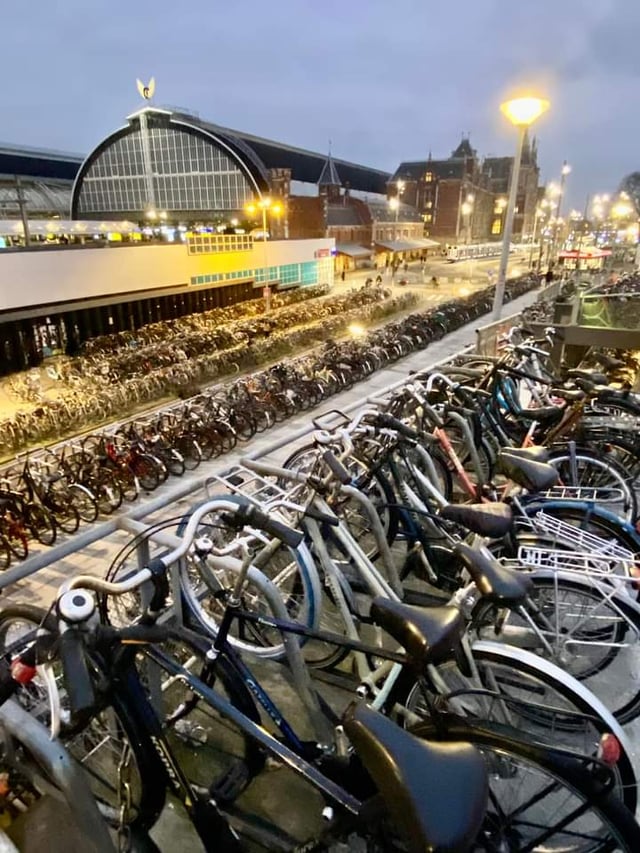
Timing matters as much as place. Most thefts happen in the evening and at night, from street parking and station areas — the seas of bikes outside stations are hunting grounds — but also from sheds and even guarded buildings, where a thief in a hi-vis jacket attracts zero attention. September is a classic peak month in student cities, when a new cohort of expensive, lightly locked bikes arrives. The practical takeaway: the riskiest hours for your e-bike are 22:00 to 07:00, outdoors, unanchored.
Recovery: the 2–5% problem, and the exception that proves it
Here’s the number nobody puts on a poster: the national police clearance rate for bike theft was exactly 2.0% in 2025 — meaning only 2 in every 100 reported cases ever get solved. Widen the question to “does the owner ever see the bike again, one way or another” and estimates still land in roughly the same 2% to 5% range. Once an e-bike leaves the street, it’s usually gone for good: frame numbers get ground off, bikes get resold domestically within days, and a steady stream crosses the border or ends up as donor parts.
There is one big exception, and it’s the reason we keep banging on about trackers. ANWB’s own recovery figures put bikes fitted with a working track-and-trace system at around 80% recovered, and professionally monitored systems with a 24/7 control room push that to 80–90% when the theft is reported immediately. Same country, same thieves, a completely different outcome — the only difference is a live location signal.
Chance of getting your e-bike back
This gap matters for buyers too. Before paying for a secondhand e-bike, run its frame number through the free national Fietsdiefstalregister — it’s populated automatically whenever someone reports a theft with a frame number, so a match should end the deal on the spot. Our second-hand e-bike buying guide covers what else to check before you hand over cash.
The prevention stack that actually works
Nothing makes an e-bike unstealable. What you can do is make it the worst target on the street and the easiest bike to find afterwards. Four layers, in order of value:
| Layer | What to do | Typical cost | What it buys you |
|---|---|---|---|
| 1. Locks | Ring lock plus a separate ART-2/3 chain or U-lock, anchored to a fixed object | €50–125 for the second lock | Stops opportunists; meets insurer conditions |
| 2. Parking | Indoors, locked shed, or supervised bike parking; battery and display inside at night | €0–a few euros per day | Removes the night window most thieves rely on |
| 3. Tracker | Hidden Bluetooth tag on budget bikes; Kiwa SCM-certified system or Bosch ConnectModule above the insurer threshold | €30–50 (Bluetooth) or ~€150–250 hardware + €45–90/yr subscription (certified) | Turns 2–5% recovery odds into 80%+; can unlock up to 20% off the theft premium |
| 4. Paperwork | Photos of frame number, lock receipt and ART certificate; insurance check once a year | €0 | Makes the report, the register match and the claim actually pay out |
Layer 1: the lock setup insurers accept
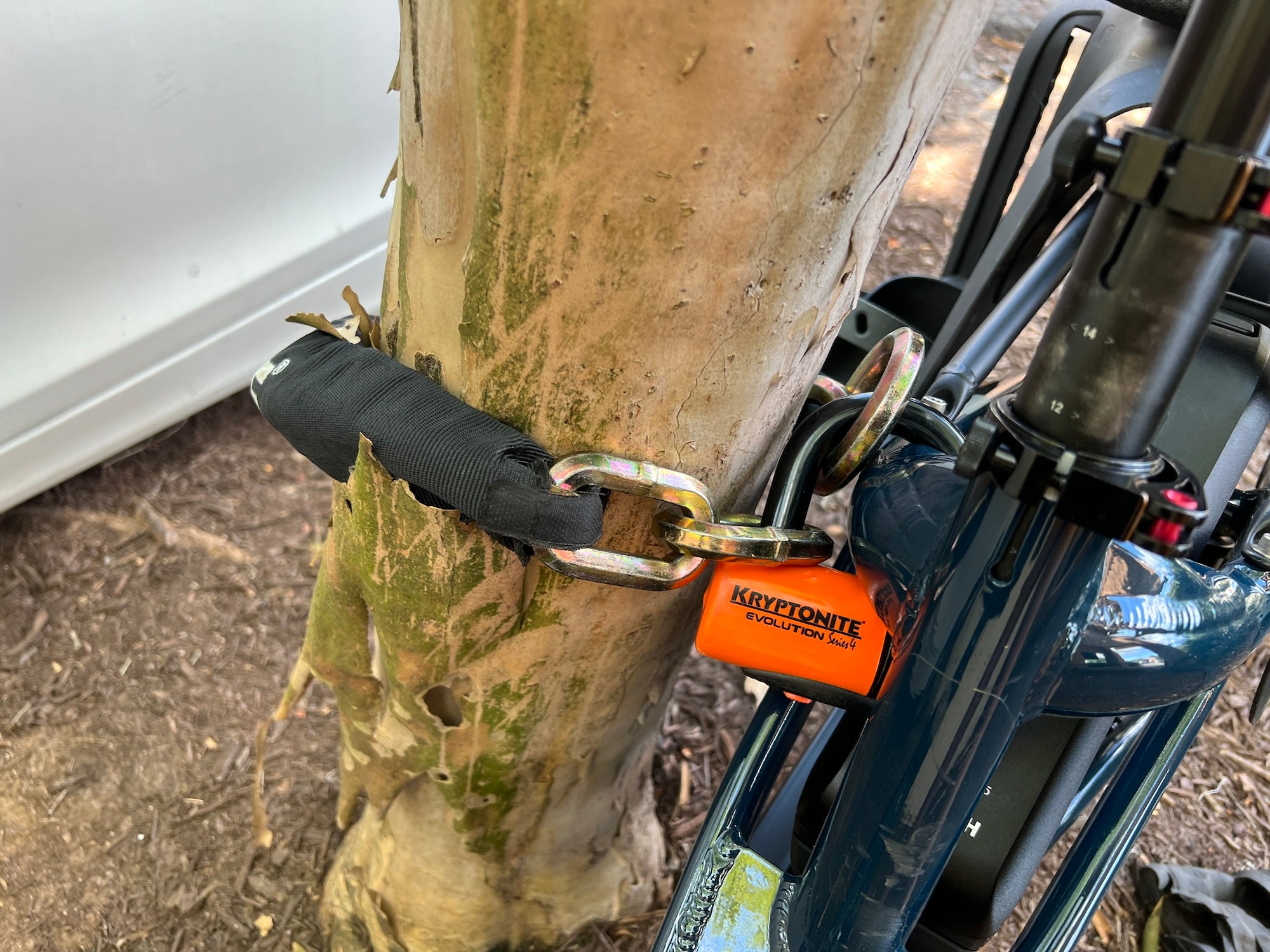
The contractual floor at most Dutch insurers is two ART-2-or-better locks: the built-in ring lock plus a separate chain, U-lock or folding lock that anchors the bike to something fixed. At ANWB and Kingpolis specifically, a plug-in chain that clips into your ring lock does not count as the second lock — that surprise refuses more claims than anything else we see. In big-city postcodes we treat ART-3 as the real standard for both locks. Budget €50–125 for a credible second lock and keep the receipt; insurers ask for it at claim time. Our full testing and buying advice lives in our guide to the best e-bike lock in the Netherlands.
Layer 2: parking beats bravery
Every hour your e-bike spends indoors or in supervised parking is an hour nobody can steal it. Covered, attended bike parking at stations and city centres has turned from an afterthought into serious infrastructure, and it’s the single most underrated theft measure in the country. If indoor parking is impossible, park in sight of cameras and foot traffic, anchor to a fixed rack, and take the battery and display with you.
Layer 3: trackers, and the €4,500 rule
On bikes under roughly €4,500 a tracker is a smart safety net: a stealth-mounted Bluetooth tag costs about €30–50 and turns neighbours’ phones into a search network. From an insured value of €4,500 upwards (or €3,500 for cargo e-bikes) it stops being optional at most major insurers — ANWB, ENRA and Kingpolis all require an approved, activated track-and-trace system (Kiwa SCM-certified, or Bosch’s ConnectModule), and a plain Bluetooth tag doesn’t qualify. The carrot side is real too: ANWB and Univé offer up to 20% off the theft premium for a voluntary certified system on cheaper bikes, and ENRA’s “Connected” policy gives a 20% discount on the theft portion specifically for e-bikes with an approved tracker installed. We compared hardware, subscriptions and running costs in our guide to the best e-bike GPS trackers in the Netherlands.
Layer 4: paperwork nobody enjoys, everybody needs
Photograph your frame number, purchase receipt, lock receipt and ART certificate today, and store them somewhere you can reach from your phone. Read your policy once a year — lock and tracker rules have tightened repeatedly since 2023, and some insurers now decline new cover for high-risk models in certain cities altogether. A handful of providers are also piloting a voluntary digital “fietspaspoort” that bundles frame, battery and motor numbers into one owner-linked record; it isn’t mandatory and isn’t yet the norm, but it’s worth watching. Our overview of e-bike insurance in the Netherlands unpacks the tiers, premiums and excesses so you know what you’re buying before you need it — theft-only cover typically runs around €7.50 a month, all-risk closer to €11, though it varies by bike value and postcode.
If your e-bike gets stolen: the first 24 hours
- Report to the police, online, the same day. You need the frame number and, ideally, photos. Yes, even though the clearance rate is 2%: the report is what puts your bike in the national Fietsdiefstalregister, and it’s what your insurer demands. The police report portal takes about ten minutes.
- Notify your insurer immediately. Theft cover runs on deadlines and proof: policy number, lock receipts, ART certificate, the police report number.
- Have a tracker? Do not play hero. Share the live location with the police instead of walking into a shed full of strangers. Insurers recover most chipped bikes precisely because owners let professionals handle the address.
- Mark it stolen everywhere. Set the stolen status in your tracker app, and watch local marketplaces and bike markets for the next few weeks — resold stolen bikes often surface close to home, badly photographed and cheaply priced.
- Check the register and the depot. Once you’ve reported with a frame number, your bike sits in the Fietsdiefstalregister automatically, which is what dealers and municipal fietsdepots check against. A frame number search at your local depot costs nothing and occasionally ends very happily.
One habit that changes everything
Ask yourself one question every time you park: “Would this bike survive tonight, here, with only what I have on me?” If the answer is no, the fix is almost always cheaper than the excess on your insurance — a €90 ART-3 chain, a €40 tag in the frame, or five extra minutes walking to covered parking.
FAQs
How likely is it that my e-bike actually gets stolen?
On police reports alone, roughly one in every 260 bicycles in the country (there are about 22.9 million on the road) is reported stolen each year. The real victim rate is several times higher, because most thefts never get reported. E-bikes and fatbikes carry a clearly above-average share of that risk, and student cities like Nijmegen and Delft actually carry more risk per resident than Amsterdam. Good locks, good parking and a tracker move you from the average group to the hard-target group.
Does a GPS tracker really get a stolen e-bike back?
More than anything else you can buy. Overall recovery of stolen bikes sits between 2% and 5%, but bikes with a working track-and-trace system are recovered at around 80%, and professionally monitored systems push that to 80–90% when the theft is reported immediately. A hidden Bluetooth tag already helps on cheaper bikes, while e-bikes insured for €4,500 or more (€3,500 for cargo e-bikes) usually need a Kiwa SCM-certified unit or Bosch ConnectModule anyway — and several insurers then discount your premium for it.
Which lock does my insurer require on an e-bike?
Most Dutch insurers require two separate ART-approved locks, each at least ART-2: the built-in ring lock plus a chain, U-lock or folding lock anchored to a fixed object. At ANWB and Kingpolis, a plug-in chain that clips into the ring lock does not count. In high-theft cities ART-3 is the sensible standard for both, and for e-bikes worth €4,500 or more many insurers add a certified track-and-trace requirement on top. Keep the lock receipt and ART certificate — no proof, no payout.
How much does e-bike theft insurance cost, and is it worth it?
Theft-only cover typically runs around €7.50 a month on average, with all-risk policies closer to €11, though the exact price depends on the bike’s value, your postcode and which insurer you pick. Given that an uninsured e-bike averages €2,000 to €3,000 and roughly 40% of Dutch owners currently have no cover at all, for most people the premium is small relative to the loss. Our e-bike insurance guide breaks down providers, excesses and the fine print on lock and tracker requirements.