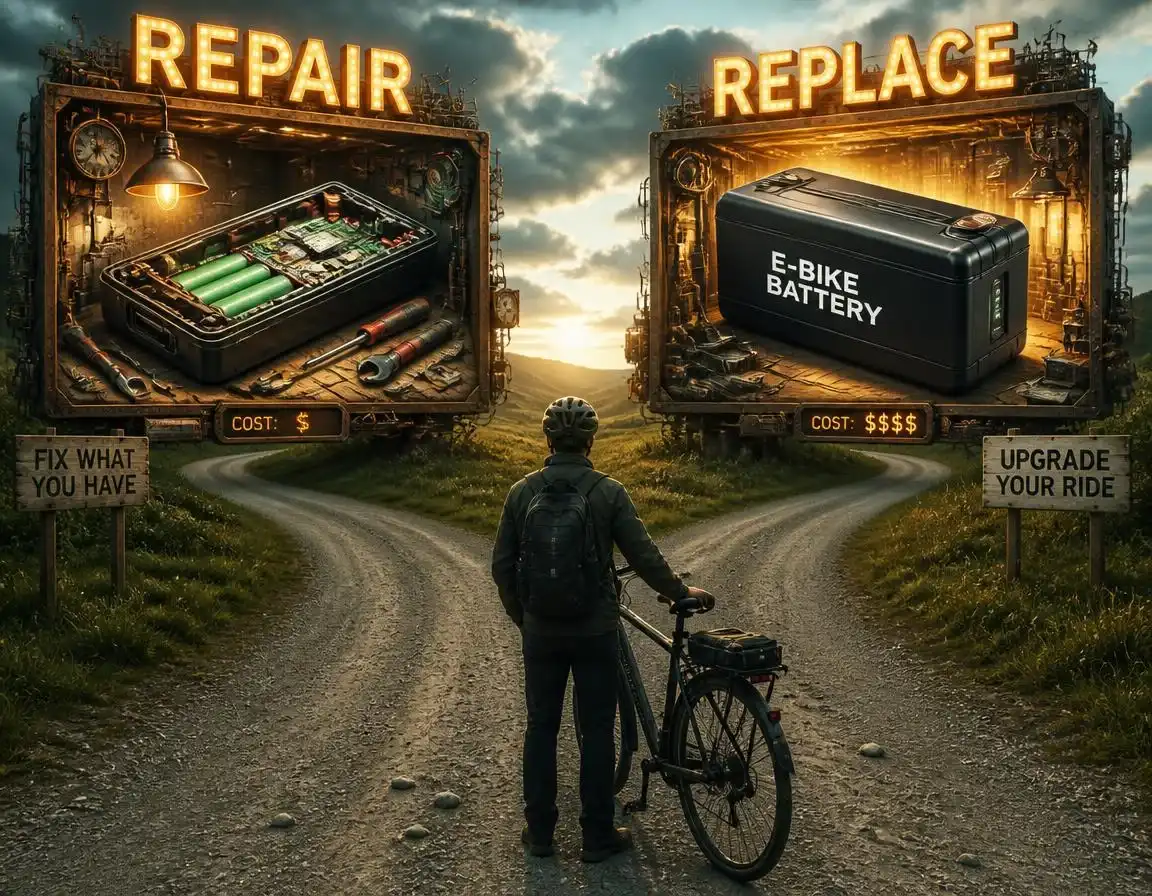
E-Bike Battery Repair vs Replacement

E-Bike Battery Repair vs Replacement: What Actually Saves You Money in 2026
There is no universal answer, but there is a fast one. If your pack is out of warranty, physically healthy and simply faded, a cell rebuild at €330–€590 gives you new capacity — sometimes more than original — for well below a new 625 or 750 Wh pack. If the battery is under warranty, water-damaged, swollen or on a cheap bike, replacement wins. Diagnose first; the case and BMS decide everything.
Repair or replace: the 60-second answer
Dutch riders call it revisie: a specialist opens your tired battery, replaces every worn cell with a new one, and hands back what is effectively a new pack in your old case. It is genuinely brilliant value on the right battery — and a waste of money on the wrong one. The table below is the whole decision in five rows.
| Your situation | The call | Why |
|---|---|---|
| Battery still under manufacturer warranty | Claim a warranty replacement | Free or heavily subsidised; opening the pack voids it |
| Out of warranty, range faded, case straight, dry and undamaged | Rebuild candidate | €330–€590 for new cells beats €529–€829 for a big new pack |
| Swollen, cracked, flooded or smelling of burnt plastic | Replace now, recycle the pack | Safety first; damaged packs are not repairable, full stop |
| Discontinued bike or battery model with no new pack available | Rebuild | Often the only route back to a perfect original fit |
| Budget bike with a generic pack that costs €200–€500 new | Replacement usually wins | A compatible new pack can cost less than the rebuild labour and cells |
Everything else in this article is nuance around those five rows — the prices behind them, the maths that flips a close call, and the checks that tell you which row is really yours.
What a cell rebuild actually involves
A rebuild is not a patch-up job. Done properly, it is a full renewal of the energy storage inside your original housing:
- Diagnosis and capacity test. The specialist cycles the pack to measure its real remaining capacity, often for free, and confirms the BMS and wiring are healthy.
- Opening the case. The original case, seals, BMS and cabling are kept; only the cell bundle leaves.
- Stripping the old cells and cleaning the nickel strips and holders.
- Spot-welding new A-grade cells — typically 18650 or 21700 lithium-ion from makers like Samsung, LG, Panasonic or Murata — into the original layout. Welding, never soldering: soldering irons cook cells.
- Balancing, cycling and re-sealing. The fresh pack is charge-tested over full cycles, balanced by the BMS, and the case is sealed back to weather resistance.
- Return with paperwork: a test report and a written warranty, usually 12 to 24 months on the cells.
Turnaround is typically five to ten working days, which matters if the bike is your commute. And here is the part most riders never hear: a rebuild can upgrade you. Newer, higher-density cells sometimes fit more capacity into the same case, so a tired 400 Wh pack can come back as roughly a 500 Wh pack. Try getting that from a replacement catalogue for a discontinued model.
The 2026 price comparison, in euros
These are the ranges we see quoted by Dutch specialists and dealers in 2026. When we first mapped these prices we put the full-rebuild band at €200–€500; that floor still roughly holds for small 24 V packs, but A-grade cell and labour costs have pushed a full re-cell on a standard 36 V or 48 V commuter pack up to €330–€590 today. Partial repairs — a single cell group, BMS work, a connector — stay well under that, typically €75–€250.
| Option | Typical price, NL 2026 | Warranty | Turnaround | Best for |
|---|---|---|---|---|
| Partial repair (BMS, contacts, case, one cell group) | €75–€250 | 6–12 months on the part | 2–5 days | One identifiable faulty component |
| Full re-cell / revisie | €330–€590 | 12–24 months on cells | 5–10 working days | Healthy case, faded cells, discontinued packs |
| Third-party compatible new pack | €200–€500 | 1–2 years | Immediate | Older generic systems with open specs |
| New branded original pack | €420–€830, plus €30–€80 fitting for in-frame packs | 2 years | Immediate | Warranty, resale value, peace of mind |
| DIY re-cell (cells only, plus tools) | €150–€250 in cells | None | Your weekends | Experienced builders only — see below |
For the new-pack column we defer to our own full breakdown of what new packs cost in the Netherlands in 2026: branded 500–750 Wh batteries list at €420–€830, and shops regularly sell below list, which is exactly what makes some close calls flip.
The break-even maths, with worked examples
Our house rule: a rebuild earns its place when the quote lands at least 25 to 30 percent below the street price of a comparable new pack and the case and BMS are healthy. Below that margin, the two-year warranty and instant availability of a new pack usually win. Here is how that plays out on real 2026 prices:
| Pack | New pack, 2026 list | Typical rebuild quote | Our call |
|---|---|---|---|
| Bosch PowerTube 500 Wh | €419–€599 | €330–€490 | Toss-up. If a dealer sells the new pack under about €450, replacement wins on warranty |
| Bosch PowerTube 625 Wh | €529–€639 | €430–€540 | Rebuild, unless you find the new pack under about €500 |
| Shimano BT-E8036, 630 Wh | €450–€700 | €460–€540 | Toss-up — this one swings on where you shop; a discounted new pack can beat the rebuild quote |
| Bosch PowerTube 750 Wh | €829 | €490–€590 | Rebuild, clearly: you keep €240–€340 |
| Older generic 36 V 13 Ah (Gazelle-style) | Compatible packs €200–€500 | €275–€350 | Cheapest decent compatible wins on price; rebuild wins on original fit |
See the pattern? The bigger and more expensive the new pack, the better a rebuild looks. On small and mid-capacity packs the discount market has squeezed the gap almost shut, so it is always worth pulling a couple of current listings before you book either job. And one more number belongs in the maths: what the bike itself is worth. If a repair bill of any kind approaches half the value of the machine, have a look at what a fresh budget machine costs — our guide to budget e-bikes under €1500 puts that in perspective fast.
Diagnose first: is your pack actually rebuildable?
Every euro in this article depends on one question: is the pack faded, or is it broken? Faded cells in a healthy case are rebuild gold. A dead BMS, a cracked case or water inside changes the answer completely. Five checks settle it:
- A dealer capacity test. Bosch dealers, for example, measure the real energy content of a pack with a dedicated CapacityTester, and the accompanying diagnostic report also shows charge cycles — the two numbers that tell you how much life is left.
- A specialist diagnosis. Rebuild companies typically test your pack free or for a small fee and tell you honestly whether re-celling or a partial repair is the right fix.
- Your own range log. Compare kilometres per full charge now against the bike’s first year. A drop of roughly a third or more usually means capacity below 70 percent — the zone where a rebuild starts making sense. We explain the fade curve in how long e-bike batteries last.
- A visual inspection. Swelling, cracks, deep scratches into the casing, corrosion at the contacts or a sweet chemical smell: any of these ends the rebuild conversation.
- BMS behaviour. A pack that sleeps instantly, refuses to charge at room temperature or throws battery error codes may have a board fault rather than worn cells — sometimes a €75–€250 partial repair instead of a full re-cell.
| What the checks show | What it means | Repair or replace? |
|---|---|---|
| Capacity 70–85%, everything else fine | Normal ageing, no fault | Neither yet — improve charging habits and monitor |
| Capacity under 70%, case and BMS healthy | Classic cell fade | Rebuild |
| Faulty BMS, good cells and case | Board-level fault | Partial repair if parts exist; replacement on locked proprietary packs |
| Swollen, cracked, flooded or hot pack | Safety-critical damage | Replace and recycle, today |
| Under two years old with a fault | Warranty territory | Replacement via the dealer, free |
Buying second-hand and worried about the pack? Make the capacity test a condition of the sale — our second-hand e-bike buying guide shows you exactly how to run it before money changes hands.
When repair is the smart call
- Big packs with big prices. On 625 Wh and 750 Wh batteries a rebuild keeps €90–€340 in your pocket.
- Discontinued models. When the catalogue no longer lists your pack, a rebuild is often the only way to keep the original fit, mounting and key.
- A healthy case on an old pack. If the housing, seals and BMS are fine, throwing them away to fix worn cells is paying twice.
- Wanting more range. Higher-density cells can lift capacity inside the same case — a quiet upgrade path no replacement offers for older frames.
- The green vote. Reusing case and electronics and recycling only the cells is the most circular option on this page.
When replacement is the smart call
- Anything under warranty. Two years is standard on branded packs; a warranty claim is free, a rebuild is not, and opening the pack kills the claim.
- Water, crash or heat damage. Flooded and swollen packs are write-offs, not projects.
- Dead BMS on a locked proprietary pack. If the board cannot be sourced or the system is software-locked, a new pack is the honest answer.
- Cheap generic packs. When a compatible new battery costs €200–€500, a €330+ rebuild is hard to defend.
- You need the bike tomorrow. Replacement is immediate; a rebuild means a week or two without your bike, unless the specialist offers a loan pack.
- Resale plans. A bike advertised with a new original battery sells faster and higher than one with a re-celled pack, however well it was built.
Not sure where to get a trustworthy diagnosis in the city? Our list of e-bike repair shops in Amsterdam covers workshops that test packs properly before quoting anything.
Safety, warranty and software locks: the fine print
Three pieces of fine print decide more of these decisions than price does.
The manufacturers are more than “not fans” — Bosch’s position is that it should never happen. Bosch states that its eBike batteries must never be opened under any circumstances, including for repair by a specialist, and that a battery which has been opened should not go back into service: the safety tests every new pack must pass before sale (standards such as EN 50604-1 and UN 38.3) can’t be re-run on a single repaired unit, so Bosch can’t vouch for what comes back. Bosch also offers a serial-number check so buyers of a used battery can see whether it is flagged as opened or defective. None of this makes professional re-celling illegal or rare — Dutch specialists rebuild thousands of packs a year, and it is a genuinely mature trade — but it does mean you are swapping Bosch’s own sign-off for the specialist’s testing and warranty instead, and quality varies enormously between shops.
Warranty dies at the first screw. Any non-authorised opening voids the manufacturer’s warranty. Check the purchase date before you book anything.
Some brands lock their batteries in software. The VanMoof bankruptcy in 2023 taught Dutch riders this the hard way: when a company with software-locked bikes disappears, owners depend on enthusiasts and rival makers to keep rolling. Open-spec systems from Bosch, Shimano, Yamaha and Bafang are far friendlier territory for both rebuilds and compatible replacements.
The wind is slowly turning, though. Under the EU Battery Regulation (Regulation (EU) 2023/1542), batteries for light means of transport — including e-bikes — placed on the market from 18 February 2027 must be removable and replaceable, which is exactly the design change that makes professional repair and re-celling easier across the board. The full text sits on EUR-Lex if you like your bedtime reading legal.
The green angle: what happens to the old cells
A rebuild is the circular option: the case, seals, wiring and BMS live on, and only the worn cells leave — into the specialist’s recycling stream, not into a shed drawer. If a pack is beyond any repair, it becomes small chemical waste and belongs at a bike shop or municipal collection point, never in the household bin; the Dutch government explains where to hand in dead batteries and e-bike packs. Either way, the lithium, cobalt and nickel inside your old cells end up in new products. The only wrong move is letting a damaged pack sit in a warm box indoors.
Picking a rebuild specialist: seven questions to ask
- Which cell brands and grades do you use — and can I see the datasheet?
- Are cells spot-welded with nickel strips, never soldered?
- What warranty do I get in writing, and what does it cover — 12 or 24 months?
- Do I get a capacity test report before and after the rebuild?
- What happens to my original BMS, and what if it fails later?
- How do you re-seal the case against Dutch rain, and to what standard?
- Where do my old cells go afterwards?
DIY re-celling: our honest word
We write buying guides for a living, and we still do not re-cell our own packs. Lithium-ion cells shorted by a slipped tool can go into thermal runaway in seconds, and the gap between a professional spot-welded bundle and a kitchen-table solder job is exactly the gap between a pack that lasts five years and one that never comes back from its first winter. If you genuinely have the tools, matched cells and BMS knowledge, respect the discipline: never bypass protection boards, never mix cell ages, and test outdoors. For everyone else, the €150–€250 you would save on labour is priced against your shed. It is not a good trade.
FAQs
Is a re-celled e-bike battery as good as a new one?
In pure capacity, yes: a rebuild replaces every worn cell with a new A-grade cell, so the pack starts again at 100 percent of its rated capacity, and with higher-density cells it can even exceed the original. The differences sit elsewhere. The case, seals and BMS are reused, the warranty is typically 12 to 24 months from the specialist rather than the two years a new branded pack carries, and Bosch’s own position is that a battery it has opened should never be put back into service, because the safety re-testing every new pack must pass can’t be repeated on a single repaired unit. Quality therefore depends heavily on who does the work.
How much cheaper is a rebuild than a new e-bike battery?
Entirely pack-dependent. On a 750 Wh battery the gap is wide: about €829 new against €490–€590 to rebuild, saving €240–€340. On a 625 Wh pack you typically keep €90–€200. On common 500 Wh packs the gap nearly closes, because new packs list from €419 and shops sell below list, so replacement often wins there on warranty alone. Our rule of thumb: rebuild when the quote is at least 25–30 percent under the street price of a comparable new pack.
Will my Bosch or Shimano system still accept a rebuilt battery?
In normal practice, yes. A proper rebuild keeps the original BMS and electronics inside the original case, so the drive system still recognises its own battery; specialists in the Netherlands re-cell Bosch and Shimano packs every week. The exceptions are software-locked direct-to-consumer brands, as VanMoof owners discovered after the 2023 bankruptcy. Two caveats: opening the pack voids any manufacturer warranty, and Bosch’s guidance is that an opened battery should never be returned to service, since the certification tests a battery must pass before sale can’t be re-run on a single repaired pack — so dealer support on a re-celled pack can be limited.