
Rules & Regulations

E-Bike Rules & Regulations in the Netherlands: The 2026 Rulebook
I’ve ridden and worked in the Dutch e-bike world for over twenty-five years, and the rules here are gloriously simple — until you tune a fatbike or step up to a speed pedelec. Here’s exactly what’s legal in 2026, what a mistake costs you in fines, and what changes are already queued for 2027.
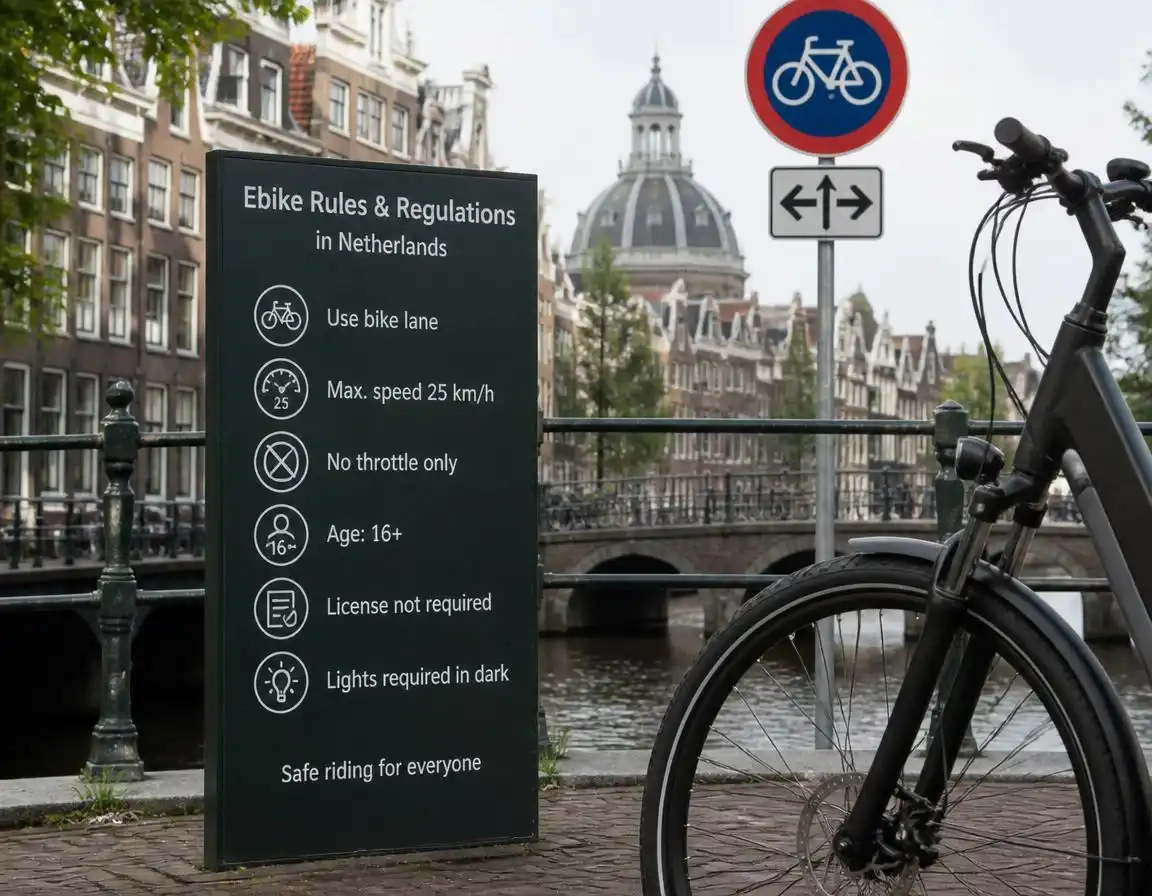
Here’s the whole philosophy in one sentence: in the Netherlands, an e-bike that assists you up to 25 km/h with a 250 W motor is a bicycle, full stop. Everything else — the freedom, the lack of paperwork, and the occasional fine — flows from that. The moment a bike assists faster, or powers itself without pedalling, it changes legal class and the moped rulebook lands on your head. Get those two thresholds straight and you understand ninety percent of Dutch e-bike law. The other ten percent, increasingly, is about where you ride rather than how fast — more on that shortly.
🛴The three legal classes, side by side
Most confusion — and most fines — come from mixing these up.
| Requirement | Standard e-bike (incl. legal fatbike) | Speed pedelec | Tuned / throttled bike |
|---|---|---|---|
| Legal class | Bicycle (fiets) | Moped (bromfiets) | Moped, unregistered |
| Max assisted speed | 25 km/h | 45 km/h | Whatever it does — illegally |
| Motor power | 250 W max, pedal assist only | Up to 4 kW typical | Often over 250 W or with throttle |
| Minimum age | None | 16 | 16 (moped rules apply) |
| Driving licence | Not needed | AM category | AM category |
| Helmet | Not mandatory in 2026 | Mandatory, approved type | Mandatory (moped rules) |
| Insurance & plate | Not needed | WA insurance + yellow plate | Required — and usually missing |
| Where it rides | Bicycle path | Moped path | Nowhere legal |
The official Rijksoverheid e-bike rules page lists the bicycle-class freedoms plainly: no licence, no plate, no helmet duty, no WA insurance, no minimum age. It also confirms the motor may not assist in any other mode — so a throttle that drives the bike without pedalling takes it out of the bicycle class.
🛣️Where you can ride, and how fast
Path choice is where speed-pedelec riders get caught out most.
| Infrastructure | Standard e-bike | Speed pedelec — max speed there |
|---|---|---|
| Bicycle path (fietspad) | Must use it where present | Only if signed for mopeds too |
| Moped path (bromfietspad) | Not allowed | Must use it where present |
| Combined bike/moped path, built-up area | Allowed | 30 km/h |
| Combined bike/moped path, outside built-up area | Allowed | 40 km/h |
| Carriageway (no path available) | Allowed, right-hand side | 45 km/h |
Those 30/40/45 speed-pedelec limits come straight from the government’s own English-language guidance on safe cycling in the Netherlands, and they’re the single most-missed detail in every English explainer I’ve read. A speed pedelec is not “an e-bike but faster” on the path network — it’s a moped with a speed ceiling that changes with the street furniture.
Signal before you turn (arm out), overtake on the left, and look for the “uitgezonderd fietsers” sign under one-way streets — it lets cyclists ride against the flow legally, and half of Dutch city cycling depends on it. On an e-bike you’re a cyclist, so it applies to you too.
💶What a mistake costs: the 2026 fines table
E-bike riders are fined as cyclists — and cyclist fines jumped again on 1 January 2026.
Yes, the phone fine is now €170 on a bike — the same rule that always applied to cyclists caught up with e-bike riders as volumes grew. Lighting is the one tourists trip over: Dutch law wants a working white front light and red rear light after dark, and officers do fine on sight in winter. Renting? Check the lights before you leave the shop, because the fine follows the rider, not the rental contract.
🛞Fatbikes, tuned bikes and what changes in 2026–27
A fatbike with pedal assist to 25 km/h and a 250 W motor is legally an e-bike, which means an ordinary bicycle: no age limit, no helmet duty, no plate. That’s still true in 2026. What changed is enforcement. Since late 2025, Dutch courts have accepted that the mere presence of a tuning kit or an unlocked “dealer mode” is enough for a fine — riders no longer need to be caught actually exceeding 25 km/h at the moment of the stop. The base fine for riding an unregistered moped like this starts upwards of €300, and stacks fast: add missing WA insurance, an AM licence you don’t hold, and a missing helmet, and combined totals well past €1,000 aren’t unusual.
And queued behind that: the cabinet plans a helmet mandate for riders under 18 on fatbikes and e-bikes from 2027. It still needs parliamentary approval, so treat it as coming, not current — but if you’re buying for a teenager, it’s a reason to fit a helmet now rather than argue later.
If the bike assists without pedalling, or keeps assisting past 25 km/h, it’s a moped in the eyes of the law — and riding it without a plate, insurance and helmet is exactly the combination the 2025–26 crackdown targets. Walk away from any seller offering a “speed unlock”.
Local area bans — a separate rule, nothing to do with speed
Since 2026, a small but growing number of municipalities have started banning fatbikes outright from specific zones, and this test has nothing to do with the 25 km/h / 250 W rule above. These are area bans defined purely by tyre width (over roughly 7cm) and wheel size, so a perfectly legal, unmodified fatbike can still be turned away. Enschede banned fatbikes from its shopping district during opening hours from March 2026; Amsterdam followed in May 2026 with a ban inside Vondelpark, backed by fines reported at €115 for riders 16 and over and €57.50 for those aged 12–15. Close to 30 other municipalities are reportedly considering similar rules, though the legal basis is being actively contested in court by at least one fatbike retailer — so treat this as a fast-moving picture, not a settled one, and check your own municipality if you’re mainly riding within a city centre. Manufacturers have already responded with narrower-tyred “skinnybikes” aimed at dodging these zones; for what it’s worth, Dutch insurers reportedly treat them identically to fatbikes regardless of tyre width when it comes to premiums. See our fatbike vs cargo e-bike rules comparison for how the different classes stack up on the street.
⚡Speed pedelec essentials, if you’re stepping up
Choose a speed pedelec and you accept moped administration: registration with a yellow plate, a left-hand mirror, WA third-party insurance, an AM licence, minimum age 16, and an approved helmet — either a speed-pedelec helmet to the NTA 8776 standard or a motorcycle helmet. The Rijksoverheid’s speed pedelec rules page lists the identifying features (yellow plate, mirror, helmet) precisely because police use them to spot non-compliant bikes. The RDW (Netherlands Vehicle Authority) maintains the official registration and technical requirements for speed pedelecs, which is worth bookmarking if you’re importing or registering one yourself.
My practical take: for Dutch city distances a speed pedelec rarely beats an e-bike door to door, because the moped-path speed caps eat the advantage inside town. It earns its keep on 15 km-plus commutes between towns — and nowhere else. Our e-bike vs regular bike comparison covers the same logic from the opposite direction.
🧰Equipment your e-bike must carry
Lights
White front, red rear, working after dark and in poor visibility. The €75 fine is per rider, per stop. Our accessories page lists compliant front and rear options.
Reflectors
Rear reflector plus pedal and wheel reflectors (or reflective tyres). Cheap, and checked alongside lights.
Two working brakes
Front and rear, independent. On a 25 km/h bike carrying battery weight, worn pads are a safety issue before a legal one.
A bell
Required equipment on any bicycle in the Netherlands — including e-bikes. Yes, really, yes, it’s in the rules.
🧳Tourists and expats: your five-point checklist
- Bring or rent a 25 km/h e-bike freely. Your UK-legal pedelec is a bicycle here; no licence, plate or insurance needed, and rental fleets in Amsterdam are the same class.
- Leave the tuned bike at home. Anything that throttles or assists past 25 km/h becomes an unregistered moped the moment it touches a Dutch cycle path.
- Speed pedelec? You’ll need AM on your licence and an approved helmet — arrange both before you land, not at the rental desk.
- Budget for the fines table. It applies to visitors identically: €170 for a phone in hand is the expensive souvenir nobody plans for.
- Lock like a local. Theft, not police, is the real Dutch hazard: an ART-approved lock pair, always. Our guide to what e-bikes cost in the Netherlands covers what a decent new or used machine should set you back if you’re staying longer, and expats planning a longer stay may want to check our best e-bikes for expats rundown.
🛒Buying in the Netherlands without buying a problem
Three checks before money changes hands. One: the spec sheet says 250 W and assistance cuts at 25 km/h, with no throttle beyond walk-assist. Two: no “unlock” or “off-road mode” menu in the display — that’s the tuning trap dressed as a feature. Three: for used bikes, the frame number matches the paperwork and the battery health is documented — our second-hand e-bike buying guide walks through exactly what to look for. If you plan to ride mostly in a city centre, add a fourth: check whether a fatbike-style tyre width will run into a local area ban before you fall for the look of one. If you’re shopping on a budget, our rundown of the best budget e-bikes under €1,500 (and the even tighter under-€1,000 list) sticks to models that stay on the right side of these rules, and our e-bike range and accessories pages cover the helmets, locks and lights the rules above actually require. For the deeper legal background, see our companion piece on e-bike laws in the Netherlands for 2026 and the helmet question in do you need a helmet for an e-bike here.
✅ The straight answer, after 25 years of this
- For nine riders in ten: buy or rent a standard 25 km/h e-bike, fit lights and a bell, ride the fietspad, and enjoy the least-regulated cycling environment in Europe. Nothing else on this page will touch you.
- Skip anything tuned, throttled or “unlocked”. The 2025–26 enforcement shift made owning one a liability even when you’re not the one riding.
- Only step up to a speed pedelec if your commute is genuinely inter-urban and you’re happy carrying moped paperwork — plate, insurance, helmet, AM licence — every single day.
- Mostly riding in a city centre? Check for a local fatbike area ban before you buy on looks alone — Enschede and Amsterdam already have one, and the list is growing.
- Buying for a teenager? Fit the helmet now. The under-18 mandate is planned for 2027 and the habit is worth more than the argument.
❓Frequently asked questions
Do I need a licence or insurance to ride an e-bike in the Netherlands?+
No for a standard e-bike. Dutch law treats a pedal-assist bike capped at 25 km/h with a 250 W motor as an ordinary bicycle, so there is no licence, no number plate, no third-party insurance and no minimum age. A speed pedelec is a different story: it counts as a moped, so you need an AM licence, WA insurance and a yellow plate.
Is a helmet mandatory on a Dutch e-bike in 2026?+
Not for adults, no. There is no helmet mandate on e-bikes or fatbikes that meet the 25 km/h and 250 W limits in 2026, though the Dutch cabinet plans to introduce one for riders under 18 on fatbikes and e-bikes from 2027, pending parliament. Speed pedelec riders of any age must wear an approved helmet today.
What’s the difference between an e-bike and a speed pedelec under Dutch law?+
Speed and legal class. An e-bike assists to 25 km/h and is a bicycle; a speed pedelec assists to 45 km/h and is a moped, which brings a yellow number plate, mirror, AM licence, WA insurance, minimum age of 16 and a helmet duty. Speed pedelecs also ride on moped paths with 30 km/h limits inside built-up areas and 40 km/h outside on shared paths.
Are fatbikes legal in the Netherlands?+
Yes, nationally, if it behaves like an e-bike: pedal assist only, cutting out at 25 km/h, 250 W maximum and no throttle. That puts it in the bicycle category with no age or helmet rule. A tuned fatbike that goes faster is legally a moped, and since late 2025 courts have allowed police to fine riders for having the tuning capability alone, without needing to catch them speeding — the base fine starts upwards of €300 and stacks quickly with insurance and licence penalties on top. Separately, a small but growing number of municipalities, including Enschede and Amsterdam’s Vondelpark, now ban fatbikes from specific zones by tyre width alone regardless of legal status, so check local rules if you’re riding mainly in a city centre.
Can tourists and expats ride their own e-bike in the Netherlands?+
Yes. A UK-legal e-bike (25 km/h, 250 W) is a bicycle here too, so visitors need no licence, plate or insurance to ride it, and rental shops in Amsterdam everywhere stock the same class. If you want a speed pedelec you’ll need a licence covering category AM plus an approved helmet, and remember the fines table applies to visitors exactly as it does to locals.
Key sources: Rijksoverheid — “Welke regels gelden voor mijn elektrische fiets?” and the speed-pedelec rules theme page; Government.nl safe-cycling guidance (speed-pedelec path speeds); Rijksoverheid statement on the planned 2027 under-18 helmet mandate; ANWB and Fietsersbond 2026 cyclist-fine schedules (effective 1 January 2026); NOS reporting (Nov 2025) on tuned-fatbike enforcement; NL Times and municipal announcements on the Enschede and Amsterdam Vondelpark local fatbike-area bans, 2026; Consumentenbond and ANWB fatbike and speed-pedelec explainers, 2026; RDW speed-pedelec registration guidance.