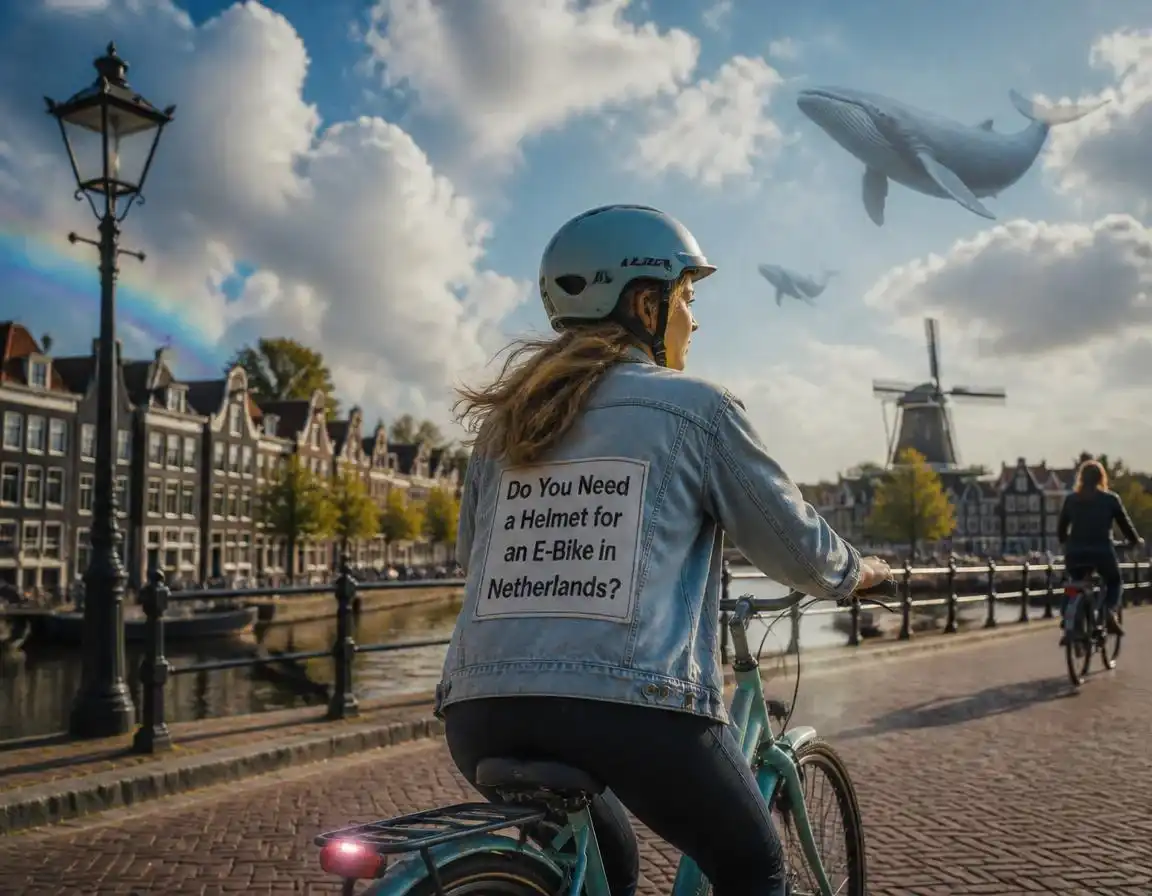
Do You Need a Helmet for an E-Bike in the Netherlands?

Do You Need a Helmet for an E-Bike in the Netherlands? (2026 Update)
Picture it: you’re standing in a Dutch bike shop, sun’s out, canal-side ride calling your name — and one nagging question. We get asked this every single week, so here’s the straight answer, checked against the Dutch government’s own 2026 rules and the actual accident data behind them.

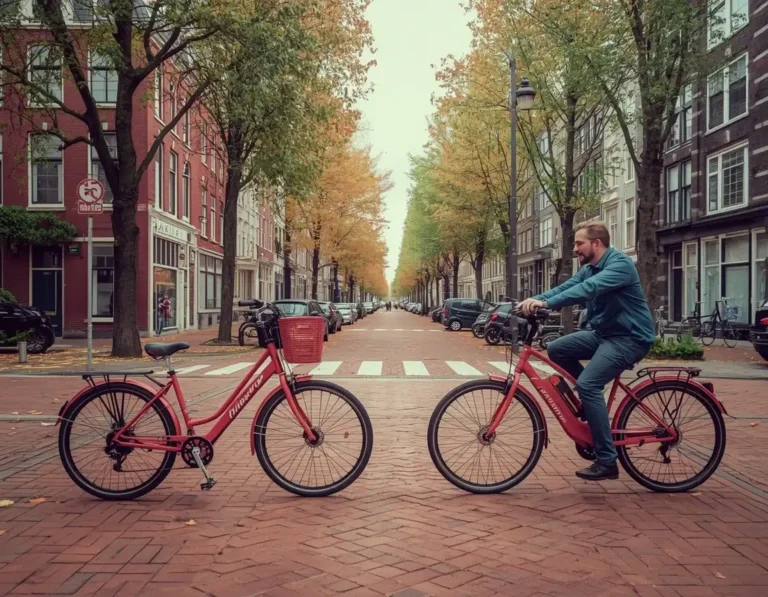
Bikes on an Amsterdam canal bridge — spot the helmets. Exactly. (Photo: Mustang Joe, CC0)
⚡ The 30-second answer
- Standard e-bike (25 km/h): no, a helmet is not legally required in the Netherlands in 2026 — for adults or kids, right now.
- Fatbike (legal, 25 km/h): same story — no helmplicht (helmet law) in 2026, even though fatbike injuries have exploded (more on that below).
- Speed pedelec (45 km/h): yes, mandatory. Skip it and it’s a €120 fine (plus €9 admin costs).
- Under-18s: a new compulsory helmet law for e-bikes, fatbikes and e-scooters is planned from September 2027.
- Official advice: the Dutch government still says “do wear one” — it cuts your risk of serious head injury by about 60%, and fatal head injury by around 71%.
That’s the short version. Now, because Dutch traffic rules have a few fun quirks (and because the law is genuinely changing next year), here’s the full picture — the same advice we give our own riders at ebykes.nl.
🚲 E-bike and fatbike helmet rules in the Netherlands (2026)
Dutch law doesn’t really care what your bike looks like — it cares about the motor. If the motor is 250 W, cuts out at 25 km/h, and only helps while you pedal, then legally it’s an ordinary bicycle. That covers classic Dutch e-bikes and those chunky fatbikes you see everywhere from Amsterdam to Rotterdam. And ordinary bicycles, as the Dutch government’s e-bike rules page puts it, have “geen helmplicht” — no helmet requirement. They do add, rather pointedly, that wearing one is smart.
One big caveat: a tuned or de-restricted fatbike is no longer an e-bike in the eyes of the law. The moment it pushes you past 25 km/h without pedalling, it’s an illegal moped — no number plate, no insurance, and a proper fine if you’re caught. Keep it legal and the table below applies to you.
| Your ride | Top assisted speed | Helmet law in 2026 | If you wear one, look for | Fine for no helmet |
|---|---|---|---|---|
| Regular bike | You, plus a tailwind | Not required | EN 1078 cycle helmet | — |
| E-bike (pedelec) | 25 km/h | Not required (recommended) | EN 1078 cycle helmet | — |
| Fatbike (compliant) | 25 km/h | Not required in 2026 | EN 1078 cycle helmet | — |
| Speed pedelec | 45 km/h | Mandatory | NTA 8776 or E-marked (ECE 22.05/06) | €120 + €9 |
| Snorfiets | 25 km/h | Mandatory | E-marked or NTA 8776 helmet | €120 + €9 |
| Bromfiets (moped) | 45 km/h | Mandatory | E-marked moped helmet | €120 + €9 |
| E-bike / fatbike rider under 18 | 25 km/h | Planned: Sept 2027 | EN 1078 cycle helmet | TBC |
Table 1 — Helmet rules by vehicle type in the Netherlands, as of August 2026. Sources: Rijksoverheid, SWOV.
🛵 Speed pedelecs: the one bike where a helmet is 100% mandatory
Ride a speed pedelec and the conversation changes completely. These are classed as mopeds, so under the official Dutch helmet rules every rider and passenger must wear an approved helmet — no exceptions, and a normal EN 1078 bike helmet doesn’t count no matter how sturdy it looks. You have two legal choices: a moped helmet with the little E-mark circle (meeting ECE 22.05 or the newer ECE 22.06 standard), or a dedicated speed pedelec helmet carrying the NTA 8776:2016 mark, which is tested for higher impact speeds. Forget it and you’re looking at a €120 fine plus €9 in admin costs — call it €129 out of pocket, on the spot.
Speed pedelecs also come with moped-style paperwork: a yellow number plate, registration, insurance and at least a category AM driving licence. If you’re visiting the Netherlands and thinking of renting one, bring the right helmet — rental shops usually supply one, but double-check it carries the NTA 8776 or E-mark label before you ride off.
🧒 The new under-18 helmet law: where it stands in August 2026
This is the bit that’s moved fastest since we first started writing about Dutch e-bike rules. After a sharp rise in teenage fatbike accidents, minister Tieman announced in August 2025 that the cabinet would make helmets compulsory for everyone under 18 on e-bikes, fatbikes, e-scooters and other light electric vehicles — targeted at September 2027. Her own words at the time: “I’m seriously worried about the fatbike. The latest figures show six times as many young people ending up in A&E with a fatbike brain injury in 2024.” A minimum age for fatbikes was also floated (14 has been mentioned), but the ministry has since said that legally distinguishing a “fatbike” from any other e-bike is genuinely hard to enforce, so don’t expect that part soon. Here’s the timeline as we understand it from the official cabinet announcement:
| When | What happened / what’s planned |
|---|---|
| 28 Aug 2025 | Minister Tieman announces measures against fatbike accidents, including a planned helmet duty for under-18s. |
| Late 2025 | Formal letter of intent sent to parliament. |
| Apr 2026 | Cabinet confirms the plan: under-18 helmet law aimed at Sept 2027; a separate minimum age for fatbikes is parked as impractical to enforce. |
| Autumn 2026 (expected) | Draft legislation goes to parliament for debate. |
| Sept 2027 (planned) | Helmet requirement for under-18 riders of e-bikes, fatbikes & light electric vehicles takes effect. |
So if you’re riding today with kids or teens: legally they’re fine without a helmet until that law lands — but honestly, with the accident numbers below, we’d be putting lids on them anyway.
💶 Fines & approved helmets at a glance
A quick note on labels, because this trips people up: an ordinary EN 1078 cycle helmet is great protection on a 25 km/h e-bike or fatbike, but it is not legal on a speed pedelec, snorfiets or bromfiets. There, you need the E-mark or the NTA 8776 label stitched into the strap or printed inside the shell. Check before you buy — if you’re shopping for one, our NTA 8776 and EN 1078 helmets are both clearly labelled by standard, precisely so you can’t get this wrong.
🇳🇱 Why doesn’t the Netherlands just require helmets on regular e-bikes?
It’s a fair question, especially if you’ve cycled anywhere else in the world first. The short answer is that Dutch road-safety policy has always leaned on preventing crashes rather than softening the impact of them — separated cycle paths, low speed limits in town centres, priority junctions designed around bikes, and decades of infrastructure spending most countries simply haven’t matched. SWOV’s own research has found no convincing evidence that a mandatory helmet law would meaningfully reduce Dutch cyclist casualties on its own, and there’s a genuine (if contested) concern among Dutch policymakers that forcing helmets on everyone could put some people off cycling altogether — which would remove a far bigger public-health benefit than the helmet would add back.
That reasoning holds up reasonably well for a 15-year-old on a granny bike doing 12 km/h down a fietspad. It holds up a lot less well for a fatbike doing 25 km/h with a heavier frame, quicker acceleration, and a rider who’s a lot easier to catch off balance — which is precisely the gap the 2027 under-18 law is trying to close, and precisely why the “no helmet needed” answer below comes with so many caveats attached.
📊 Why everyone in the Netherlands is suddenly talking about helmets
The Netherlands remains one of the safest places on earth to cycle, and roughly 95% of Dutch cyclists still ride bare-headed — current observed wearing rates sit around 5%. So why the sudden urgency? Two reasons: fatbikes, and a genuinely bad year for cyclist safety generally.
Fatbike hospital (A&E) visits, Netherlands
Roughly half of the 2024 victims were aged 12–17. Source: Ministry of Infrastructure & Water Management / VeiligheidNL, Kamerbrief 28 Aug 2025.
Cyclist road deaths, Netherlands
A rise of 35 people (~14%) in a single year — the worst cyclist death toll since 2007. Source: CBS, “Meer verkeersdoden in 2025.”
Fatbike hospital visits went from zero recorded cases in 2020 to 301 in 2024 — and eight people died on a fatbike in 2025 alone. Meanwhile 41–44% of all Dutch cyclist deaths in the last two years involved someone riding an e-bike, and 60–63% of every cyclist death, e-bike or not, was caused primarily by a head injury. Add in that e-bikes now outsell regular bikes in the Netherlands, and you can see why The Hague stopped shrugging and started drafting.
🛡️ What a helmet actually does for an e-bike rider
Here’s the thing the no-helmet culture can’t easily argue with: when Dutch cyclists end up seriously injured, about one in three has a head or brain injury — and that share jumps to nearly half (48%) in crashes involving a car or van, versus roughly 30% in solo falls and tumbles with nothing else involved. That second number matters more than it looks for e-bike riders specifically: e-bikes are heavier, quicker off the line, and easier to lose your balance on at low speed, which is exactly the kind of solo, no-other-vehicle crash SWOV, the Dutch road safety research institute, is describing.
Share of seriously injured cyclists with head/brain injury
≈33% overall — rising to 48% when a car or van is involved. A helmet is the cheapest, lightest piece of protection you can bolt onto your commute.
Source: SWOV fact sheet, bicycle helmets.
How much a helmet cuts head-injury risk
Two distinct SWOV figures: 60% fewer serious head/brain injuries, 71% fewer fatal ones. Protection is strongest at impact speeds up to ~20 km/h — exactly where most e-bike falls happen.
Put another way: SWOV’s own modelling suggests that if every single cyclist in the Netherlands wore a helmet, it would prevent somewhere between 100 and 110 deaths and 1,700 to 1,900 serious injuries every year. Nobody’s proposing to make that compulsory nationwide — but it’s the number that explains why “just wear it anyway” keeps coming up in every Dutch newsroom this year.
🤔 So… should you wear a helmet on a Dutch e-bike?
Legally, in 2026, you can hop on a 25 km/h e-bike in Amsterdam as bare-headed as the locals. And there’s real logic to the Dutch view: superb separated cycle paths, slow traffic in city centres, and decades of safety engineering do more for you than any lump of foam. But law and risk aren’t the same thing, and our house position is simple — the law is the floor, not the ceiling. We’d especially wear one (and make our kids wear one) if you’re:
- New to Dutch traffic — those one-way cycle streets and tram rails bite beginners hardest.
- Riding a fatbike: heavier, quicker off the mark, and trickier to catch in a wobble.
- Over 60 — older riders are increasingly over-represented in cyclist casualty figures.
- Commuting in rain, darkness or rush hour.
- Riding with kids on board (cargo bikes included).
- On a speed pedelec — where it’s the law anyway.
Even the Dutch government’s own campaign boils down to three words: “Zet ‘m op!” — just put it on.
⛑️ Picking the right lid (without overpaying)
| Helmet type | Standard on the label | Right for |
|---|---|---|
| City / cycle helmet | EN 1078 | Regular bikes, 25 km/h e-bikes & fatbikes — the sensible daily choice |
| Speed pedelec helmet | NTA 8776:2016 | 45 km/h pedelecs — tested for higher impact speeds, often with more rear coverage |
| Moped helmet | E-mark, ECE 22.05 / 22.06 | Speed pedelecs, snorfiets & bromfiets — also legal on the 45 km/h class |
Five quick fitting tips we give every customer
- Measure your head first; sizes vary wildly between brands.
- It should sit level, two fingers above the eyebrows — not tilted back.
- Consider MIPS or similar rotational-impact tech if the budget allows.
- Pick a bright colour or add a rear light — Dutch evenings are dark and drizzly.
- Replace it after any crash, and roughly every 5 years regardless.

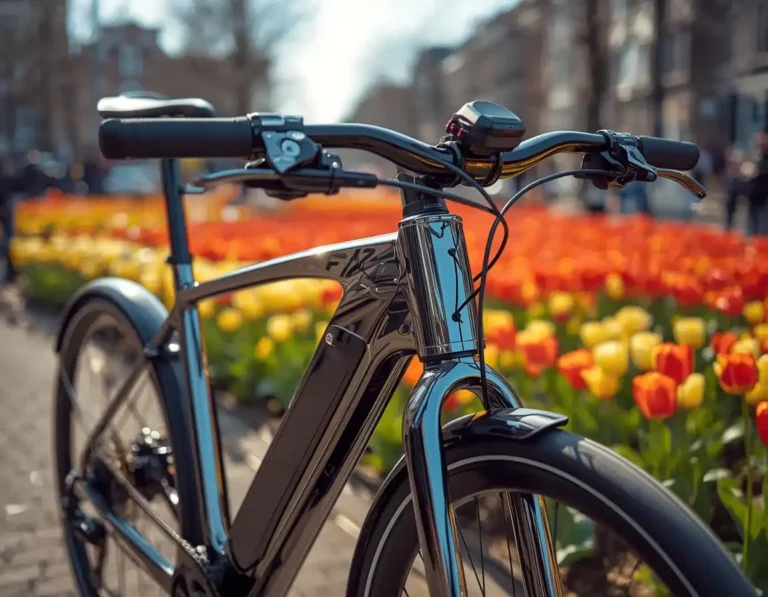
A compliant fatbike is legally an ordinary e-bike in the Netherlands — no helmplicht in 2026, though we’d recommend one. (Photo: Novoklimov, CC0)

An EN 1078 cycle helmet: the right pick for 25 km/h e-bikes and fatbikes — not valid on a speed pedelec. (Photo: Wikimedia Commons, CC BY-SA 4.0)
❓ FAQs
Do you need a helmet for an e-bike in the Netherlands in 2026?
Is a helmet mandatory on a speed pedelec in the Netherlands?
When will the Netherlands make helmets compulsory for under-18 e-bike riders?
Is a helmet required on a fatbike in the Netherlands?
Can I wear a normal bike helmet on a speed pedelec?
How much does a helmet actually reduce your injury risk?
🚲 The bottom line
So, do you need a helmet for an e-bike in the Netherlands? In 2026 the law says no for 25 km/h e-bikes and fatbikes, yes for speed pedelecs, and yes, soon for anyone under 18. The data says something simpler still: a decent lid slashes your head-injury risk by well over half, costs less than a night out, and fits in a backpack. Ride like the Dutch, sure — but there’s no medal for being the only bare head in the bike rack.
Looking for a compliant, comfortable e-bike to put all this into practice on? Have a browse through the range at ebykes.nl — and if you’re ever unsure which helmet pairs with which bike, that’s exactly the sort of question we love.